


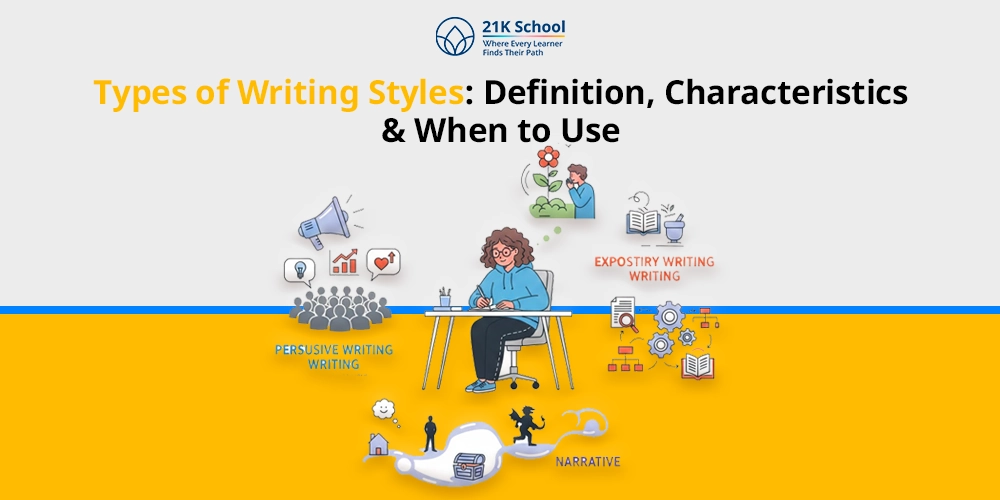
What is the secret behind how the correct style of writing changes ordinary words into great messages?
Writing is not merely about putting words on paper; it is about the manner in which the words are utilised to convey ideas effectively and clearly. Different circumstances require different modes of writing, be it the purpose is to narrate, convey information, create a visual image of words or persuade views.
Principally, four styles of writing exist, namely Persuasive, Descriptive, Expository, and Narrative.
Using the genre of writing styles will help the reader to comprehend the change of language based on the purpose and audience, and it allows the writer to select the most successful way of conveying their message.
Table of Contents
What are Writing Styles?
Writing styles are various styles that writers employ in order to convey ideas, thoughts and information through language. They influence the manner in which a message is formatted and the way it is interpreted by the readers.
Each writing has a purpose, whether it is narrating a story, describing a subject matter, making a vivid description, or convincing the readers to adopt the viewpoint. The selection of writing style will be determined by the readers and the occasion.
Knowing about the styles of writing helps the reader of the text to identify the purpose of a written text, and also allows the writer to convey his/her ideas in a precise and efficient and interesting way.
Also, read about preparing a study timetable
4 Types of Writing Styles
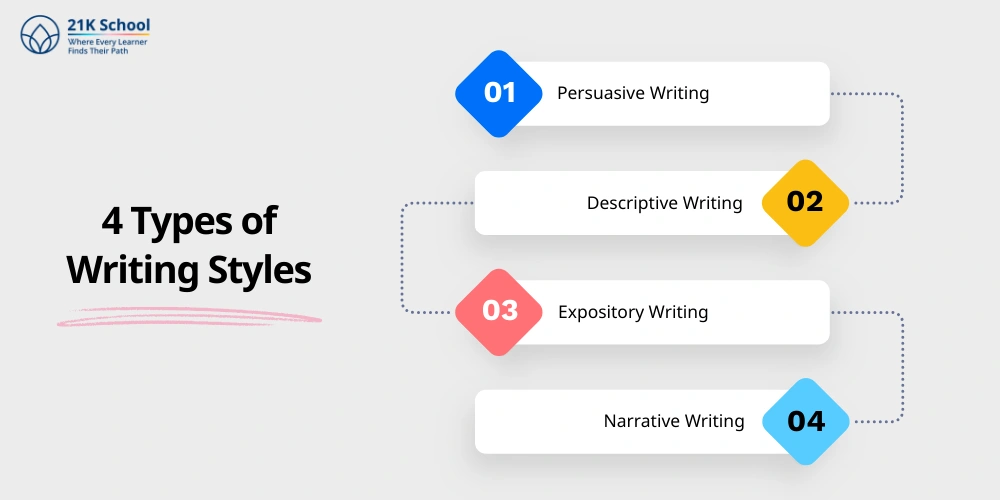
There are various styles of writing, and they are meant to achieve a certain purpose. The four broad categories are persuasive, descriptive, expository and narrative, which assist writers to persuade, explain or describe or narrate a story.
The familiarity with these styles makes writing easier and more interesting to read. The styles of writing are the following.
1. Persuasive Writing
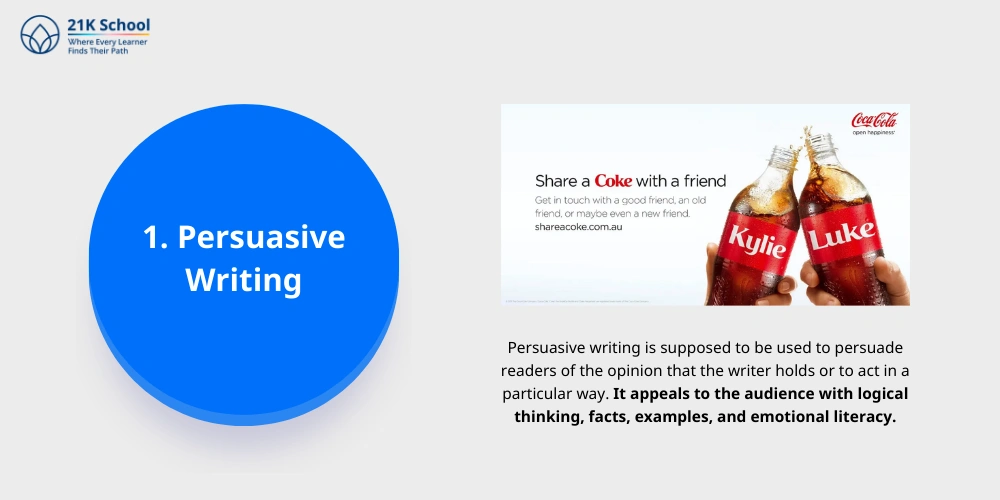
Persuasive writing is supposed to be used to persuade readers of the opinion that the writer holds or to act in a particular way. It appeals to the audience with logical thinking, facts, examples, and emotional literacy .
The style is mostly used in speeches, advertisements, opinion essays and editorials. The author presents strong points, proves them with facts, and discusses the contrary arguments to make his message more persuasive and notable.
2. Descriptive Writing
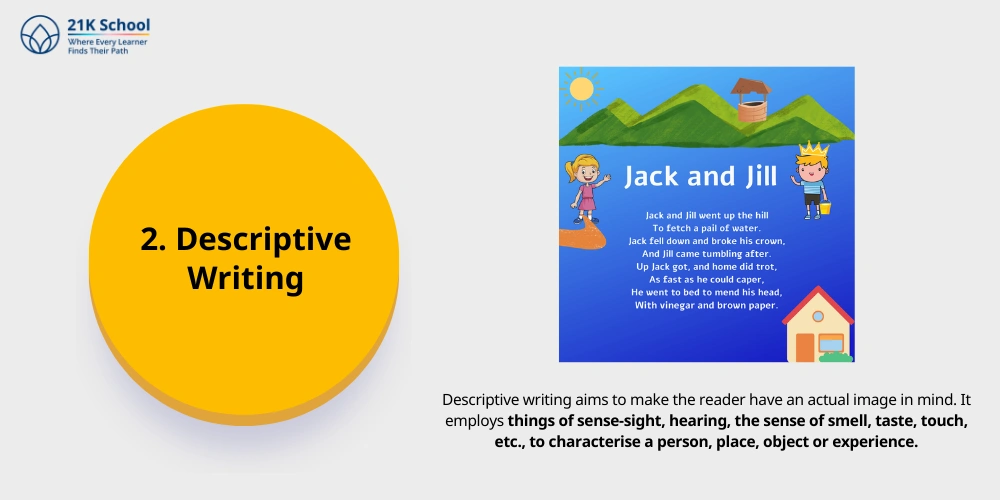
Descriptive writing aims to make the reader have an actual image in mind. It employs things of sense-sight, hearing, the sense of smell, taste, touch, etc., to characterise a person, place, object or experience.
The style assists readers in visualising of what is being explained and being related with it. Some examples of descriptive writing are poems, stories, travel writing, and creative compositions.
Do you know what are the benefits of good handwriting
3. Expository Writing
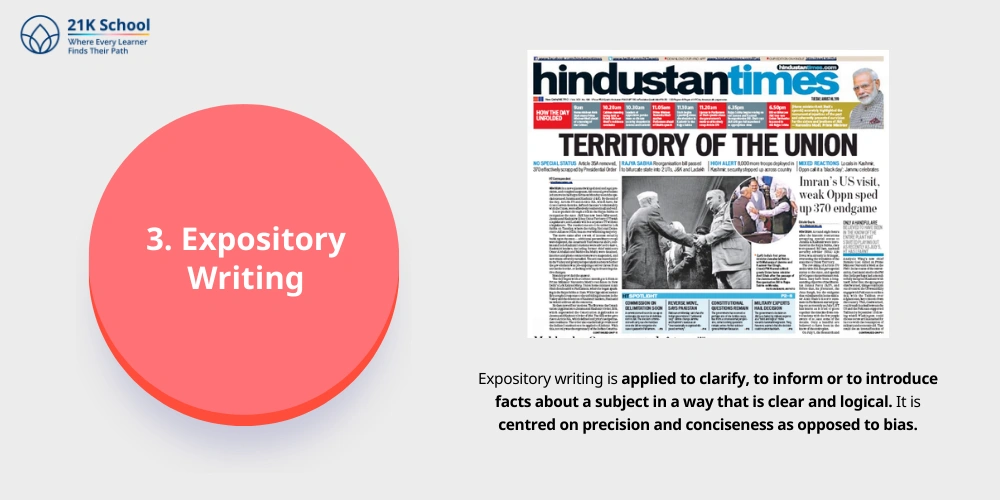
Expository writing is applied to clarify, to inform or to introduce facts about a subject in a way that is clear and logical. It is centred on precision and conciseness as opposed to bias.
This style consists of explanations, definitions, comparisons, and cause-and-effect connections. Expository writing is regularly present in textbooks, articles, reports and essays in which the principal aim is to make the reader comprehend a topic or idea.
4. Narrative Writing
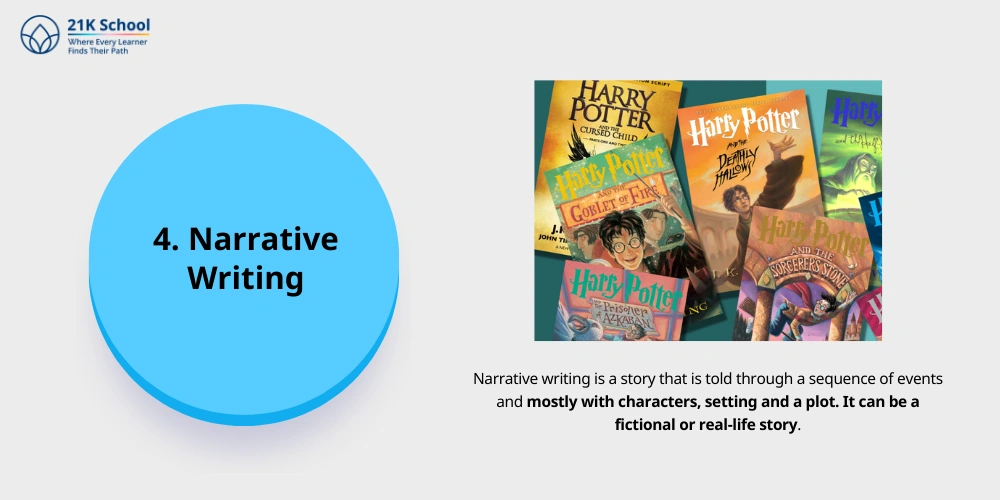
Narrative writing is a story that is told through a sequence of events and mostly with characters, setting and a plot. It can be a fictional or real-life story. The goal of this style is to amuse, entertain or communicate experience with readers.
Narrative writing makes use of dialogue, conflict and the beginning, middle and ending and is popular in novels, short stories and personal essays.
This is how storytelling for learning works.
Characteristics of Persuasive Writing
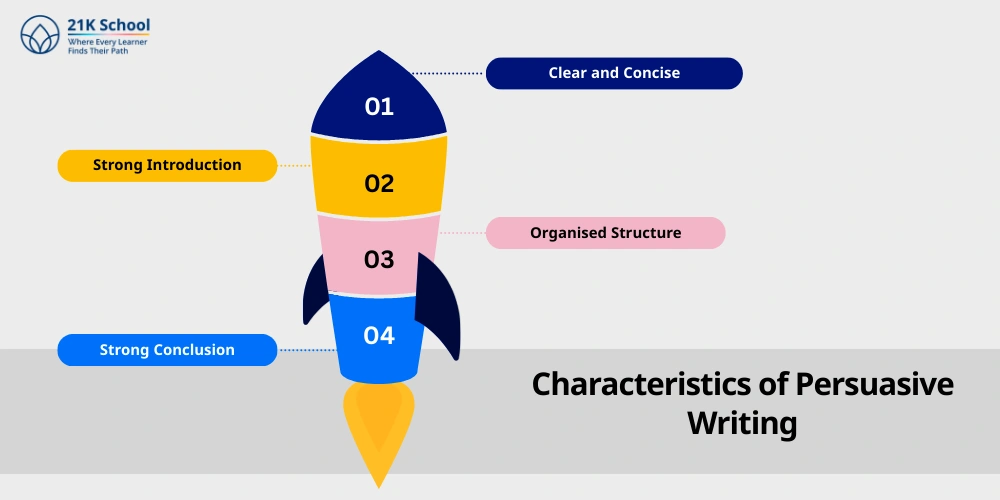
Features in persuasive writing explain the features that make it successful in persuading the readers. These are the ability to make clear points, employing effective pieces of evidence, a logical flow, and trying to touch the reader on emotions or critical thinking skills to persuade their views or behaviours.
1. Clear and Concise
Persuasive writing ought to convey thoughts in such a simple form that they are easily comprehended.
Use fewer unnecessary words, repetitions, and use understandable sentences. Clear makes your argument easily understood by the reader, and concise leaves just one focused on what is important, making your message more effective and persuasive.
2. Strong Introduction
The introduction must draw the attention of the reader from the very first moment. It typically introduces the subject, gives your view or assertion in a straightforward manner and indicates the arguments which are to support.
A good introduction establishes tone, appeals to the readers and inspires them to read the rest of your persuasive document.
3. Organised Structure
Persuasive writing is logically organised, and in most instances, has an introduction, body paragraphs with supporting evidence and a conclusion.
Every paragraph needs to have one point, and it is easier to follow the argument presented by the reader. Obvious breaks between points make them even more persuasive.
4. Strong Conclusion
The conclusion supports your main point and is memorable. It highlights the main points, repeats your stand with confidence, and it can contain a call to action.
A mighty conclusion assures people that they will not forget what you said, and they will be compelled to agree or respond.
Characteristics of Descriptive Writing
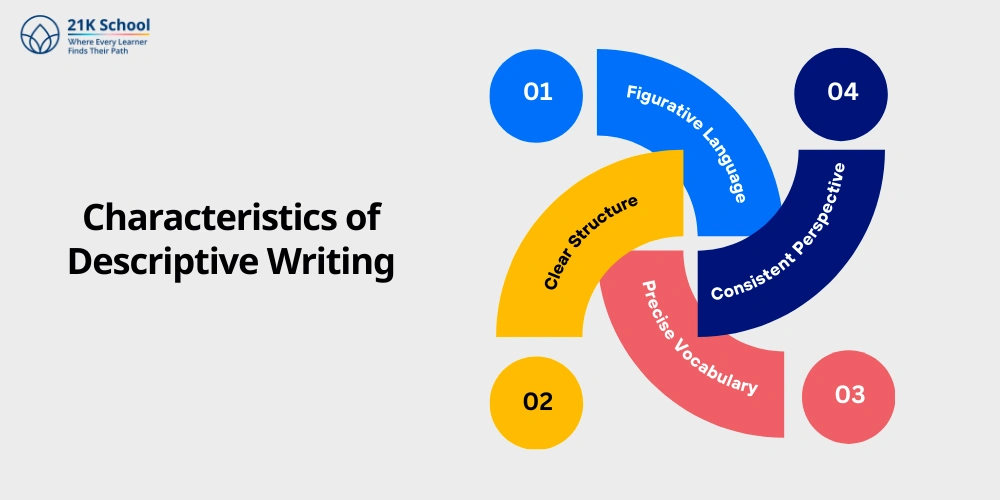
Characteristics of descriptive writing present the elements that make descriptions become bright and captivating.
These characteristics are beneficial in helping the authors create vivid pictures with the assistance of rich language, a sense of place and constructing a picture that allows the reader to visualise the people or places or experiences realistically.
1. Figurative Language
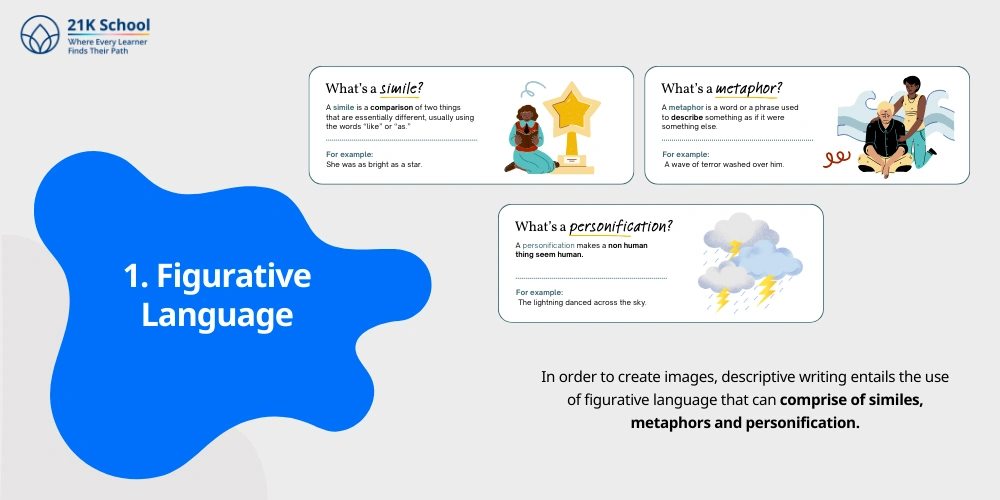
In order to create images, descriptive writing entails the use of figurative language that can comprise of similes, metaphors and personification.
These devices assist a reader to envision something better and experience feelings more vividly; as a result, the writing becomes alive, full of emotions and worth remembering, not monotonous and factual.
2. Clear Structure
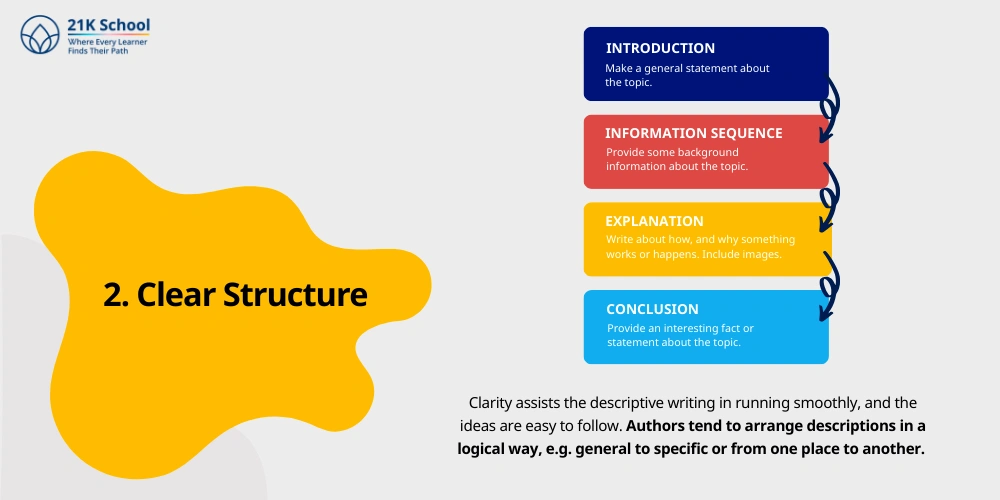
Clarity assists the descriptive writing in running smoothly, and the ideas are easy to follow. Authors tend to arrange descriptions in a logical way, e.g. general to specific or from one place to another.
An explicit outline prevents confusion and enables the readers to visualise the details systematically.
3. Precise Vocabulary
The correct use of vocabulary is the use of precise and correct words to describe people, places or things.
Strong descriptive writing uses specific adjectives and verbs. This accuracy contributes to the clarity, power of images, and allows the readers to form mental images.
4. Consistent Perspective
Constant point of view is the explanation of the scenes from the same point of view in the text. It is either 1st person or the 3rd person, yet it is not easy to confuse the perspectives.
It contributes to the fact that the reader can be involved in the description and perceive the events or settings in a more natural way.
Characteristics of Expository Writing
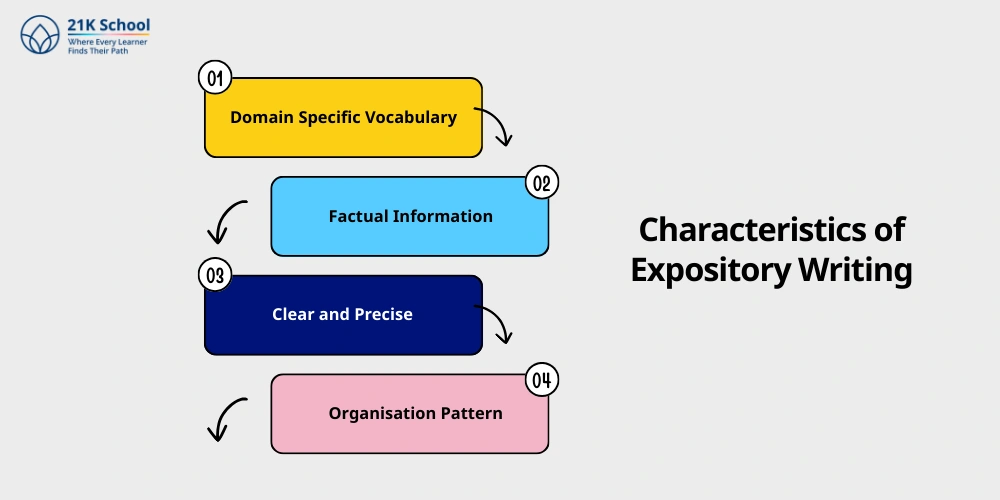
The features of expository writing describe the way this type of writing is clear and objective in the presentation of information. These attributes enable authors to arrange information, apply proper words, and elaborate eloquently about certain concepts in a way that is easy to digest and comprehend by the audience.
1. Domain Specific Vocabulary
Expository writing contains specific and rather domain language, which is connected with the topic that is being expounded. Such technical or subject-related terms assist in conveying ideas in an accurate manner.
The correct use of vocabulary leads to less ambiguity, demonstrates the knowledge of a subject and enables the reader to gain knowledge of the right terminology in a given subject.
2. Factual Information
Expository writing entails factual information as compared to opinions. It is the expression of checked realities, data, illustrations, and facts to clarify or justify a subject matter.
This accuracy and reliability create trust in readers and also ensure that the information presented is objective and informative.
Also, have a look at the conceptual learning examples
3. Clear and Precise
Expository writing must be simple and to the point. The description of concepts must be presented in a simple manner and without the use of jargon.
They are explained in a plain way, and the reader can simply understand complex issues, and the accurate use of words enables one to have correct information that does not go lost or misunderstood.
4. Organisation Pattern
Expository writing is structured in a definite way, which can be cause-and-effect, compare and contrast or sequence.
The structure assists in presenting information in a logical way. There is a powerful organisational structure that takes the reader through the text in a smooth flow and thus allows one to grasp the relationship between ideas and memorise information.
Also read: Types of Reading Skills
Characteristics of Narrative Writing
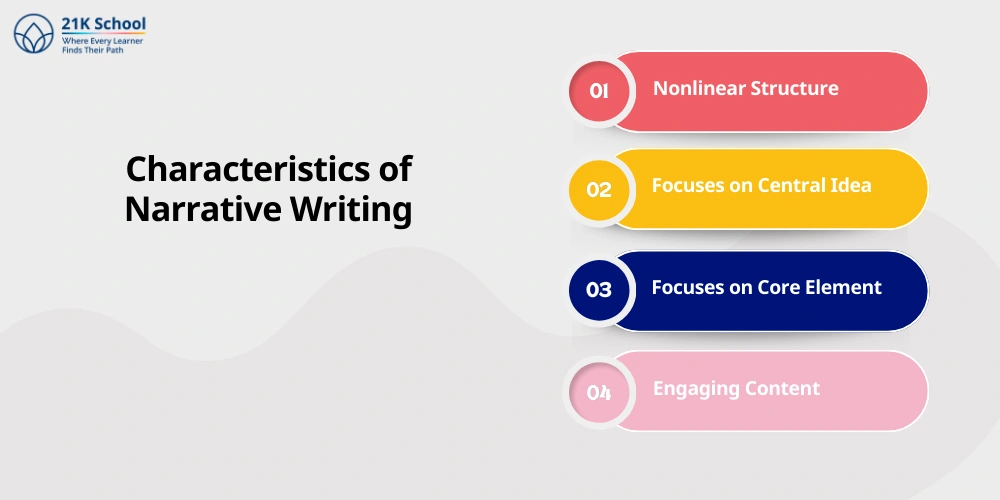
Features of narrative writing explain the features that make a story interesting and significant. They have a clear plot, well-developed characters, a central theme, and a well-structured or even a nonlinear flow of events.
1. Nonlinear Structure
Narrative writing does not necessarily take the events in strict sequence. The authors can rely upon flashbacks, flash-forwards, or time movement to build the story.
This construction provides more depth, creates suspense, and assists in letting out background information that complements the story.
2. Focuses on Central Idea
The focus of narrative writing is a main idea or theme that brings meaning to the story. This idea is related to events, characters and conflicts.
Concentrating on a single concept makes the story seem like it is meaningful and enables the reader to decipher the message or lesson.
3. Focuses on Core Element
Narrative writing focuses on such fundamental parts as plot, character, setting, conflict, and resolution. All these are collaborating to advance the story. With the emphasis on these essentials, the story will not be lost, unequal, or meaningless.
4. Engaging Content
Interesting characters, descriptions, and meaningful conflicts make the reader interested in reading. Powerful stories bring emotional attachment and interest that can motivate one to read on. Interaction will also assist the reader in getting attached to the storyline and the message in general.
When to Use Each Writing Style?
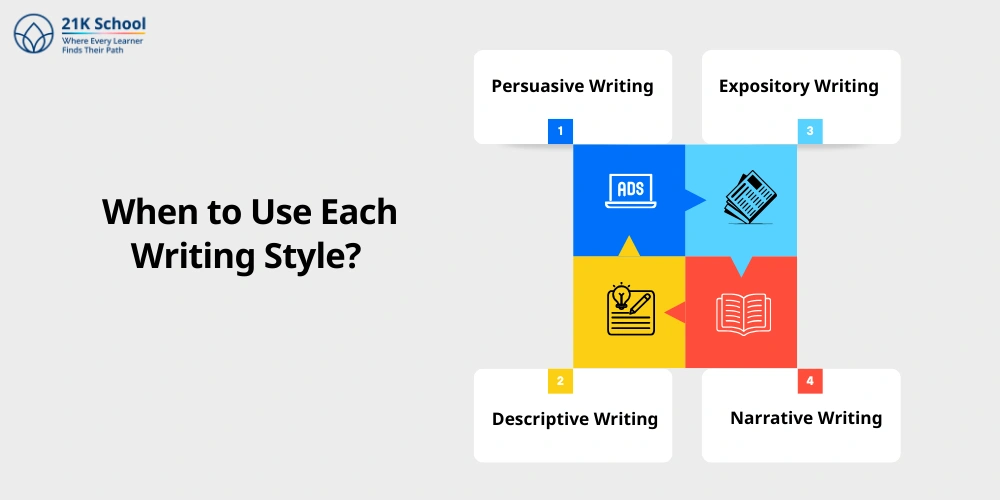
The writing styles achieve different purposes, like to persuade, describe, explain or tell a story. The right style will make your message understandable, efficient and fit the right audience.
1. Persuasive Writing
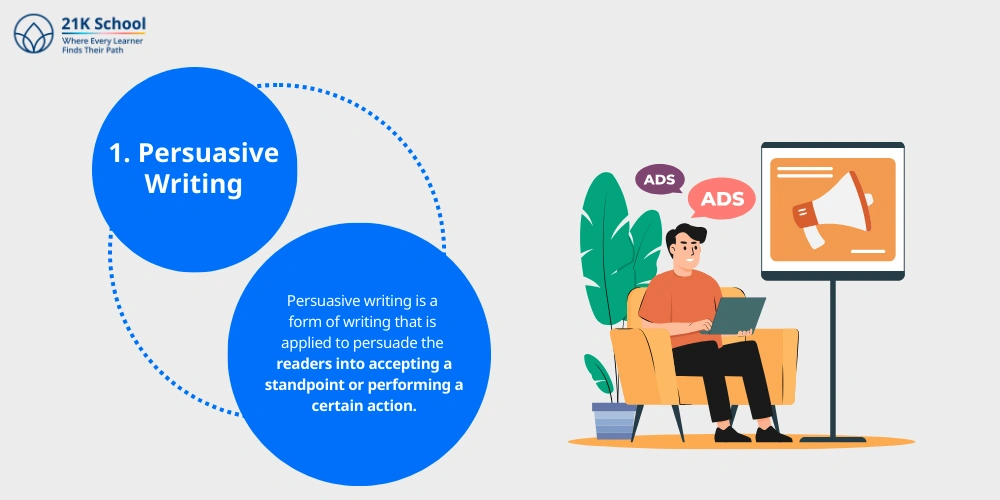
Persuasive writing is a form of writing that is applied to persuade the readers into accepting a standpoint or performing a certain action. It contains explicit views with reasons and evidence with a view to persuading the reader to their thoughts, beliefs, or judgments.
- Opinion Essays: Opinion essays are essays that have been written in order to give a personal opinion about a subject matter. They employ logical arguments, evidence and examples to persuade the readers to agree or at least think that what the writer has to say is worth thinking about.
- Advertisements: Advertisements are used to convince a group of people to purchase or utilise a product, service or even an idea. They are emotional, appeal to needs, desires, or social pressure to the extent that they use creative words, phrases, or pictures to persuade the decision.
- Cover letters: The cover letters are statements of persuasion in job applications. Instead, they give qualifications, expertise, and experience and prove why the candidate is best. They are also out to make employers get the candidate to an interview.
- Editorials: The editorial is the view of a writer on the existing issues, directed at shaping the opinion of the population. They use facts, reasoning, and argumentative language to present an argument, which usually causes the reader to think, agree or act.
Learn more about what are the factors affecting learning
2. Descriptive Writing
Descriptive writing refers to a writing form that entails the use of descriptive words in describing a person or place, object or experience. It attracts the senses through depicting vivid images, which helps the readers to imagine and feel what is being said in a clear and realistic manner.
- Creative writing: Imagination and expressive language are essential in creative writing, where stories are narrated or feelings brought to the fore. The detailed use of sensory description by writers creates vivid pictures that the reader can visualise, feel or emotionally relate to a character or a phenomenon.
- Poetry: Poetry is a presentation of feelings, thoughts or narratives in the form of rhythm, diction and imagery. The descriptive methods bring the experience closer, enabling the reader to taste, visualise, or imagine things, usually symbolic or metaphorical in nature.
- Character Descriptions: Character descriptions define how a person looks, personality, habits or feelings so that the reader can visualise and even comprehend the character. Good descriptions render characters likeable, memorable, and believable, which in many cases back up the story or theme.
- Setting Descriptions: Setting descriptions are the detailed descriptions of places, settings, or times. They provide atmosphere, mood and context of stories and make the reader feel that they are in the world and perceive the events of their surroundings and can relate to scenes in their hearts.
Learn more about what are the Importance of Sports in Students
3. Expository Writing
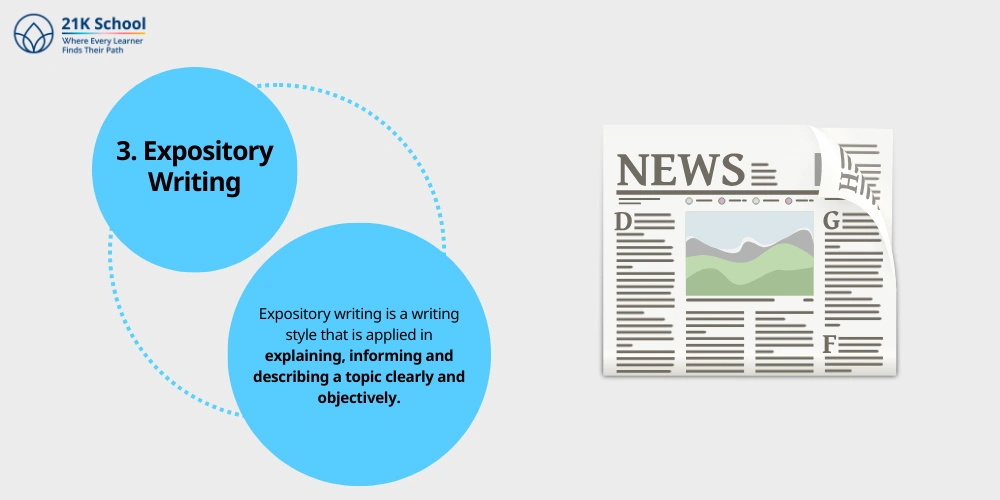
Expository writing is a writing style that is applied in explaining, informing and describing a topic clearly and objectively. It is organised in a logical way with facts, definitions and examples in a logical order, and it does not lead the reader to comprehend the information subjected to personal opinion and emotional language use.
- Research papers: Research papers entail providing the information, analysis and evidence about a topic in a systematic way. They are aimed at explaining concepts, defending arguments and in most cases, citing data and logical structure are employed to clarify.
- News articles: News reports are written in a concise way, which describes events or facts. They dwell on the five W (who, what, when, where, why) and occasionally how to make sure that the readers obtain the right, timely and comprehensible information concerning the current events.
- Textbooks: The textbooks are organised in such a way as to teach the reader about certain topics. They make explanations, examples, definitions, and images to explain the concepts in an orderly manner to enable the learner to comprehend and remember the knowledge.
- How-to guides: How-to guides contain step-by-step instructions in order to accomplish something or master skills. They are concerned with clarity, order, and feasibility and tend to subdivide complicated processes into easily understandable acts which readers can accomplish.
Check: how modern education is different from traditional education
4. Narrative Writing
The style of writing that retells a story or narrates events is known as narrative writing. In this type of writing, stories, both actual and imaginary, are frequently told in an organised and significant manner to bring out a message or a lesson.
- Short stories: Short stories are short, complete stories that have a beginning, middle and conclusion. They attach importance to involving characters, conflict, and resolution to give the readers an experience of events, emotion, and message in a concise narrative framework.
- Novels: Novels are extensive stories that dive into characters, plots and themes. They create elaborate plots, characters, and locations and give their readers encounters, experiences and chances to reflect or emotionally connect with a lengthy tale.
- Memoirs: Memoirs are recollections and cogitations of the author on his/her life. They intertwine narratives and revelation, and explore the emotional or personal applicability of the occurrences and tend to teach or uphold the memories that can be noticed by the readers that are related to themselves.
- Personal essays: Personal essays are a mix of both narrative and reflection. They enable the authors to discuss the ideas, feelings, or lessons and attract the readers by means of relatable, sincere, and descriptive narration.
This is why digital literacy is important
Conclusion
This knowledge of the various types of writing, persuasive, descriptive, expository, and narrative, is useful to both the writer and the reader.
Authors can select the most appropriate method of conveying information, narrating, or shaping outlooks, whereas readers are able to make a better analysis of the intent and meaning of a text.
The art of these styles will improve comprehensiveness, originality, and participation to make writing more effective and efficient in any context.
