

Have you ever thought about how social learning is changing the educational landscape?
Learning is a natural process that commonly occurs during our daily contacts with people. Since childhood, we learn behaviours, ways of speaking, and habits through the opposite example, observing others and imitating them.
The plan is useful in the development of communication, cooperation, as well as social expertise and understanding of concepts.
Social learning results in confidence, active participation and allows the learners to obtain different perspectives, thus making the learning methods more engaging, meaningful and relevant to life experiences.
Table of Contents
- What is Social Learning Theory in Education?
- History of Social Learning
- 1. Pre-1900s Philosophy (Early Philosophy)
- 2. Behaviorism Era (1900s-1950s)
- 3. Social Learning of Miller and Dollard (1941)
- 4. Contribution of Julian Rotter (1954)
- 5. Bobo Doll Experiment conducted by Bandura (1961)
- 6. Bandura’s Social Learning Theory (1977)
- 7. Development of Social Cognitive Theory (1986)
- 8. Recent Developments (2000s-Present)
- 4 Key Elements of Social Learning
- 4 Types of Social Learning
- 4 Factors Affecting Social Learning
- Top 8 Benefits of Social Learning
- Top 7 Drawbacks of Social Learning
- Final Thought
What is Social Learning Theory in Education?
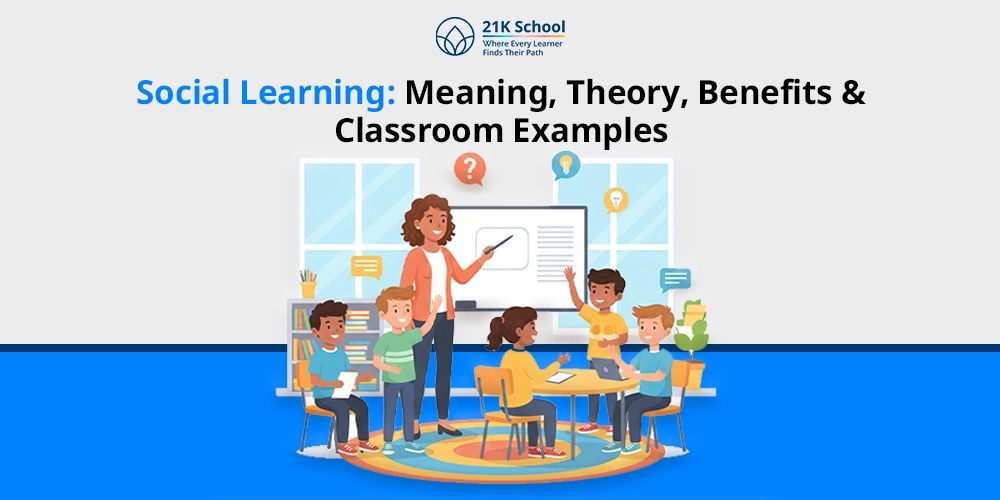
The concept of social learning theory in education is based on education through interacting with other people, observing others, and working together. Students are taught through observation and interaction with their peers, listening to their teachers, and through group activities and exchanging of ideas.
Social learning theory is beneficial in building communication, collaboration, and social expertise and enhancing the comprehension of concepts.
Social learning also creates confidence, active involvement and enables the learners to acquire various viewpoints, which results in the learning experience being more interesting, significant and related to real-life experiences.
History of Social Learning
The history of social learning dates back to 1900s and can be understood in the different phases as mentioned below:
1. Pre-1900s Philosophy (Early Philosophy)
It is philosophy in the application to specific issues, which is meant to explain problems and facilitate the improvement of human existence. The ancient philosopher, like Aristotle, was familiar with the knowledge that human beings learn through imitation.
John Locke suggested the mind to be a blank slate, which is filled by observations. Scholars Pestalozzi and Froebel stressed social interaction in education.
Nevertheless, it was not until the 20th century when psychology was recognised as a science that systematic scientific investigation of social learning commenced.
2. Behaviorism Era (1900s-1950s)
Pavlov and B.F. Skinner’s work reigned over the early 1900s of psychology and was behaviourism. They focused on experience and reinforcement as a method of learning, to the exclusion of social and cognitive variables.
However, other scholars like Edwin Tolman began to incorporate cognitive elements, which meant that learning was not a collection of stimuli but a cognitive process which was the foundation of the social learning theories.
3. Social Learning of Miller and Dollard (1941)
Neal Miller and John Dollard were the first to explicitly write about social learning in the title, Social Learning and Imitation. They proposed the imitation to be instrumental learning, where the observers would be reinforced to imitate the model behaviours.
Even though it is still based on behaviourism, this work observed that individuals can learn through observation of others and hence the theoretical transformation in psychology is noteworthy.
4. Contribution of Julian Rotter (1954)
Julian Rotter formulated his own social learning theory, which stressed such cognitive variables as expectancy and reinforcement value.
He put forward the locus of control-internal (people think that they are in control of what happens to them) or external (external forces). The work of Rotter transcended the field of pure behaviourism, whereby the beliefs and expectations have a significant impact on learning and behaviour.
5. Bobo Doll Experiment conducted by Bandura (1961)
The seminal Bobo Doll Experiment by Albert Bandura demonstrated that children acquire aggressive behaviour by observing adults, without being reinforced. Children who observed the adults hitting an inflatable doll ended up mimicking the behaviour thereafter.
This was a breakthrough study that proved learning observational, a behaviourist theory was set aside, and learning turned out to be a cognitive process that mediated between behaviour and observation, turning the psychology of learning upside down.
6. Bandura’s Social Learning Theory (1977)
Albert Bandura composed social learning theory that summarised the work in a complete-scale outline. According to the theory, learning is a process of observation, imitation and modelling that is mediated by four cognitive processes, among them are attention, retention, reproduction and motivation.
This made social learning different to behaviourism and cognitive theories and gave emphasis to reciprocal determinism between the behaviour, individual factors and environment.
7. Development of Social Cognitive Theory (1986)
Bandura extended his previous model to the so-called Social Cognitive Theory, focusing more on the processes of cognition and the appearance of self-efficacy beliefs regarding personal abilities.
The evolution incorporated self-regulatory processes, self-reflection, forethought and planning. The theory identified humans as active and thinking agents who consider behaviour, have goals, and control action, as opposed to the passive recipients of environmental effects.
8. Recent Developments (2000s-Present)
Social learning was transformed by the digital revolution around the internet, social media and online learning space. It is possible to use both YouTube tutorials, virtual communities, and MOOCs in global observation and modelling.
The brain imaging, cultural differences in learning processes, social media impacts, and integration with neuroscience are discussed in current studies as the neurological basis.
4 Key Elements of Social Learning
Such issues as observation, modelling, imitation, and reinforcement are vital to social learning. These aspects enable the learners to acquire skills, behaviours and knowledge by interacting with other individuals and by learning.
1. Observation
Social learning is based on observation, whereby the learner notes the behaviour and actions of other people and the outcomes. A person gets to know how something is performed and how behaviour is rewarded or corrected through close observation of the teachers, their fellow teachers or role models.
The observation also allows the learners to acquire new skills, attitudes and responses without necessarily being instructed to do so; therefore, learning is natural and continuous in the social context.
2. Modeling
Modelling can be defined as the learning from the examples of other individuals. When the teachers, the parents or the peers show positive behaviours, chances are high that learners will adopt them. Model learning is effective due to the correct actions, problem-solving style, and social skills that are depicted by the models.
The modelling also helps the learners to be aware of what is expected and activate the learning of the desirable behaviours through the presence of clear and visible examples.
3. Imitation
Studying through observation and imitating the actions or behaviour. Students imitate the actions of other people, including language, gestures or problem-solving skills. Skills are also practised and developed with time through imitation.
This learning enables students to learn behaviours fast and correctly, particularly when behaviours in question are not complex, repetitive and those reinforced by society.
4. Reinforcement
Learning is reinforced by encouraging the repetition of an action. Learners tend to repeat the actions when there are rewards, praise, or any positive results. Reinforcement may be either direct or one that is observed in others.
It motivates students, gives them self-esteem and can be applied in developing more sustainable positive behaviours in social and educational settings.
4 Types of Social Learning
Social learning may have various forms, and they are observational learning, modelling, collaborative learning and peer learning. All of them help the learners to acquire their skills, knowledge, and behaviours through interaction and living together.
1. Observational Learning
Observational learning is a form of learning that individuals participate in by observing other individuals performing an act and documenting the results. The learners make their statements by monitoring the behaviours, strategies and outcomes and putting them into practice in a similar situation.
Such learning is especially strong in classroom learning and the workplace as well as social life in general, since it is applicable in learning new skills, attitudes, and responses without even being instructed.
2. Modeling
The modelling form of learning involves the use of examples demonstrated by the teachers, parents or peers. Role models influence good behaviour, skills or attitudes that are adopted by students.
Coherent modelling helps the learners in understanding the anticipation and shaping of appropriate social behaviours and embracing effective learning procedures, through concrete and meaningful illustrations.
3. Collaborative Learning
Collaborative learning occurs when students are grouped and strive to accomplish shared objectives. By engaging in discussion, problem solving and shared responsibility, the learners share ideas and perspectives.
This form of social learning enhances communication skills, teamwork, critical thinking and understanding because cooperation and participation are encouraged among group members.
4. Peer Learning
Peer learning refers to learning through peers or people of the same age or standing. Students share information, define ideas, and help one another to understand.
The strategies foster trust, mutual respect, and understanding as students tend to feel freer to ask questions and to learn in a positive atmosphere with their peers.
4 Factors Affecting Social Learning
The behaviour of the model, the nature of the learner, the consequences of action, and the immediate environment are some of the factors which influence social learning and determine how well knowledge and skills are acquired. These are the determinants of social learning.
1. Characteristics of the Model
Social learning requires a well-observed model, which is vital to its effectiveness. Confident, skilled, respected or admired models are more prone to being imitated.
As the model shows positive, clear and successful behaviour, the learners become more attentive and encouraged to make the same action, attitude, or skills in their own experiences of learning.
2. Characteristics of the Observer
Social learning depends on the age of the learner, his or her motivation, level of attention, confidence and previous knowledge. Curious, attentive and motivated observers learn better.
The individual differences are relevant to the social learning process because personal interests and abilities dictate the effectiveness of behaviours being observed, comprehended, and exemplified.
3. Consequences of Behaviour
Actions that are reinforced will have higher chances of being learned and repeated. Learners are likely to repeat the rewards, praise, or success that is associated with some kind of action.
The adverse outcomes decrease imitation. The results that can be seen assist learners in determining what actions are tolerable, useful and worth assuming in social contexts.
4. Environmental Factors
Social learning is closely affected by the social and physical environment. Helping environments, good friendliness, and interaction will promote holistic learning.
Conducive environments that facilitate cooperation, communication and safety assist the learner to observe, practise the behaviour effectively, whereas stressful or negative environments might restrict the attention, motivation and willingness of the learner to perform social learning behaviours.
Top 8 Benefits of Social Learning
With the help of observing, imitating and interacting with others, social learning increases the skills, knowledge and collaboration. It facilitates interaction, problem solving, communication, and practical knowledge, thus effective and meaningful learning.
1. Better Skills
Social learning helps learners to attain real-world skills through learning and interaction with others. Watching peers and teachers can be used as one of the performance and understanding.
The common activities provide the learners with communication, teamwork, leadership, and problem-solving. These are learned skills that are intuitively obtained during the process of working together, discussing and experiencing social life, which makes them more efficient and closer to the learning process.
2. Higher Knowledge Retention
Learning is also improved through teamwork with others. The ideas are solidified in the form of discussion, group projects and common description. Acquiring information is more complete when the learners explain concepts and hear different views.
Such involvement improves knowledge retention over time and reduces the memorisation of the information by heart so that the learners are able to remember and apply the knowledge more efficiently in various situations.
3. Problem-Solving
Social learning promotes collective problem-solving by learners. During group discussions, it is possible to share ideas, strategies, as well as views. Learners can study the situations and compare solutions collectively, and select the effective solutions.
This process is important as it develops critical thinking skills, reasoning, and decision-making skills and makes the learners have a better understanding of complex problems by thinking collectively and collaborating.
4. Collaboration
Collaboration is one of the benefits of social learning. Students work together towards accomplishing the same goals, sharing responsibilities and supporting each other.
This creates teamwork, collaboration and respect. Cooperative learning helps the learners to appreciate the diversity of opinion, improve their work and learn to work well with others both at school and in the real-life environment.
5. Conflict Resolution
Social learning assists the learners in acquiring the skills of resolving conflicts through interaction with others. Group activities can result in disagreements, which are solved by discussing and compromising.
This imparts empathy, patience and bargaining. Gaining skills in conflict management enhances emotional maturity and equips learners with skills in healthy relationships in their professional and personal lives.
6. Better Communication Skills
Social learning improves communication skills through group discussions, presentations and group tasks. Students learn how to communicate effectively, be active listeners, and respect other people.
Such interventions develop an assurance in speaking and enhance language competence. Good communication skills facilitate educational achievement and enable the learners to communicate with each other in social, school and work environments.
7. Culturally Relevant Learning
Social learning introduces learners to different cultures, views and experiences. Getting to mingle with other peers fosters respect and understanding. Students connect new ideas with the cultural situations in real life, and learning becomes interesting.
This diversity makes a student feel appreciated and makes him ready to operate effectively in any society and other environments around the world.
8. Cost-effective Approach
Social learning does not consume a lot of resources and is therefore cost-effective. Peer-based and group learning techniques on learning issues through shared resource materials minimise reliance on costly technology.
Groups naturally facilitate the exchange of knowledge, which utilises the available resources to the maximum possible. This method is effective in both institutions and learners as it offers quality learning experiences without necessarily spending a lot of money.
Top 7 Drawbacks of Social Learning
Despite the various benefits of social learning, the concept is linked to challenges. It can include such negative aspects as imitation without knowing the time, which limits the effectiveness and further affects the personal and academic growth of students. The disadvantages of social learning include the following.
1. Negative Consciousness
Social learning introduces the learner to behaviours, attitudes or habits that are exhibited by peers or role models. When these influences are bad, then the learners will follow them unwillingly, resulting in bad habits or unhealthy behaviour.
This may affect an individual, his or her performance and socialisation. When using groups, the teachers should show learners the correct path to ensure that they are not exposed to negative behaviours.
2. Self-Doubt
It may make the learners feel incompetent or unsafe in some situations when they watch others perform. Self-doubt, when the students compare themselves to students who appear more skilful or confident, may occur.
This may decrease the motivation, involvement and participation in social learning processes. Lack of encouragement will make the learners reluctant to participate, a factor that curbs the success of any collaborative learning process and individual development.
3. Inner Conflicts
Social learning may also lead to internal conflict where the behaviours or beliefs followed by a learner do not fit into their values, beliefs and cultural practices. The management of these conflicting emotions might be a cause of students stress, confusion or frustration.
Such conflicts may affect the decision-making process, participation, or even the emotional state of the learner, and teachers need to assist them of divergent thinking in a positive and secure environment.
4. Less Authentic
Students can copy the behaviour or actions that they see without necessarily getting to know the principles or context of the behaviours. This may lead to superficial learning, whereby the knowledge and skills are imitated as opposed to internalising them.
Complacency creates a situational deprivation of critical thinking, problem-solving and independent analysis, so that the learner cannot gain actual mastery or use their knowledge creatively in new or real-life scenarios.
5. Loss of Innovation
In the case that the learners concentrate more on being observers and imitators of others, originality of thought and creativity go to waste. Students can fail to experiment or test their own ideas to match those of their peers or expectations.
This may eventually restrain creative thinking skills and the ability to create original solutions, which are prerequisites to individual, educational and professional developments.
6. Assessment Difficulties
Social learning usually presupposes working in groups, group projects, and discussions, so it is quite difficult to estimate what kind of contribution an individual makes.
It is hard to distinguish personal knowledge and dependence on others, which interferes with grading and feedback. Teachers need to critically construct the assessment methods, which will adequately assess the individual effort and the collaborative learning results.
7. Time Constraints
The activities like group work, discussions, and peer-based tasks are social activities that take a lot of time to organise, implement, and oversee. The interactions among the various learners may cause the process of covering the curriculum to be slow, and this may therefore pose a problem in completing their lessons in an efficient manner.
Teachers must strike the right proportion between social learning and conventional teaching strategies so as to be able to make sure that there is not only engagement but also a timely achievement of the intended learning outcomes.
Final Thought
Social learning has been critical in the education system, which determines the way learners learn, acquire knowledge and skills and the way they behave as a result of observing, interacting and collaborating.
It improves communication, problem-solving and social growth and encourages engagement and critical thinking.
Nevertheless, despite the limitations, such as time or bad neighbours, guided social learning offers significant, culturally relevant and economic prospects of personal, academic and professional development.
Through models, reinforcement and cooperative activities, teachers are able to establish dynamic learning experiences that make students successful in the real world.

You may also want to read