


One of the most vital elements of human development and civilization has been education.
The shift to the present-day massive educational infrastructure from Gurukuls is worth knowing and acknowledging.
Earlier, mostly the princes and kids of higher authorities were allowed to study, but present schools focus on inclusivity and believe in providing equal opportunities to study.
The structure, provision, policies, outlook, and agendas have changed significantly from what they were years ago.
This article will take you on a journey that shows this development of education in India and how it has shifted the perspective of knowledge among educators, parents, and children.
Table of Contents
Development of Education in India
Indians have a long and rich history of civilization, which is reflected in the development of education in India.
This is because the spiritual and philosophical education of the ancient times changed to the present-day modernized and technology-driven educational system. Still, the Indian educational system has been undergoing extensive changes in nature.
The social organization, religion, political developments, British colonial implications, and post independent reforms, have influenced education in India.
Today, Indian policies are geared towards building an inclusive, equitable, and globally competitive education system. These majorly include the Right to Education Act and National Education Policy (NEP) 2020.
It is crucial to understand this evolution so that we can appreciate how far we have come and what challenges lie ahead to improve our educational systems.
1. Education in Ancient India
In ancient India, education was strongly based on spiritual and intellectual development.
This system had its foundation mainly on the Gurukul system, where the students (shishyas) cohabited with their teachers (gurus) in ashrams.
Education was focused on character building, student discipline, self-realization, and academic education.
The main subjects were the Vedas, philosophy, mathematics, astronomy, medicine, warfare, and arts. Famous higher institutions like Nalanda University and Takshashila University used to admit students from all over the Asian continent.
These schools had a variety of classes and were reputed due to their high educational demands. Education was, however, widely denied to lower castes and women’s contribution to education, which existed in ancient times, slowly declined.
Though, even with these weaknesses, ancient India laid a sound intellectual base in the area of math, science, literature, and philosophy.
2. Education in Medieval India
Islamic traditions actively developed education in India during the medieval period due to invasion of different Muslim dynasties.
Madrasas and Maktabs grew as very significant centres of learning with emphasis on religious training, Arabic, Persian, theology, law, and literature.
The teaching period of the Delhi Sultanate and the Mughal Empire stressed on Islamic jurisprudence and classics.
Rulers like Akbar encouraged a liberal method of education, promoting translation of Sanskrit scriptures into Persian language, and supporting the scholars from various religious sects.
But, education was still limited to Hindu and Muslim elite classes to a great extent.
Although the traditional Hindu education still took place in the temples and pathshalas, the system was fragmented.
3. Education During British Rule
The colonization of the British was the turning point in the history of Indian education.
At first, the East India Company was not interested in education. But, the controversies between the Orientalists and the Anglicists later resulted in promoting English education.
In 1835, Thomas Babington Macaulay presented his Minute on Education which promoted English as a medium of instruction, and western sciences and literature.
The modern era of higher education in India, modeled on the University of London, started in 1857 with the introduction of universities in Calcutta, Bombay, and Madras. The British education policies brought organized curriculum, examinations, and degrees.
Although the British policies formed a new educated middle class who had their own ideas, they were also accused of ignoring indigenous systems of knowledge and focusing more on clerical training instead of vocational education .
Still, education during British rule made a significant contribution in expanding nationalist consciousness and reform movements for realizing the importance of education.
4. Education in Post-Independence India
Then came the time when we were finally declared an independent country that could have its own systems of learning and manifest a great future for learners.
- Early Reforms and Expansion
When the nation got its independence in 1947, education became the priority of nation-building.
In 1956, the government set up higher education coordinating and maintaining bodies like the University Grants Commission (UGC). Primary, secondary and higher education were expanded in the country.
The Kothari Commission (1964-66) suggested a common school system and equal opportunity in education. The National Policy on Education (1968 and 1986) aimed at adult literacy, universal access, and quality education.
Measures like the operation Blackboard and mid-day meal scheme were brought to enable increased enrollment and lowered dropout rates.
- Right to Education and Universalization
One of the historic changes was the enactment of the Right of Children to Free and Compulsory Education Act (RTE) in 2009. It was the enabling legislation to make education a fundamental right for children between the ages of 6 and 14.
It also guided the policymakers and administrators to maintain student-teacher ratio, develop optimal infrastructures, and provide other learning resources.
Though this act brought positive changes in enrolment rates and helped in declination of gender and societal inequalities, its implementation still needed attention.
Recent Reforms: National Education Policy 2020
In 2020, the Government of India replaced the 1986 policy and approved the National Education Policy (NEP 2020).
NEP 2020 suggests a new curricular model with 5+3+3+4 structure, with a focus on early childhood care and learning, experiential learning, critical thinking, and multidisciplinary learning. With the same agenda, 21K School also celebrated the launch of an experiential learning center.
It also aims at encouraging regional languages as the medium of instruction at the lower levels and also advocates for greater public investment in education.
Other areas of interest in the policy are subject choice flexibility, vocational learning, online learning, and internationalization of higher education.
NEP 2020 also aims to increase the Gross Enrolment Ratio GER in higher education to 50 percent by 2035. Its success requires efficient execution and equitable allocation of resources among the general public.
5 Challenges in the Indian Education System
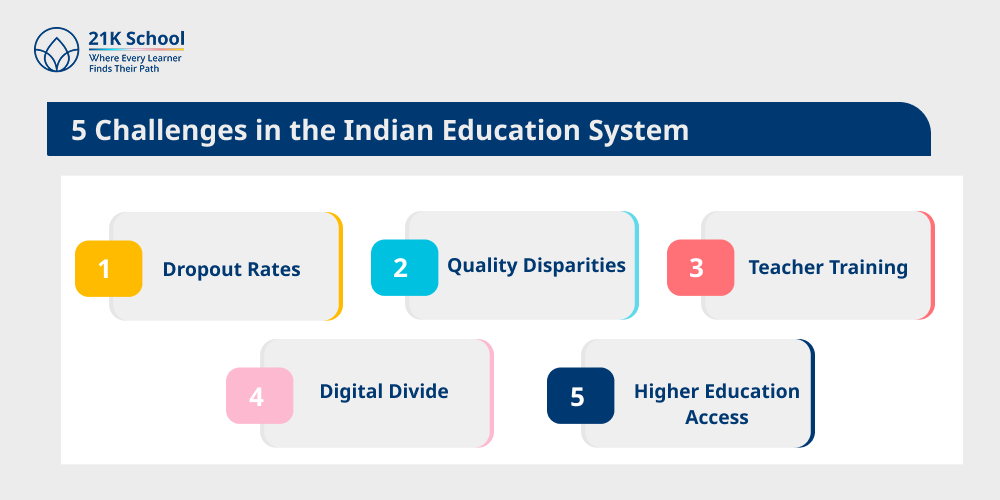
The limitations of the Indian education system can be mentioned as:
1. Dropout Rates
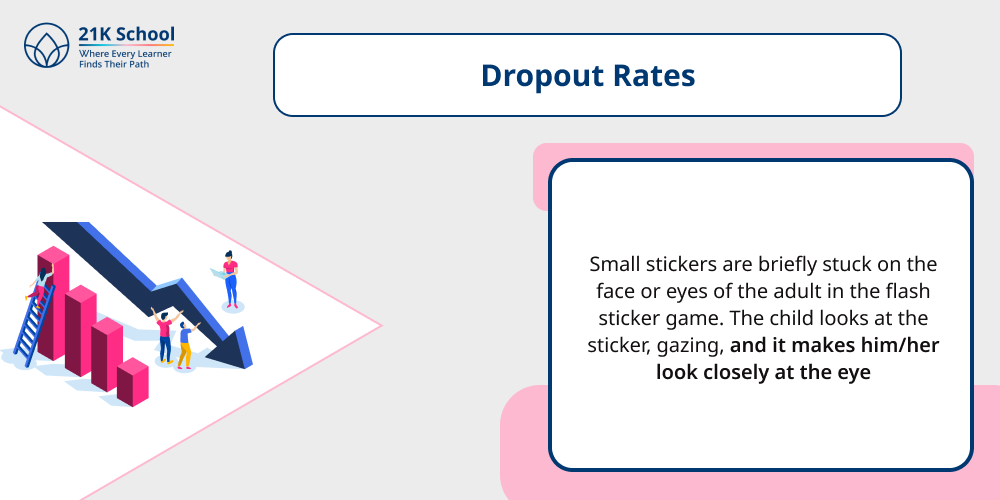
Increasing dropout rates, majorly after secondary-level education is one of the challenges that the government still wants to fix.
Despite some government programs like the Mid-Day Meal Program that are motivating students to complete their primary schooling, many find it difficult to proceed to higher levels.
The majority of students stop pursuing education due to early marriages, forced child labor, poor financial status, and far-off schools from their villages.
2. Quality Disparities
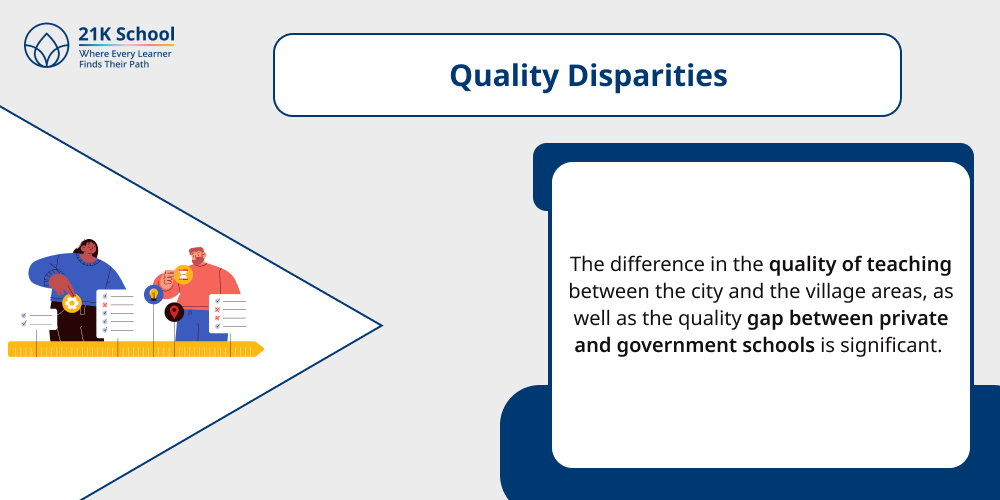
The difference in the quality of teaching between the city and the village areas, as well as the quality gap between private and government schools is significant.
Learning outcomes, infrastructure, and teaching standards are diverse.
Most government schools are unable to offer basic amenities, while the elite private schools are equipped with optimum resources.
3. Teacher Training
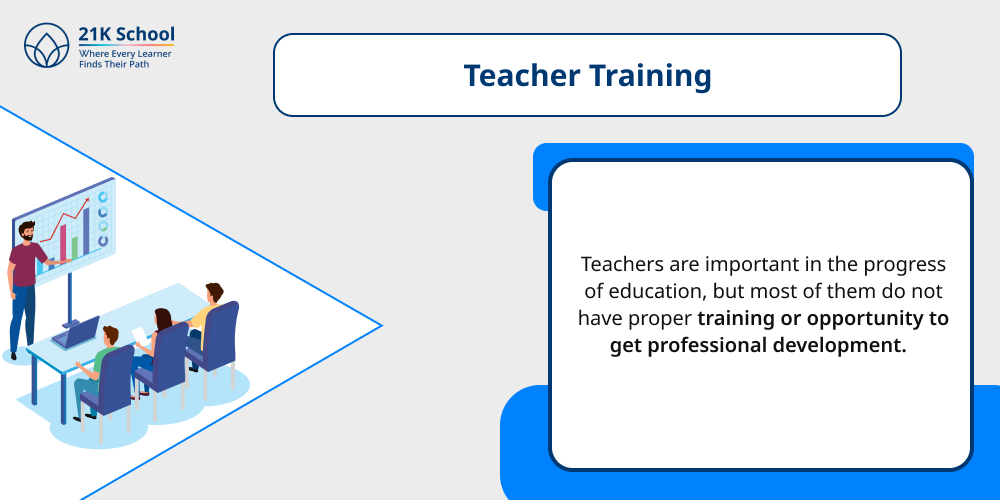
Teachers are important in the progress of education, but most of them do not have proper training or opportunity to get professional development.
There are also the problems of absenteeism of teachers, outdated pedagogy, and low accountability which negatively influence learning.
There is a need for continuous professional training and performance assessment to enhance the quality of teachers.
4. Digital Divide
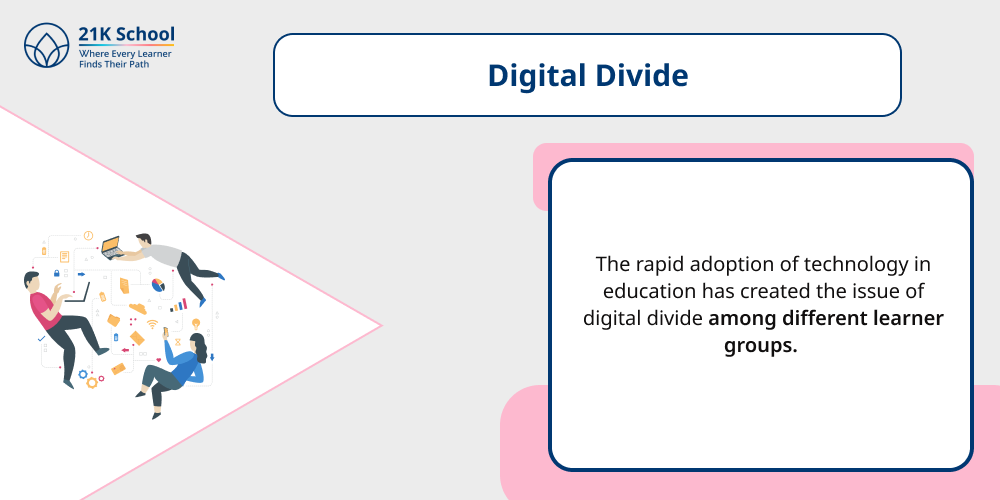
The rapid adoption of technology in education has created the issue of digital divide among different learner groups.
Online learning became common during the COVID-19 pandemic. At this time, most students lacked access to electronic devices, good internet, or lacked digital literacy.
This disparity increased the learning gaps, especially for rural and economically advantaged regions.
5. Higher Education Access
Another most significant reason why our education system is lagging and not producing skilled workforce is lack of higher education access.
Despite having several number of private and government universities, students don’t get into them.
The major here is the poor financial support and lack of enough seats in these colleges and universities.
To solve this problem, the government should come up with more scholarships, new colleges, and easy access to student loans.
Role of Technology and Globalization in Development of Education in India
Technology and globalization has played a vital role in the educational development in India, like many other nations.
Online courses, digital classrooms, and all forms of learning materials have broadened the base of knowledge.
Distribution of free online educational resources is done through government programmes like DIKSHA and SWAYAM.
The introduction of smart classrooms and virtual libraries are slowly finding their way to schools and universities.
Globalization has further brought curriculum changes and global partnerships for student exchange.
Indian colleges and universities are increasingly collaborating with other universities across other countries, due to which students are moving out to study.
The exposure to international standards has promoted innovation, research, and development of abilities suited to the international markets.
It is still essential to balance global competitiveness and the need to retain local knowledge and cultural values.
Conclusion
India has come a long way in the field of education with the help of inclusive education and continuous improvements.
Now, it focuses more on development of practical skills and lifelong learning, instead of only focusing on rote learning.
Blackboards are replaced by white interactive boards. Though modern education started from the colonial period, the present policymakers are working efficiently to uplift our students and secure their future jobs.
