

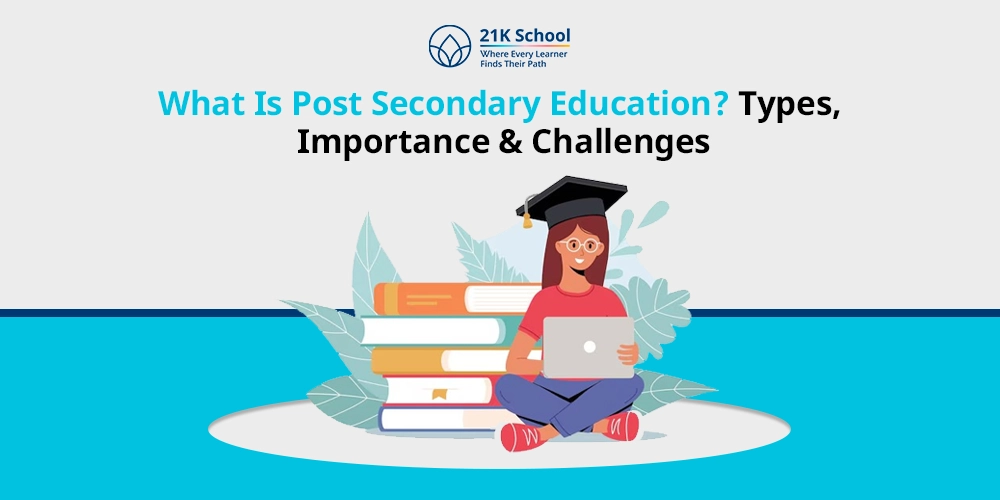
Post-secondary education constitutes some of the levels of education as stated by the International Standard Classification of Education (ISCED) that occurs after attending secondary schools.
It can offer you the best opportunities that align with your professional interests. Children or parents who are really serious about their learning should make an investment in it.
In this article, we shall briefly understand the meaning, benefits, types, and limitations of post-secondary education to decide if we really need to pursue it.
Table of Contents
What is Post Secondary Education?
Post-secondary education is any kind of formal education provided after completion of secondary education from high schools or obtaining a GED equivalent.
It incorporates a broad spectrum of learning provided by academic institutions such as universities, colleges, vocational colleges, and professional training institutions.
Post-secondary education is voluntary and more specialized in most cases, unlike secondary education, which is basically compulsory.
The main aim of post-secondary education is to equip learners with the advanced academic skills or professional skills that can help them find future jobs in the 21st century.
The programs might be long or short in duration, based on the certificates and degrees chosen. These degrees might be based on academic theories, practical skills or a mix of the two.
The post-secondary education is flexible and accessible to a wide category of learners as it is available in full-time, part-time, online, or blended forms.
5 Types of Post-Secondary Education
Post-secondary education can be classified into the following types:
1. Universities
The most commonly known forms of post-secondary education include universities.
They mainly concentrate on academic and research-based education for extended degree programs including undergraduate, postgraduate, and doctoral programs.
Before moving forward, understand the importance of research in education.
A wide spectrum of courses offered in universities are arts, sciences, engineering, medicine, business, and social sciences.
Alongside teaching, universities also provide research opportunities that lead to improvements of science, innovations, as well as development of society.
University education stimulates independent learning, problem-solving, and critical thinking skills. Therefore, it is applicable to students wishing to pursue academic careers or occupations which demand a higher level of theoretical knowledge.
2. Colleges and Community Colleges
Colleges and community colleges have more practical and career-oriented courses than the universities.
They normally offer diplomas, associate degrees, and certificates in areas of healthcare, information technology, business, education, and skilled trades.
Local communities are often served by community colleges, which are concerned with access and affordability.
These institutions are particularly beneficial to students who need to join the labor force within a short time or acquire practical experience.
In addition to this, most community colleges have transfer programs through which students can continue their studies in a university after completing the initial courses.
3. Technical and Vocational Education
Technical and vocational education is provided with the intention of advancing job-related skills and competencies.
Such programs are created to equip students to become entrepreneurs and technical employees such as electricians, mechanics, plumbers, carpenters and technicians.
Training can be extremely practical and comprise workshops or apprenticeships.
Vocational education is also very important for addressing the demand of the labor market, especially where skills are required instead of academic degrees.
It offers a direct entry into employment, and is usually less expensive and time-consuming, compared to the conventional academic programs.
4. Professional Education
Professional education is intended to prepare careers entailing specialized module training or licensure.
Examples are law, architecture, teaching, nursing, accounting, and medicine.
Professional bodies often control these programs, where the academic standards are very strict.
Professional education focuses on theoretical and practical knowledge acquired by professional qualifications.
The field graduates have to fulfill the work requirements in their respective specialties, since they require high quality services which directly impacts the society.
5. Online and Distance Education
Technology in education and the need to have flexible learning have increased the demand of online and distance education.
This kind of post-secondary education enables students to attend courses and programs online through digital mediums.
Online education offers special advantages to working adults, those who have some family obligations, or those who live in distant regions.
It is flexible in terms of schedules and location, while also allowing an individual to access accredited programs and recognized qualifications.
4 Importance of Post-Secondary Education
Post-secondary education is crucial for any individual because it provides the following:
1. Career Opportunities and Employment
Better employment opportunities can be considered one of the most significant advantages of post-secondary education.
Most jobs these days demand that one be more educated than just high school graduates. Employers are interested in people who have specialized education and training.
Therefore, if people are highly educated (up to post-secondary education), they get higher chances to build their career and have a better lifestyle than others.
2. Higher Earning Potential
Post-secondary education is closely related to increased earning capacity.
These education levels tend to result in the ability to get better jobs, promotions, and long-term financial stability.
Higher incomes along with supporting their families, also contributes positively to the national economic growth rate.
3. Personal Development
Post-secondary education contributes greatly to the life of the individual besides career and monetary gains.
It promotes discipline and helps learners to be self-reliant.
Through this, students get exposed to a wide variety of ideas, cultures, and world views, thus fostering critical thinking and gaining a better insight into the world.
Post-secondary education is also useful in enabling people to be confident and have a sense of purpose.
These aspects of personal growth boosts the overall well-being and lifelong learning in individuals.
4. Social and Civic Benefits
Post -secondary education results in many social and civic benefits.
Educated people tend to be more willing to engage in community activities, volunteerism, and in democratic activities like voting.
They are more knowledgeable of social problems and are better prepared to take part in social debates.
Education also encourages social mobility.
This happens because someone from a disadvantaged background is given a chance to change his or her circumstances, and become a responsible member of the society.
Role of Post-Secondary Education in Economic Development
Post-secondary education is very important in economic development as they give rise to a skilled and knowledgeable workforce.
Due to increased economical and technological complexity, the need for educated workers has been on the rise.
Colleges and universities are some of the institutions that support this need by supporting professional development of learners.
Economic development is also supported by higher learning institutions in terms of research and innovation.
In most cases, universities and colleges work hand-in-hand with industries to come up with new technologies, enhance productivity, and address real-life issues.
These steps maintain competitiveness, generate investment, and create employment.
Economic growth and global competitiveness in countries that invest in education are usually high.
3 Challenges in Post-Secondary Education
Post-secondary education seems so beneficial but the challenges that lie ahead necessitates consideration. These are as follows:
1. Cost and Accessibility
The increasing cost of tuition and other associated costs is one of the biggest problems in choosing post-secondary education.
Many students from low-income families often get stuck in the loop of loans repayment and debts due to the higher costs of post-secondary education.
These financial limitations prevent several individuals from achieving their dreams of becoming respectable members in society and support their families well.
Although in many developing countries, government colleges provide post-secondary education, the quality of education and administration still need improvement.
Note some of the top cheapest universities in the world for international students and continue your learning journey efficiently.
2. Academic Pressure and Mental Health
Academic pressure, which occurs in post-secondary education, causes stress, anxiety, and mental health problems in the students.
Rigorous expectations, loads of work, and exam stress may have a negative influence on well-being.
Educational institutions are becoming more aware of the need to support student mental health. They are hiring counselors, support services, and wellness programs to help students manage these issues.
3. Skills Mismatch
Another problem is that there is a mismatch between skills that are learned in post-secondary programs and job market demands.
In many instances, the graduates are unable to secure jobs due to a lack of relevance with the prevailing industrial needs.
This problem could be solved only when the policymakers, educational centers, and industrial companies align with present demands of jobs and the education provided.
Conclusion
Post-secondary education is the level of education that enables you to get specialization in your selected field and earn more than normal high-school graduates.
It is often used interchangeably with higher education and tertiary education, but there are certain differences between them.
An individual who has completed their post-secondary education also contributes to the national income rate while breaking the vicious cycle of poverty.
If the challenges like higher expenses and skills mismatch are managed well by the government, many students could become better supporters for their families and society.

You may also want to read