

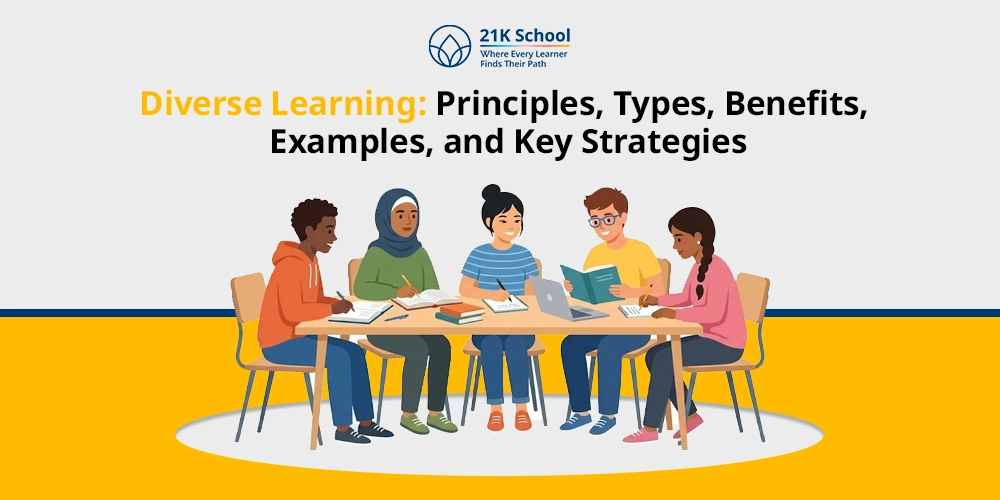
Education today has become more flexible for each student. Students with different backgrounds, abilities, styles, and needs feel valued and can achieve success without obstacles.
To make this happen, diverse learning plays an important role in students’ educational journey.
In this detailed journey, we will explore all the information about diverse learning, its principles, types, benefits, examples, key strategies and many more.
Table of Contents
- What is Diverse Learning?
- Diverse Learning Styles
- Inclusive Education Practices for Students with Diverse Needs
- Examples of Diverse Learning
- 7 Key Principles of Diverse Learning
- 5 Types of Diverse Learners
- How to Create a Diverse Learning Environment?
- 5 Benefits of Diverse Learning
- Diverse Learning Needs in the Classroom
- 4 Challenges in Implementing Diverse Learning
- 5 Key Strategies of Diverse Learning
- Conclusion
What is Diverse Learning?
Diverse learning in education is an effective way to understand and value individual differences in their learning styles, background, abilities, cultural, languages, and life experiences.
Diverse learning promotes inclusive teaching strategies to meet the needs of diverse students.
Through diverse learning, teachers understand how to teach diverse students in the classroom.
This technique is ideal for different types of diverse learners such as students with disabilities, gifted learners, multilingual students etc.
Diverse Learning Styles
Diverse learning styles include some effective ways through which students can easily absorb, process, and retain information.
These styles are used by teachers for students’ engagement and outcomes by offering varied methods like diagrams, discussions, hands-on activities, and reading.
Educators can also use popular teaching strategies for promoting diverse learning styles such as differentiated instruction, blended learning, technology integration, formative assessments etc.
Inclusive Education Practices for Students with Diverse Needs
Inclusive education is an educational approach of providing equal teaching to every learner irrespective of their background.
This aims to promote a healthy environment among students and provide equal opportunity in the classrooms without discrimination.
Effective inclusive practices for students with diverse needs include:
- Using a structured curriculum is effective for different learning abilities.
- Using flexible assessment techniques.
- Support peer and collaborative learning.
- Providing a safe and accessible learning environment.
Examples of Diverse Learning
To understand diverse learning in student day to day life go through some real world examples:
- A teacher using various educational approaches such as storytelling for learning and hands-on experiments to engage students in learning.
- For deep understanding of concepts using diverse learning styles.
- Teachers provide extra time to students with disabilities to complete assignments.
- Using technology in the 21st century to learn effectively. For example, use of screen readers, speech-to-text tools, online videos etc.
7 Key Principles of Diverse Learning
To understand diverse learning in education one must go through the 7 principles in detail:
1. Universal Design for Learning (UDL)
Universal Design for Learning (UDL) is an educational framework that includes principles which enhance learners’ ability to learn, present and engage with the resources.
It aims to construct curriculum and instructions helping each type of student to achieve desired goals from the start.
Also, explore the benefits of UDL in special education of students with disabilities.
2. Inclusive Environment
The purpose of an inclusive environment is to provide respect, acceptance, and opportunity to each learner irrespective of their backgrounds, physical, social abilities.
A classroom environment should be free, flexible, and encourage students to present themselves without obstacles.
3. Differentiated Instruction and Flexibility
Differentiated learning is an effective approach that helps in fulfilling the diverse needs of students. It goes beyond that one-size-fits-all model.
It provides an equitable classroom environment where diverse students can learn at their own pace.
4. Cultural Responsiveness and Equity
To support students’ unique learning needs, teachers must promote students’ cultural, linguistic, and personal backgrounds.
Creating a safe and welcoming environment helps them to learn without challenges.
5. Individualized Support and Scaffolding
Many learners often need extra support and guidance to fulfill their long-term goals. Through scaffolding and diverse learning teachers can provide structured assistance.
This helps them to gain confidence and independence.
6. Collaboration and Social-Emotional Growth
For professional and personal growth, collaboration and social-emotional learning is important. It helps them to develop resilience in students, empathy, and a positive attitude towards learning with diverse students.
In this way, students can meet personal and societal objectives.
7. Reflective Practice
Through reflective practices, teachers continuously assess and improve their teaching strategies to achieve desired goals.
It is an effective strategy that helps teachers to understand diverse learning needs of students.
5 Types of Diverse Learners
Every child is different and their needs make them diverse students. A diverse learner simply means a student with different abilities, background, and learning style.
Some common types of diverse learners include:
1. Cross-Cultural, Linguistic Children
Cross-cultural and linguistic children are those who collaborate from different backgrounds. Each one of them speaks languages other than English.
The children bring unique thoughts, culture and activities in the classroom to create effective learning environments.
2. Developmental Delays and Disabilities
Learners who are dealing with development or any kind of disability like Autism Spectrum Disorders, ADHD etc require diverse learning styles such as individualized learning programs.
3. Gifted Learners
Gifted learners are those who have advanced abilities, creativity, or ehances academic performance in comparison to normal students.
The kind of learners need different environment and educational support such as implementation of:
- higher-order thinking skills tasks
- independent projects and innovation opportunities
- flexible learning and advanced learning options
4. Socio-Economic Diversity
Learners who are economically weaker as compared to other students come under social economic diversity.
It impacts students’ educational journeys due to low income challenges such a lack of resources, lack of awareness, nutrition or technology.
They need equal opportunity and access to required material, food, and education.
5. English Language Learners (ELLs)
English Language Learners (ELLs) use English as a second language and require special educators for language instruction to achieve desired goals.
How to Create a Diverse Learning Environment?
To create a diverse learning environment, one should follow the steps including:
1. Understand Learner Diversity
This initial step is to understand different students through:
- Learning styles like visual, auditory, kinesthetic
- Cognitive abilities and developmental levels
- Cultural, linguistic, and socioeconomic backgrounds
- Emotional, behavioral, and social needs
2. Adopt Inclusive Teaching Practices
Choose inclusive teaching practices that help students in learning. Strategies like UDL principles and peer learning.
3. Create a Culturally Responsive Classroom
Create a culturally responsive learning environment in the classroom to ensure students are respected, and more engaged in learning.
4. Support Linguistic Diversity
Supporting linguistic diversity means selection of the right language that helps in simple and clear instructions while learning.
5. Use Assistive Technology and Learning Tools
Using technology in education can help students bridge learning gaps by useful tools such as:
- Text-to-speech and speech-to-text software
- Audiobooks and captioned videos
- Interactive learning apps
- Adaptive assessment platforms
6. Encourage Student Voice and Choice
Lastly, encourage students to choose desired topics or projects to motivate them for future learning.
5 Benefits of Diverse Learning
Diverse learning offers various opportunities from connecting diverse learners to making classroom environments positive. Major benefits include:
1. Enhanced Cognitive and Academic Growth
To enhance students’ cognitive ability and academic growth, diverse learning offers different viewpoints, learning styles, and problem-solving approaches.
In this way, students can improve their personality and perform better in the classroom by understanding concepts.
2. Social and Emotional Development
Social and emotional development is also important for a child’s growth. Diverse learning promotes social and emotional development by regular interaction with peers and collaborative learning.
In this way, students can improve their communication skills and build confidence in life.
3. Preparation for the Real World
Diverse learning encourages diverse students to connect and collaborate which prepare them for real life situations.
In this way, students understand people and their unique perspectives and handle the situation accordingly.
4. Reduction of Stereotypes
Diverse learning is all about exploring different cultures, abilities, and identities, misconceptions are challenges which help individuals to reduce stereotypes.
Through diverse learning one can promote positivity, fairness, and respect.
5. Enhanced Engagement and Collaboration
Connecting with people from different perspectives such as unique backgrounds, culture, and identities make learning more engaging.
For example, students with different opinions in a group discussion are more interesting to participate in.
Diverse Learning Needs in the Classroom
Some key aspects of diverse learning needs one must know are:
1. Learning Styles
Creating a diverse classroom means fulfilling the needs of every student which requires various learning styles.
From listening to reading and hands-on learning activities to ensure learners understand and retain the concepts effectively.
2. Cognitive Abilities
Each learner’s intellectual abilities are different from each other. It can be measured by their learning pace, memory, improved attention span, and problem-solving skills.
Including diverse learning needs in the classroom supports students to grow and develop at their own speed.
3. Cultural and Linguistic Backgrounds
Children’s beliefs, values, and learning are based on their backgrounds like from which cultural and linguistic backgrounds they come from.
Using culturally responsive teaching techniques helps in fulfilling the diverse needs of the classroom.
4. Emotional and Social Factors
In learning, emotional and social factors play an essential role. For example, choosing activities and methods that children enjoy helps motivate them to participate.
Other common emotional and social factors include self-esteem, anxiety, peer interactions, and family environment etc.
4 Challenges in Implementing Diverse Learning
Implementation of diverse learning in the classroom comes with various challenges like:
1. Teacher Preparedness and Training Gaps
Lack of teachers training in diverse learning implementation strategies negatively impacts the classroom. This leads to struggle in finding the student’s needs.
2. Curriculum and Assessment Limitations
Curriculum and assessment play an important role in educational growth. Using rigid curriculum can impact the implementation of diverse learning in the classroom.
3. Resource and Infrastructure Constraints
Lack of resources and infrastructure is one of the challenges faced by teachers and students to effectively implement diverse learning in the classroom.
4. Social and Attitudinal Barriers
Negative attitudes and social stigma is one of the biggest limitations of diverse learning in which students’ overall academic progress can impact badly.
5 Key Strategies of Diverse Learning
For effective implementation, go through key teaching strategies for diverse students in detail:
1. Varied Materials
Using varied materials help in understanding the preferences of each student. Including textbooks, storybooks, charts, infographics, maps, videos etc.
It helps in student engagement and retention.
2. Hands-On and Interactive Learning
Through hands-on and interactive learning students get familiar with peers and collaborate to participate and enhance in the learning process.
It is beneficial for conceptual clarity and enhances knowledge with time.
3. Collaborative Work
Through collaborative learning students learn together as a group or pair to participate in activities or programs.
This helps in building social skills, empathy, and confidence to share thoughts.
4. Project-based Learning
Project-based learning helps students to acquire information that is used in the real-world to understand problems and find solutions.
It increases student engagement and active participation in classroom learning.
5. Assessment Strategies for Diverse Learners
Assessment in diverse education needs to be flexible, inclusive, and ongoing, allowing students multiple ways to demonstrate their understanding.
Conclusion
Diverse learning is one of the effective ways one can implement in the classroom.
By understanding its principles, types, benefits, examples, and key strategies for effective learning help parents and teachers to create a positive learning environment.
Hopefully, the above-mentioned detailed information is helpful to understand what diverse learning really means and how to implement the strategies effectively to ensure equitable access to learning for all students.

You may also want to read