Declarative Knowledge: What It Is, Types, Importance, Benefits, Examples & More!
 Written byRahul PalContent Specialist
Last modified: 27 Jul 2026 14 min read
Have you ever thought about how declarative knowledge helps in the interpretation of knowledge?
Declarative knowledge plays a vital role in the cognition and interpretation of the world around them by individuals. It determines how well we are able to remember information, expound ideas and communicate effectively with others.
This form of knowledge helps to learn in all fields, including historical events, as well as the concepts of science.
Declarative knowledge also offers a basis for further thinking, reasoning and efficient application of information in the day to day life by organising the information in a clear and easy-to-understand manner.
What is declarative knowledge?
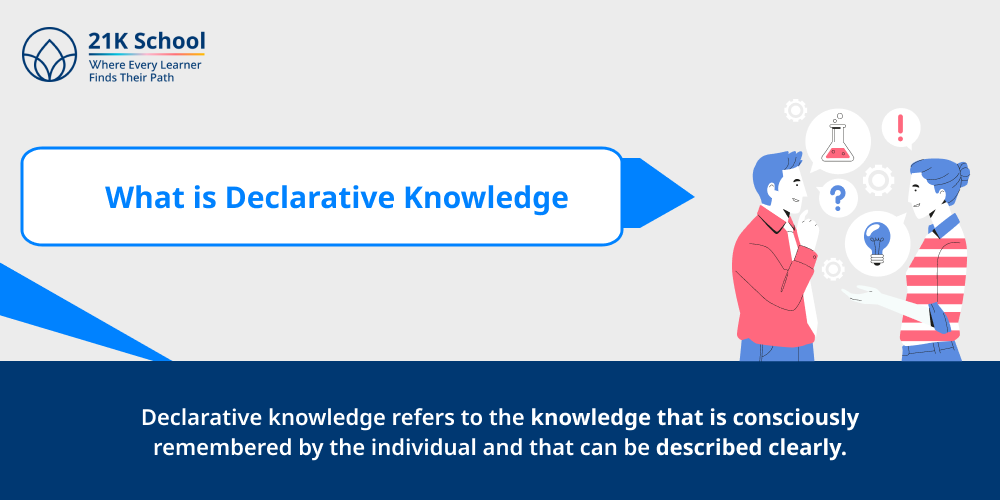
Declarative knowledge refers to the knowledge that is consciously remembered by the individual and that can be described clearly. It involves facts, concepts and ideas to describe what something is and not how to do something.
This kind of knowledge is useful in knowing, communication and thinking in day-to-day life and in education. Typical ones are recalling the date in history, scientific facts or the meaning of words.
Declarative knowledge is advantageous in that it helps the learner to organise knowledge and create a valid understanding, depending on the high level of thinking and problem-solving on most subjects and in real-life situations.
Types of declarative knowledge
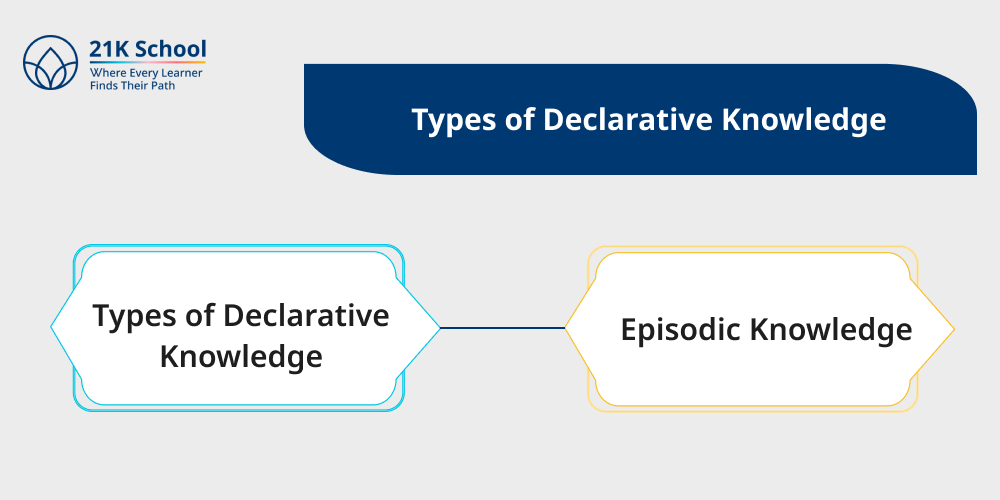
Declarative knowledge has been categorised under other forms, which enable us to recollect and put information in sequence. The semantic and episodic are the two major types, which contain the general facts and the personal experiences, respectively. Declarative knowledge has the following forms.
1. Semantic knowledge
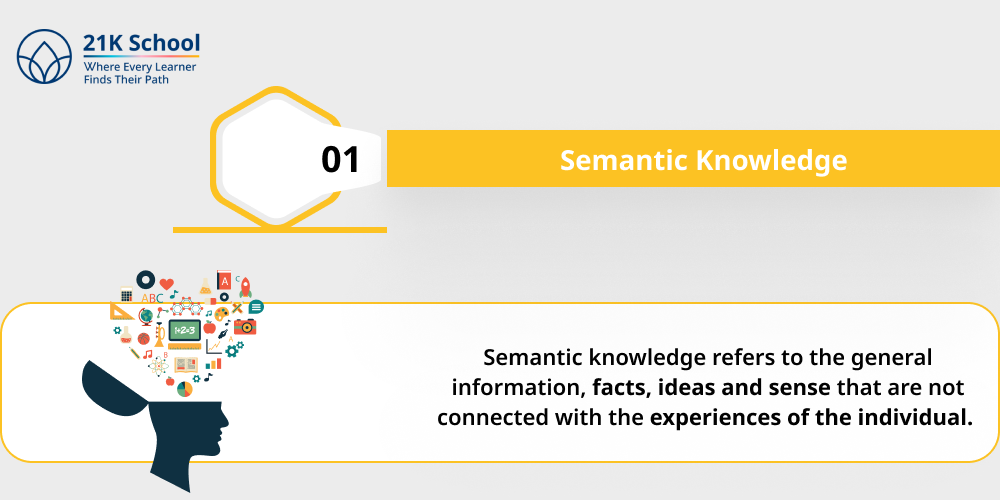
Semantic knowledge refers to the general information, facts, ideas and sense that are not connected with the experiences of the individual. IIt has Knowledge such as vocabulary, mathematical rules, scientific and cultural ideas.
Such knowledge is typical of a considerable number of people, and it will not vary greatly over time. The knowledge that is semantic helps individuals understand the language as well as interpret information and apply the learnt concepts to different contexts and topics.
2. Episodic knowledge
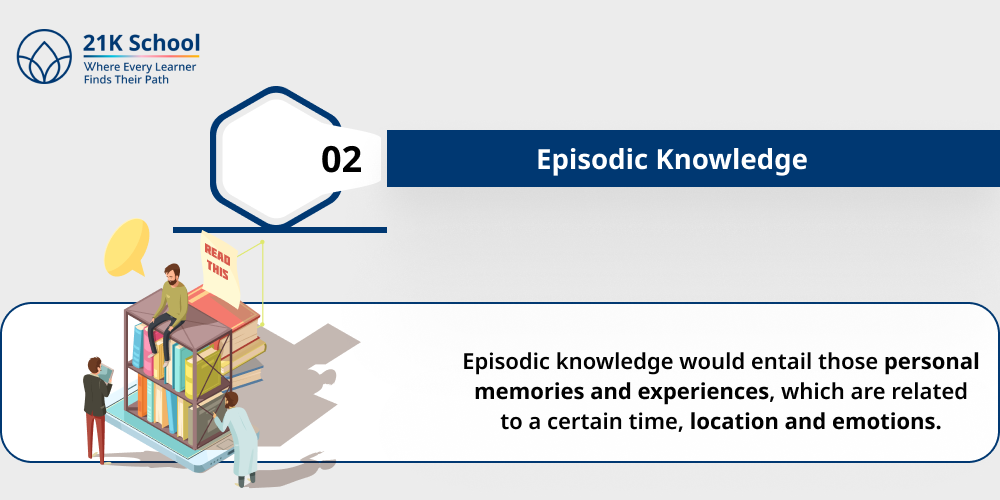
Episodic knowledge would entail those personal memories and experiences, which are related to a certain time, location and emotions. It includes such events as birthdays, school life or important processes in life.
This one is the personal one, and people recollect the past events in detail. Episodic knowledge is useful in self-identity, being emotionally aware and reflective of the past events in order to aid in decision-making in the future.
Importance of declarative knowledge
The possession of declarative knowledge, the knowledge of facts and information, is extremely important in the way of learning, problem-solving, and decision-making, which is the core of critical thinking and proper implementation in various areas. The value of declarative knowledge could be verified below.
1. Supports critical thinking and logical reasoning
Declarative knowledge gives vital facts and concepts on which people can analyse information rationally. When learners are familiar with fundamental concepts and connections, they will be able to contrast the perspectives, analyse evidence and make rational conclusions.
This kind of knowledge makes it easy to put order in thinking, in which the individual is capable of disputing assumptions, discerning patterns, as well as making assumptions in academic, professional and daily life circumstances relying on knowledge.
2. Improves problem-solving
Decent declarative knowledge makes individuals recognise the problems and perceive the information that is relevant within a limited time. The things and ideas stored in the memory assist the learners in determining what the possible solutions are, applying the right methods, and foreseeing the results.
This learning facilitates effective problem-solving skills through coming up with a clear picture of the situation, decreasing confusion and making better and more confident decisions.
3. Aids in effective communication
Declarative knowledge is an enhancement of communication skills since it assists an individual to express themselves in a certain and accurate manner. Knowing the correct facts, terms, and concepts can enable individuals to elucidate concepts, conduct a dialogue, and understand other people.
Such knowledge helps to develop language, to study the knowledge better, and to make serious communications in the situations of education, social, and professional life.
4. Enhances knowledge retention
Declarative knowledge helps learners memorise and recall information effectively over a period of time. The facts and ideas are better stored in the memory, and once they are well organised in the memory, they will be easier to remember and can be applied in different circumstances.
Good declarative knowledge helps in the long term memory, consolidates learning and helps one build relationships between any new information and existing information more efficiently.
5. Forms the foundation for higher learning
Declarative knowledge is a basis of higher learning. The facts and ideas presented in the first place give the students an opportunity to master complex ideas and obtain some skills.
It is applicable in the conversion of simple knowledge to more analytical and practical thinking, and should be there so that an individual can be successful in academic and career growth, and lifelong learning in other aspects.
Benefits of declarative knowledge
Besides improving the learning process, the efficacy of the declarative knowledge is more effective in problem solving, increasing the memorising ability of the knowledge and conceptualising of the concepts clearly that can be done effectively in any sphere. The advantages of declarative knowledge can be confirmed below.
1. Foundational learning

Learning is based on declarative knowledge that gives the fundamental facts, concepts and principles. It assists in teaching the students methodically and relating what they know to the newly acquired.
When one has a good foundation, it makes learning faster and easier, academic success and empowers one to go further to higher and specialised areas of study with no fear.
2. Improved communication

Having a good level of declarative knowledge, people can formulate ideas effectively and correctly. Having proper vocabulary, facts and concepts enables proper elaboration and conversation.
This enhances the ability to understand what should be heard, spoken or written and thus leads to a meaningful interaction in the academic, social and professional setting as well as lowers the chances of being misunderstood and boosts confidence.
3. Enhance decision-making skills

Declarative knowledge facilitates informed decision-making by providing reliable and accurate information. When they remember the appropriate facts and ideas, people will be in a position to weigh out their choices and take appropriate action.
It results in improved decisions in everyday life, education and the workplace, and minimising mistakes and enhancing efficiency.
4. Contextual understanding
The declarative knowledge will help people to learn the information in the right context. The background facts and concepts enable learners to be able to perceive the situations and see the relationships between ideas.
This knowledge boosts understanding, minimises misunderstanding and facilitates useful application of knowledge in various circumstances and real-life experiences.
5. Professional growth

Declarative knowledge creates experience and competency in the workplace. The knowledge of the industry concepts, rules, and terms can assist people to act efficiently and speak in a professional manner.
It makes lifelong learning and flexibility possible, as well as career development, due to the possibility to learn new skills and adapt to any changes in the demands of the workplace.
6. Problem solving
Declarative knowledge plays a role in problem solving since it allows the provision of information that is needed to analyse situations. Relevant facts and concepts enable people to recognise and formulate the problems, as well as to measure the results.
The knowledge leads to a decrease in uncertainty, increases accuracy and provides effective resolution of challenges in academic and real-life situations.
Limitations of declarative knowledge
Declarative knowledge, which is concerned with facts and information, is limited in its practical use, development of skill and flexibility usually necessitates the incorporation of other procedural and experiential learning to solve problems in the real world.
1. Isolated knowledge
In some cases, declarative knowledge may be in the form of disconnected facts. The problem is that one might recite information without knowing the connections between them, and so learners might remember the information, but they cannot make use of it.
This is a weakness of deep learning, and it can lead to the inability of individuals to combine knowledge in one subject as well as be able to apply this knowledge in real-life scenarios.
2. Poor transferability
Declarative knowledge is not always easily transmitted to new or unfamiliar situations. Students can also be familiar with facts under one context and be unable to transfer the same elsewhere.
This knowledge is specific to a context and therefore, without practice and application, it is constrained to contribute to the resolution of real problems of the world or to adjustment to the changing environment.
3. Lacks functional application
Declarative knowledge is concerned with knowing what, as opposed to knowing how. Consequently, people are probably to grasp ideas in theory but fail to apply them practically.
Declarative knowledge might not prove to be an effective source of action or skill-based performance without procedural or experiential learning.
4. Not suitable for everyone
Declarative knowledge is a problem for some learners because there may be differences in terms of learning styles, memory capacity or intellectual preferences.
Excessive memorisation and retention can be disadvantageous to those learners who prefer practical activities or visual and experience-based learning solutions, and cause less engagement and learning performance.
5. Lack of context
Declarative knowledge is not always easy to grasp or recall when it is given out of context. Isolated facts can appear to be meaningless, which is why they will be forgotten. Learners might not be able to see the relevance or the purpose of the information without real-life examples or connections.
Difference between declarative and procedural knowledge
The difference between declarative knowledge of what facts and information and procedural knowledge of how skills and processes are established is that they portray a difference between an understanding of concepts and their actual application in practice. The differences between declarative and procedural knowledge are the following.
| Aspect | Declarative Knowledge | Procedural Knowledge |
|---|---|---|
| Meaning | Knowledge of facts, concepts and information; knowing what something is. | Skills and process knowledge; being aware of how to do something. |
| Assessment | Assessed in terms of recall, quizzes, written responses, or explanations. | Evaluated using performance, demonstration, or practical. |
| Nature | Cognitive and explicit; can be consciously thought about. | Tacit and implicit; automatic or unconscious. |
| Verbalisation | Can be explained or described in words in an easy manner. | Not easy to explain; acquired by experience. |
| Learning Method | Acquired by reading, experience, lecturing, or learning. | Acquired by practise, repetition and experience. |
| Application | Applied to comprehension, logic, and problem-solving. | Used to carry out things effectively and competently. |
| Examples | Being aware of the equation of the area of a circle. | Determining the area of a real field by using the formula. |
Examples of declarative knowledge
Declarative knowledge can be seen in the case of knowing the dates of history, facts of science, words, mathematical formulas, grammar rules, and world knowledge or knowledge concerning a particular subject. An example of declarative knowledge is the following.
1. Common knowledge
Common knowledge is the knowledge that is known by the majority of society. An example of this is that we know that fire is hot, that the sun rises in the east and the most important social norms.
Such kinds of declarative knowledge assist individuals in connecting in day-to-day lives, communicating, and interpreting the general information without having to undergo any special training or experience.
2. Academic facts
Academic facts are the information learned in a formal school setting, e.g. historical facts, geographical facts or economic concepts.
This declarative knowledge has also been shown to aid academic performance as students of this knowledge are able to remember the major points during exams, discussions and assignments. It lays the foundation of knowledge on subjects and becomes a stepping stone to advanced-level learning.
3. Mathematical knowledge
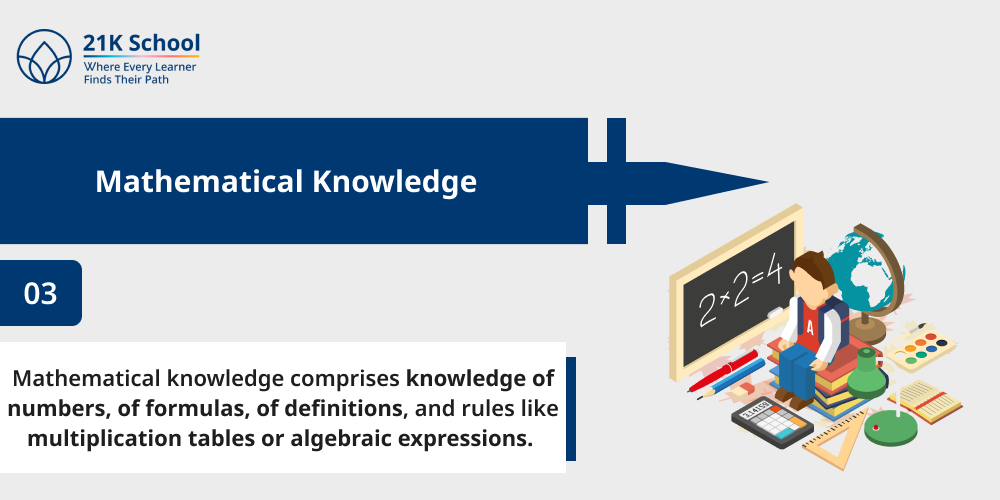
Mathematical knowledge comprises knowledge of numbers, of formulas, of definitions, and rules like multiplication tables or algebraic expressions.
This is declarative knowledge, which makes learners identify mathematical concepts and be able to explain them in a clear manner. It aids in problem-solving techniques and lays a basis for the application of the mathematical processes correctly in different academic and real-life circumstances.
4. Scientific knowledge
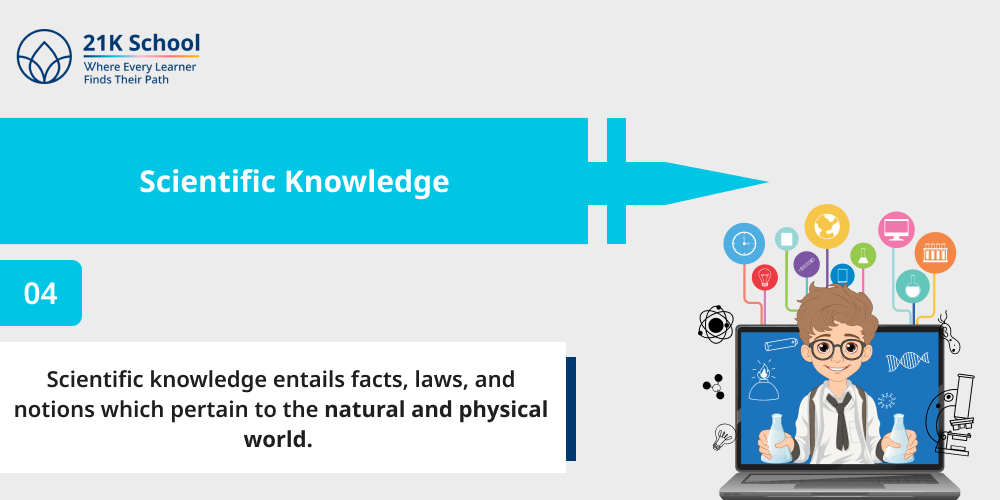
Scientific knowledge entails facts, laws, and notions which pertain to the natural and physical world. Examples are the knowledge of gravity, photosynthesis, or states of matter.
This kind of declarative learning assists learners in explaining scientific phenomena, interpreting experiments, and developing logical thinking, creating foundations of scientific inquiry and higher learning.
5. Language and grammar
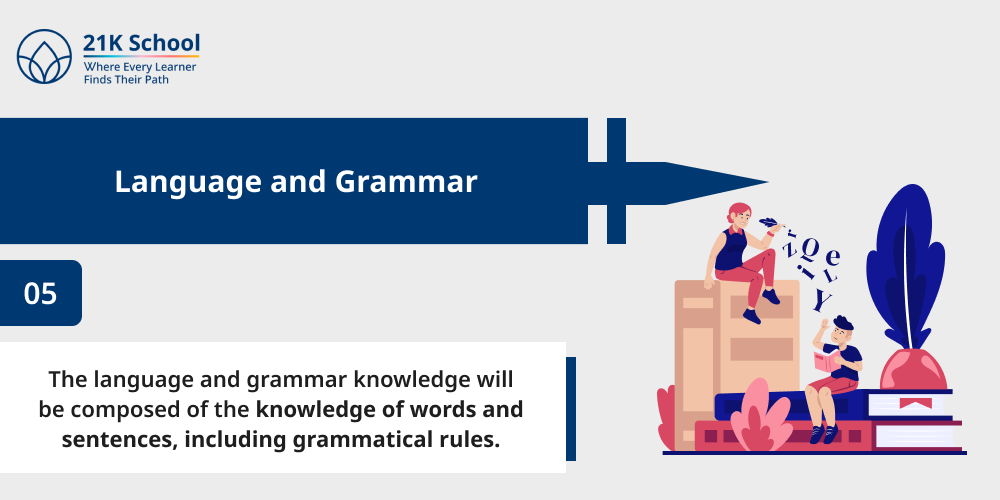
The language and grammar knowledge will be composed of the knowledge of words and sentences, including grammatical rules.
This whole type of declarative knowledge enables one to create appropriate sentences, read and comprehend written and oral texts, and share ideas. It enhances reading, writing, and speaking competencies, which are highly imperative in communication in academia and life in general.
Conclusion
Declarative knowledge is the foundation of human understanding as it allows us to receive, store and express information.
Although it offers the requisite facts, ideas and context of learning, reasoning and problem solving, it will be most effective when used together with procedural skills and practise. Through the reinforcement of declarative knowledge, people can think critically, make decisions, and engage in lifelong learning, which will bridge the concept of knowing what and knowing how, both in school and in general life.
Frequently asked questions
8 questions
What is declarative knowledge?
Declarative knowledge is knowledge that can be remembered and verbally taught. It is composed of facts, concepts and information on what something is. They may have knowledge of historical dates, definitions, rules or facts that are clear and may be explained.
What are the main types of declarative knowledge?
These are semantic knowledge and episodic knowledge. Semantic knowledge comprises facts and general concepts that most people share, whereas episodic knowledge entails individual experiences and memories that have occurred at certain periods and events.
How is declarative knowledge different from procedural knowledge?
Declarative knowledge is about knowing what facts and information, and procedural knowledge is about knowing how to do things or competence. To illustrate, the knowledge of the road traffic laws is declarative, but knowing how to drive a car is procedural.
Why is declarative knowledge important in learning?
Declarative knowledge is based on learning since it can help a learner to understand the concepts, recall and form connections between the thoughts. It also promotes reasoning, communication and problem solving as well as providing advanced and applied learning to the learners.
What are some examples of declarative knowledge?
This may involve knowing the multiplication tables, knowing the rules of grammar, remembering historical events, knowing the facts of science and knowing the definitions and concepts that can be described or explained in an understandable manner.
What is declarative knowledge in AI?
In artificial intelligence, declarative knowledge is knowledge which is expressed in the form of facts, rules, or statements stored in knowledge bases. It dwells on what is true and not on the way to do things; this allows systems to be able to reason, make inferences, and provide answers to questions in a logical manner.
What is declarative and procedural knowledge?
Declarative knowledge is the one which can be expressed as facts and information, whereas procedural knowledge is the one that is learned through practice and is a set of skills and processes. They both collaborate in learning, such as knowing the rules of grammar (declarative) and applying them during speaking or writing (procedural).
What is declarative knowledge in metacognition?
Declarative knowledge in metacognition defines the knowledge of learning processes, learning strengths and learning strategies of the person.
About the author
Rahul Pal
Content Specialist
Rahul Pal is an Education Content Specialist at 21K School- India’s fully accredited online school recognised by the Cambridge International (IA702) and Pearson Edexcel (94883). His graduation from Journalism and Mass Communication from Swami Vivekananda University gives him a strong foundation in factual reporting, source verification, and investigative research. With around 2 years of experience at 21K School, he has written extensively for the CGPA conversion guides, marking schemes, and Indian and International boards (IGCSE, GCSE, and A-Levels). His articles are highly relevant for the guardians looking to guide their learners for board exam preparation across 78+ countries. All Rahul’s content is reviewed by the school’s academic team to ensure alignment with the latest board guidelines and latest notifications from the official resources
Every 21K School guide is written by our education team and reviewed by a subject facilitator before publishing.
Exploring a CBSE-pathway online school?
Talk to an advisor about 2026–27 admissions — no obligation.
Talk to an advisorComments
No comments yet — be the first to share your thoughts or ask a question.