

Have you ever questioned yourself why core subjects cannot be compared to the elective subjects?
Students who are proceeding into the higher levels of studies get to study two subjects, which are core subjects and elective subjects. This is a major difference that should be considered when making an informed choice for your future career and education.
The academic programme of the students is based on core subjects. They are mandatory courses that all students must attend to graduate with a degree or certificate. On the contrary, elective subjects offer flexibility as well as enabling the students to follow their areas of interest, develop specialised skills or strive towards some career goals.
Even though the core subjects provide the student with a balanced education where they receive all the knowledge and skills that they need, electives give the student freedom to mould their learning process according to their interests and objectives in life.
Table of Contents
What are Core Subjects?
Core subjects, also known as compulsory subjects or mandatory subjects, are the subjects which every learner has to take in order to pass their educational programme.
Core subjects are those courses which educational boards, universities or institutions have defined as basic constituents of a specific degree, diploma or certification programme. They are meant to equip students with an all-inclusive base of knowledge and skills required to continue academic advancement and to implement in practice.
They are the pillars of any curriculum, and there is no option to negotiate on them, as a student cannot refuse to follow them, irrespective of their personal interests and career aspirations.
What are Elective Subjects?
An elective course is any course that the student is allowed to take according to their interest, aspirations and abilities. Elective subjects enable students to shape their education and provide them with a chance to learn something new, as compared to core subjects, which are required for all students.
These subjects help the students to develop additional skills, find new talents and learn something that is not in their core subjects. The elective subjects give the students an opportunity to learn in the fields that they are interested in and that they consider fitting their career choice, and thus make it a more interesting and valuable learning process.
The process not only enhances their academic life, but in some manner, it empowers them to be more conscious and self-assured about their choices.
Key Difference Between Core and Elective Subjects
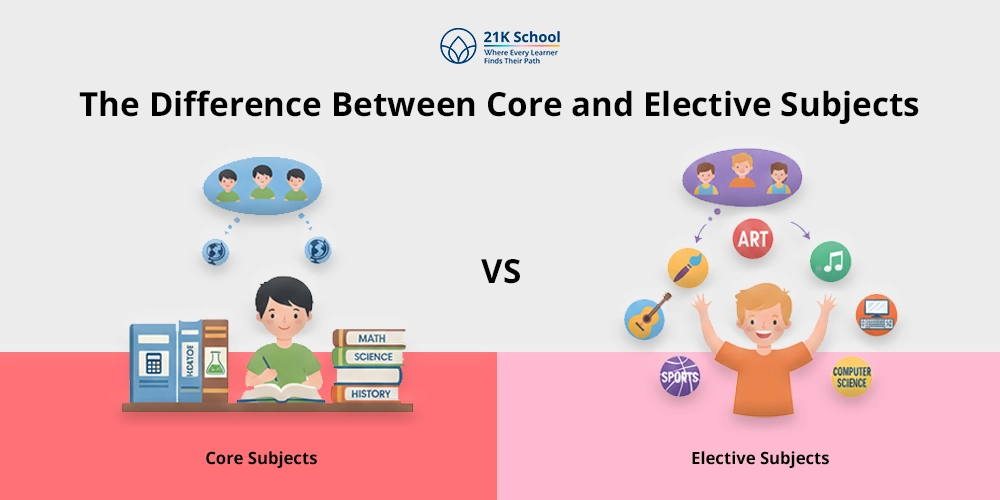
The distinction between the two is that core subjects are mandatory and they form the foundation of a curriculum, whereas elective subjects are not mandatory and can be chosen by students depending on their interests or career goals. The differences between core and elective subjects are as follows.
| Aspect | Core Subjects | Elective Subjects |
| Nature | These are the foundations of education that are compulsory for every learner. They include such major areas as language, mathematics, science and social studies. | Elective courses are the courses that the students choose and find as optional, based on their interests, strengths or career goals. They allow the students to explore different fields other than the main curriculum, such as music and art. |
| Purpose | The main purpose of core subjects is to make sure that no student fails to get the basic knowledge and skills that they would need in their further studies and in their everyday life. They help in maintaining a given academic standard among the learners. | Elective courses are meant to provide students with leeway and self-development. These assist learners to find new areas of interest, acquire special skills and equip them to take a certain career or tertiary education. |
| Assessment | Core subjects are normally evaluated using written tests, exams and assignments that test the knowledge of major concepts. | Subjects that are chosen offer a more flexible form of assessment, e.g. projects, presentations, or work. |
| Flexibility | Core subjects lack flexibility because they are compulsory and have a fixed syllabus provided by the learning boards or institutions. | Elective courses provide flexible learning. The courses offered by students are diverse, and thus students have a choice depending on their interests, schooling facilities and the academic goals. |
| Curriculum | The core subjects curriculum is standardised and presented in a manner that meets the national or school standards. | Curriculum in the elective subject is more flexible and varied. It is variable in various institutions and could be modified with ease to meet the current trends and technology. |
| Standardisation | Most schools have core subjects which are uniform to provide equality and uniformity in education. Their grading, assessment and syllabus are well observed. | Elective subjects are not as standardised as the ones that are mandatory and can differ in schools. This enables the teachers and students to experiment with creative ways of teaching, projects, and cross-disciplinary learning. |
| Subject Availability | All students can take core subjects, which are required at all grades or educational stages. | Elective subjects are dependent on the available resources of the school, the teachers and the demand of the students. |
| Examples | Examples include English, Mathematics, Science, Social Studies, and Languages such as Hindi or regional languages. | Examples include Fine Arts, Music, Computer Applications, Psychology, Business Studies, Physical Education, Environmental Science, or Foreign Languages. |
1. Nature
Core Subjects: Core subjects are the pillars of education and are compulsory for all students. They contain the basic facets of knowledge that comprise language, mathematics, science and social studies. These subjects build the basic skills and competencies needed to achieve both academic and personal development.
Elective Subjects: The elective subjects are not compulsory courses, and the students undertaking the subjects do so due to their interest, or because of their intrinsic capabilities or career goals. They allow the learners to explore other fields besides the mandatory curriculum, such as music, art, psychology or computer applications.
2. Purpose
Core Subjects: The gist of core subjects is to ensure that every learner is able to acquire elementary knowledge and skills that would be essential in subsequent education, as well as in their everyday existence. They help in the development of a general academic standard among all learners.
Elective Subjects: Electives are meant to provide a person with flexibility and enrichment. They help students discover new interests, specialisations and provide them with Assessment or further education in areas chosen.
3. Assessment
Core Subjects: Core subject assessment is usually standardised, which means it consists of written tests, exams, and assignments which test the knowledge of a student in major concepts and skills. Academic growth or even promotion is sometimes based on performance in the core subjects.
Elective Subjects: Electives are evaluated in a more lenient manner. Depending on the subject, evaluation can be in the form of projects, presentations, portfolios or practical work. The emphasis is directed towards creativity, application and comprehension and not memorisation.
4. Flexibility
Core Subjects: Core subjects are not very flexible as they are compulsory and have a given syllabus, established by the education boards or institutions.
Elective Subjects: Elective subjects are very flexible. Students are given a very broad option to follow based on their interests, resources and their academic level.
5. Curriculum
Core Subjects: The curriculum of core subjects is organised, homogeneous and able to comply with national or institutional academic standards. It is focused on the underlying literacy, numeracy and reasoning.
Elective Subjects: Elective curricula are dynamic and flexible. They can differ depending on schools or programmes and are frequently revised regarding the modern trends, technologies, and interests of students.
6. Standardisation
Core Subjects Core subjects are those subjects, common to most education systems, that provide equality and consistency in learning outcomes. Their content, grading and assessment criteria are highly controlled.
Elective Subjects: The electives are not as standardised and can vary across institutions. This will enable teachers and students to test out teaching styles, project-based learning, or interdisciplinary learning.
7. Subject Availability
Core Subjects: Core subjects are offered to every student and tend to be obligatory elements of any grade or course of study.
Elective Subjects: Elective subjects are determined by the resources of an institution, faculty skills and student requirements. Not all of the elective subjects are offered everywhere.
8. Examples
Core Subjects: English, Mathematics, Science, Social Studies, and Languages (Hindi or Bengali) are examples of core subjects.
Elective Subjects: The examples of elective subjects are Fine Arts, Music, Computer Applications, Psychology, Business Studies, Physical Education, Environmental Science or Foreign Languages.
Conclusion
One should understand the difference between the core and elective subjects to make good academic choices. Central subjects provide knowledge and skills needed by all students and enable one to lead the students to the same level of mastery in most vital areas like language, mathematics and science.
Elective courses, however, possess the benefit of providing the freedom to follow passions, develop specialisation skills, not to mention specific careers. These two types of subjects are essential subjects that play important roles in holistic education.
Despite having the foundation subjects that equip learners with fundamental skills, electives enable learners to shape their learning process according to their interests and goals.

You may also want to read