

Have you ever wondered why early childhood education curriculum is important in the future success of the child?
The Early Childhood Education (ECE) curriculum is a systematic way of helping young children to develop in a holistic manner during their tender age.
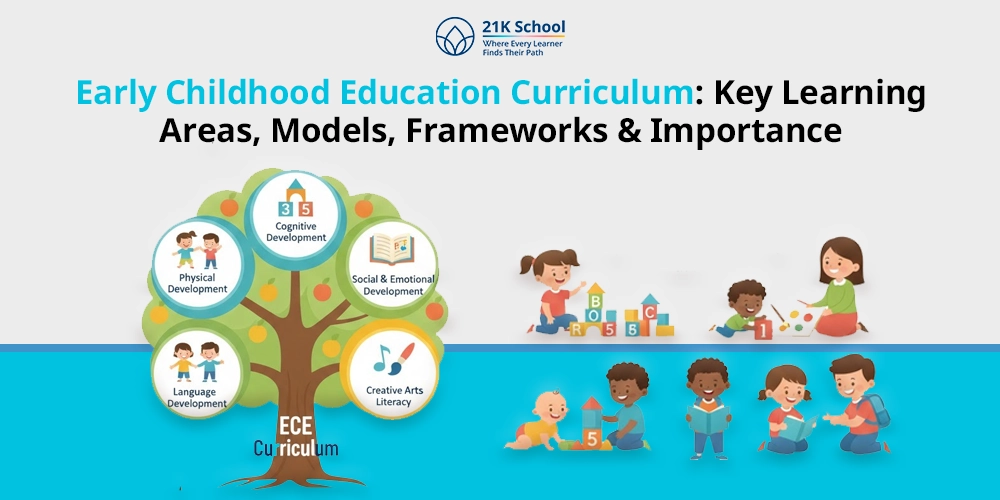
It aims at the development of cognitive, social, emotional, physical and language development in age-related, play-based and experiential ways of learning.
An effective ECE curriculum provides a foundation to lifelong learning through curiosity, creativity, positive relationships and necessary early skills acquired in a safe and inclusive learning environment.
Table of Contents
- What is the Early Childhood Education Curriculum ?
- 6 Key Learning Areas in Early Childhood Curriculum
- Early Childhood Education Curriculum Models
- 6 Importance of Early Childhood Education Curriculum
- Early Childhood Curriculum Core Principles
- Early Childhood Education Curriculum Framework Examples
- Conclusion
What is the Early Childhood Education Curriculum ?
Early Childhood Education (ECE) curriculum refers to a systematic model, which is aimed at promoting the holistic development of early childhood children, usually between birth and the age of eight.
It aims at fostering cognitive, social, emotional, physical and language skills development by using play-based, child-centred and age-based learning.
It is the curriculum that assists teachers to establish secure, warm and engaging environments that encourage inquisitiveness, imagination and early skills acquisition, which forms a firm foundation of life-long learning and well-being of the child.
6 Key Learning Areas in Early Childhood Curriculum
The Early Childhood Education curriculum has six major areas of learning that can help children develop holistically. Physical, cognitive, language and literacy, social and emotional, expression of creativity and understanding the cultures contribute to the development of necessary skills in children and their curiosity.
1. Physical Development
The physical development is related to the increase in the body of children, motor skills, power and health. At a young age, play facilitates confidence and independence and good lifelong habits of mind.
1.1. Gross motor skills
Gross motor skills refer to the utilisation of large body muscles like the arms, legs and the torso. Running, jumping, climbing, throwing, and balancing activities enable a child to build up his or her strength, coordination, posture, and spatial awareness.
1.2. Fine motor skills
Fine motor skills involve the use of smaller muscles in the hands and fingers. Other activities that contribute to hand-eye coordination and dexterity of the fingers include drawing, scissors, stacking blocks, buttoning clothes, and manipulating small objects.
1.3. Health, safety, and well-being
This aspect relates to inculcating healthy behaviours among children, such as proper nutrition, personal hygiene, sleep and exercise. It also incorporates the instruction of safety regulations at home, school and on the outside.
2. Cognitive Development
Among the functions of cognitive development of children, there is the possibility of children thinking and learning. It involves problem-solving, critical thinking, as well as simpler mathematical concepts (numbers, shapes, patterns, and measurement). Scientific inquiry promotes curiosity, discovery and testing.
2.1. Problem-Solving and Critical Thinking
It is through problem-solving and critical thinking that the children will be able to think and solve problems, as well as give creative solutions to problems, as they analyse them. Puzzles, experiments, games of logic, etc., allow one to form logic, flexibility and a line of independent thinking.
2.2. Early Mathematics
Plays introduce the simple ideas of numbers and counting, shapes, patterns, and measurements. Practical activity helps the children to grasp mathematical and logical relations and simple numeracy skills, which would allow them to study subsequently.
2.3. Scientific Inquiry and Exploration
Spark curiosity about the natural world, conduct observation, science experiments, and exploration. Kids get to know how to ask the questions, foresee the results, experiment with ideas and build their perception of the cause and effect relationships.
2.4. Memory and Attention
Learning preparedness is developed by activities which develop focusing, concentration and recall. The development of memory facilitates the acquisition of language, the solution of problems and academic abilities, and the development of attention skills assists students in their engagement during tasks and interaction with other people.
3. Language and Literacy
Language and literacy growth facilitates communication skills, understanding and early reading and writing. It allows the children to communicate thoughts, learn from others, acquire vocabulary, and gain literacy backgrounds that are vital to gaining knowledge, interacting with others, and academic achievements.
3.1. Oral Language Development
Encourages oral communication, listening, and speaking by telling stories, conversing and discussing. Oral language skills play a key role in the expression of thoughts, comprehension of instructions, socialisation, and the development of early literacy.
3.2. Pre-reading Skills
Awareness of letters, sounds, rhyming words and simple print is a pre-reading skill that prepares children to read. These abilities form a base for decoding, understanding and a passion to read books and literature.
3.3. Early Writing/mark-Making
Teaching children to scribble, draw and write letters to utilise their fine motor skills, hand-eye coordination and early writing. Mark-making enhances communication, creativity, as well as formal preparation of pre-teen writing.
3.4. Vocabulary expansion
Understanding, presentation and critical thinking will be enhanced by the introduction of new words, concepts and phrases. The presence of varied vocabulary will help children to comprehend stories, instructions and also to express ideas effectively.
4. Social and Emotional Development
It is through social and emotional development that children get to understand the emotions, relations and also learn to control themselves. It will make one trusting, empathetic, cooperative and independent and will make the children associate with others and have a positive attitude towards issues.
4.1. Self-regulation and Emotional Control
Children learn to cope with their emotions, impulses and frustration. The cultivated emotional control results in resiliency, self-confidence and positive behaviour both in the social and educational context.
4.2. Building Relationships with Peers and Adults
Encourages partnership and sharing, compassion, and teamwork. Good relationships provide emotional security, learning, and assist children in learning social codes and proper communication skills.
4.3. Empathy and Perspective-Taking
Children get to learn how to associate themselves with the emotions, perceptions and experiences of other people. Compassion fosters goodwill, respect, cooperation and assimilative behaviour in the school and community levels.
4.4. Independence and Self-help Skills
Children get to know that they can do little things, like dressing, eating, cleaning, etc., without any assistance. Self-help skills enhance responsibility, autonomy and problem-solving skills, which are very crucial in daily life and school preparedness.
5. Creative Expression
The imaginative expression allows the children to study the ideas, emotions and imagination through art, music, movement and play. It contributes to innovation, emotional intelligence, problem-solving and confidence and also allows the children to self-express with creativity and originality.
5.1. Visual Arts
To enable children to be able to express thoughts, feelings and ideas through the visual process, drawings, painting and craft activities are used. Visual arts encourage imagination, the development of fine motor skills, observation and appreciation of aesthetics.
5.2. Music and Movement
Singing, dancing, and working with musical instruments help discover rhythm, coordination, self-expression, and auditory abilities. Music helps in cognitive growth, creativity and emotional health.
5.3. Dramatic Play and Role-Playing
Pretend play is an opportunity that children have to explore social roles, problem-solving, and imagination. Role-playing builds up sympathy, interaction and simulation.
5.4. Creative Thinking and Imagination
Expands the problem-solving process, promotes creativity and originality through open-ended activity. Children acquire new ideas, conceptual flexibility and daringness of self-expression.
6. Cultural and Social Understanding
The social and cultural awareness also makes the children to be appreciative of the roles played by their communities, culture and diversity. It will help in respecting, incorporating and being socially conscious and this will help the children appreciate differences, a sense of belongingness and a sense of belongingness to the society.
6.1. Understanding Community and Society
Children get to know rules, roles and responsibilities in the community. Activities present the notion of civic, cooperation and understanding of the workings of societies.
6.2. Awareness of Diversity and Inclusion
Instructs respect for differences in culture, abilities, beliefs and experience. Children learn to accept, empathise, and be inclusive of other people.
6.3. Cultural Identity and Respect for Others
This teaches the children to learn to appreciate their culture and the culture of others. Cultural identity makes people proud, feel a sense of belonging and experience the world at a very young age.
Early Childhood Education Curriculum Models
Early childhood education curriculum models direct learning, development, and play and provide systematic methods of fostering cognitive, social, emotional, and physical development and are based on a variety of educational philosophies and teaching practices.
1. Montessori Curriculum
According to the Montessori curriculum, child-centred and self-directed learning is emphasised. Children work with practical materials at their own pace and develop independence and the ability to concentrate, and practical life skills.
Teachers are facilitators and not lecturers because they create a ready setting which benefits discovery, problem finding and sensory growth. The model fosters curiosity, innovation and lifelong learning behaviours by promoting organised freedom and personalised learning.
2. The Reggio Emilia Approach Curriculum
The area of interest of the Reggio Emilia model is experience-based, project-based learning. The curriculum is also encouraging the children, and the learning process is participatory, involving the teachers, the classmates and parents playing an active role.
It is creativity-oriented, expressive and critical thinking-driven and grows by documentation and reflection. The approach views the child as an able and competent child through encouragement of exploration, communication and problem solving with a positive learning environment.
3. HighScope Curriculum Model
HighScope curriculum places a lot of emphasis on participatory learning. Children are scheduled to have daily activities, which are performed and reviewed to motivate them to become independent, solve problems and make decisions.
It utilises routine and daily study schedules and observation assessments. Teachers are facilitators and promote interactions and thought. The model dwells on cognitive, social, emotional, and physical development based on real-life experiences and practical knowledge.
4. The Waldorf Education Curriculum
Waldorf philosophy is founded upon the whole child development, which entails intellectual, artistic and practical development in kids. Creative learning Creativity learning refers to experiential learning in which imagination, narrative, music and art are utilised.
The curriculum is chronologically graded and age-wise and caters to the emotional, social and cognitive developments. The teachers establish a strong rapport with the students, which makes them curious, express their selves, and develop morally in a friendly and well-structured environment.
6 Importance of Early Childhood Education Curriculum
The prerequisite skills, intellectual, social, and emotional development, imagination, further learning, and the development and health of the future are largely dependent on the early childhood education curriculum.
1. Cognitive Development of Children
An organised early childhood refers to a curriculum that helps in developing the capability to think, solve problems and reason in children. The children are taught to move, experiment and utilise their brains, and finally they learn memory, attention and critical thinking.
At this age, academic success is well-grounded based on cognitive learning development, enabling the child to formulate thoughts and deliver sufficient judgment to grasp ideas and think rationally in life.
2. Better Language Skills
Early childhood education assists children in having a vocabulary, grammar and comprehension of the language. Children develop oral and written language skills through storytelling, discussions, songs and reading activities.
Good language abilities enable good communication skills, reading preparation and articulating opinions and emotions, which will be vital in academics and interpersonal skills.
3. Communication Development
Through the curriculum, children are able to interact with other people (peers and teachers) and improve listening, speaking and non-verbal communication patterns. The activities that build confidence in the correct expression of ideas are group work, role-playing, and presentations.
Communication skills can lead to the effective expression of thoughts, comprehension of directions, collaboration skills and establishment of positive relationships by children, which is vital to personal and academic development.
4. School Readiness
Early childhood curriculum refers to the preparation of children to start formal schooling by introducing them to the basic concepts in the world of literacy, numeracy and social skills.
Incorporation in the classroom and learning activity makes the children adapt to the school setting, obeying instructions, and having individual discipline. School readiness helps provide smooth access to primary school and the elimination of anxiety or learning deficiencies.
5. Promotes Creativity
Curriculum-based activities that encourage creativity and innovative thinking include art, music, dramatic play and creative and imaginative games. Children gain experience in thinking, open-mindedness and problem-solving.
The creative experiences promote cognitive flexibility, emotional expression and thinking outside the box, which are useful in the general development and lifetime learning.
6. Better Social Development
The social skills developed with early childhood education are cooperation, sharing, empathy and teamwork. Group activities, peer communication, and collaboration will help children learn the rules of society and make relationships.
The social development is good, thereby enhancing emotional intelligence, confidence and ability to connect with other individuals positively in an effort to make an individual succeed and enjoy personal wellness in society.
Early Childhood Curriculum Core Principles
The key principles in early childhood curriculum inform the educator of the holistic development of the child within the learning process that promotes inclusive learning, active exploration, a student-centred learning process, and balanced development in cognitive, social, emotional and physical development.
1. Play-based Learning
The play-based learning stimulates children to be explorers, experimenters and problem solvers using meaningful play. It boosts cognitive, social, emotional and physical development and promotes curiosity, imagination and interest.
Through play-based learning, children will be able to learn various things in their natural manner and learn to think critically and build confidence in an interactive and fun in learning environment.
2. Integrated Learning Approach
An integrated approach to learning connects various domains of development, such as cognitive, social, emotional and physical development. Whole learning experiences take the form of thematic or project-based learning exercises.
Children not only form meaningful relationships among topics, but also put the knowledge into practice in real life, and come up with a cohesive understanding of the knowledge, thus making learning interconnected, relevant and effective.
3. Inclusive and Responsive Curriculum
The responsive curriculum accommodates the needs of the children, their capabilities and backgrounds. It is participative, inclusive of children with special needs, and inclusive of cultural diversity.
This plan facilitates belonging, equality and social-emotional learning in addition to improving personalised learning and optimistic development of every child.
4. Activity-Based Learning
Activity-based learning focuses on experience in the sense of practical and experiential learning, in which children acquire learning through doing. Experiments, arts, music, movement and collaborative tasks are active in the participation of children in content.
This will not only promote cognition, memory, problem solving and practical ability of the learner, but also make the process of learning enjoyable, meaningful and productive and help in the overall development and creativity of the learner.
5. Balanced Assessment
Balanced assessment entails capturing and quantification of learning and development of children through constant observation. It integrates summative and formative assessments in order to monitor the progress, inform instruction, and meet requirements.
By putting emphasis on holistic development, as opposed to academics, it assists teachers to offer constructive feedback, encouragement of personal development, as well as foster confidence and lifelong learning skills.
Early Childhood Education Curriculum Framework Examples
The early childhood education curriculum framework is an organised plan of teaching and learning, including the objectives, content, and process. The model of an early childhood education curriculum is illustrated below.
1. Early Years Foundation Stage (EYFS) (UK)
It is the EYFS model, and it offers a systematic approach to a child between the ages of 0-5 years whose foundation lies in the learning of the individual in terms of play, social-emotional, communication and physical development.
It identifies seven areas of learning and development (3 prime areas and 4 specific areas) that include numeracy and personal development, and literacy. It is supposed to ensure that the teachers are able to prepare the school and initiate innovation, exploration and general growth in a child-centred environment.
2. Head Start Early Learning Outcomes Framework (USA)
The Head Start Early Learning Outcomes framework has its focus on children aged between 0-5 years and helps in getting the school-age children ready as per the cognitive, social-emotional, language, and physical development.
It offers measurable learning goals and evaluation tools, and research-based pedagogies. The framework will ensure that children will have the skills they need to succeed in their future academic endeavour, as well as enable the family the practise inclusive and play-based and experiential learning.
3. National Early Childhood Care and Education (ECCE) Framework (India)
The Indian ECCE system is focused on the holistic child development (3-6 years old) on the grounds of both play-oriented learning and early literacy, numeracy, life skills and socio-emotional development. However, it is important to note here that while 3-6 years is correct for the preschool ECCE component, the broader National ECCE Policy covers children from birth to 6 years with sub-frameworks for 0-3 and 3-8 years as per NEP 2020.
It assists teachers in balancing between formal and informal learning, preparing schools, achieving inclusive learning, and enjoying cultural diversity, and the physical, cognitive, and creative development.
4. Te Whariki (New Zealand)
Te Whariki is a bicultural model, child-centred and holistically developed model of learning. In this case, the birth-to-school entry age is generally 0-6 years in New Zealand because children join school at the age of 5.
It takes into account the interests and cultural values of children and fosters their social, cognitive, emotional and physical development.
5. Nurturing Early Learners (NEL) Framework (Singapore)
NEL offers a systematic progression of children between the ages of 4-6 with emphasis on literacy, numeracy, social-emotional and creativity. It also focuses on inquiry-based and play-based learning, constant evaluation and age-suitable activities.
The framework promotes holistic development, school preparation, and interpersonal interaction to build the school-family and community relationship to support the learning process and encourage young children to create a learning habit throughout their lives.
Conclusion
The Early Childhood Education curriculum is very crucial in determining the overall development of the child and success in life.
It equips the children with the knowledge, confidence and curiosity they deserve courtesy of the organisation, learning through play and inclusion learning opportunities in order to enable them to develop cognitively, socially, emotionally, physically and creatively.
They require a sound curriculum to help the school preparedness, lifelong learning and balanced students to succeed in their academic studies as well as socially and personally in the dynamic and diverse world.

You may also want to read