

Every learner is different and unique in their abilities. This never means that they cannot improve their lives with the education that others are provided with.
The 4th sustainable development goal says that education should be for all, and differentiated curriculum instruction and assessment makes sure to make that accessible.
In this way, inclusivity can be offered to all students besides their need of varied learning styles, assessment structure, content, and educational support.
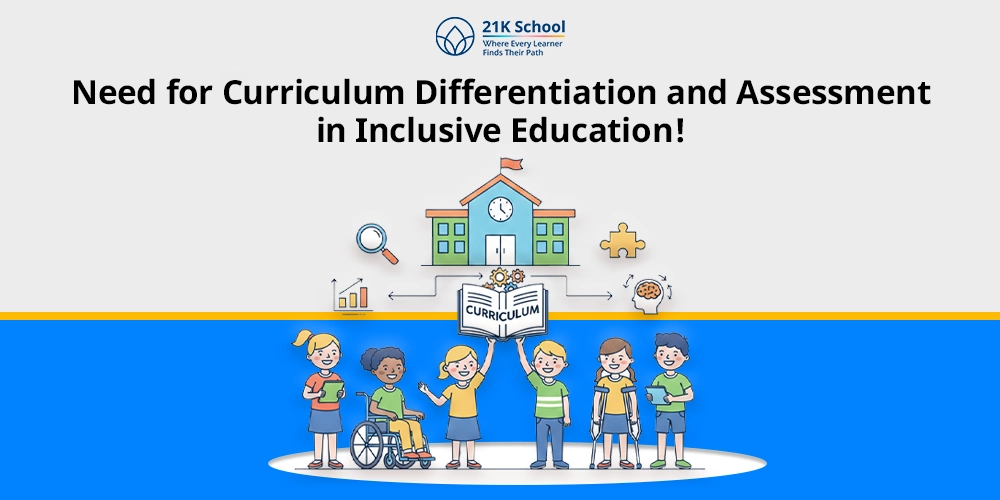
In this article, our aim is to make you understand the need of inclusive education leveraging differentiated instruction and assessment. We will also be looking at their multiple types of these facilities.
Table of Contents
What is Inclusive Education?
Inclusive education is a system where students from varied backgrounds, abilities, language variations, cultural affiliation, needs, and learning systems study under the same roof.
Inclusive education denies segregation and embraces equality.
The main aim of inclusive education is to eliminate any limitations to learning and give personalized assistance through special education provisions to whosoever wants it.
Such that the classroom environment, the teaching methods, the curriculum development process, and even the assessment practices can suit the diverse learners.
Need for Curriculum Differentiation in Inclusive Education
Differentiated curriculum is the need for diverse learning students. It comes with the understanding that they are learners who need different kinds of learning plans and syllabus to execute their best potential.
1. Addressing Diverse Learning Needs
Inclusive classroom students differ considerably, in regard to preparation, previous knowledge, learning tendencies, and intellectual abilities.
There are those who may need additional scaffolds and others who need enrichment or challenging learning activities through differentiated learning approaches.
The concept of differentiation will ensure that the work is not too difficult, or the other way around.
So that all students are able to work according to their own pace, and still manage to reach the same necessary learning outcomes.
2. Ensuring Accessibility of the Curriculum
A comprehensive curriculum should also be open to students with any disabilities, communication challenges, and learning blocks.
Teachers can easily adjust the curriculum with simplified texts and assistive gadgets so that all students can learn.
This might create a sense of acknowledgement and fairness in learners, including those with learning disabilities.
3. Promoting Student Engagement and Motivation
When the young learners are confident that their differing curriculum is as per their learning abilities and needs, they feel more likely to be successful.
Differentiation instruction offers a broad range of learning opportunities, and thus allows teachers to integrate diverse activities and styles of learning.
Students who are active usually have better attendance, discipline, and performance.
4. Encouraging Inclusion and Participation
Differentiation helps provide a feeling of belonging since none of the students are left behind.
Every learner gains social skills and good relationships when they can meaningfully contribute to the learning processes without hesitation.
This builds on the inclusive classroom atmosphere and assists in eliminating the stigmatization of learning differences.
5. Supporting Holistic Development
Differentiation in curriculum is more than just academic study.
All areas of growth like physical, social, emotional, and cognitive development can be encouraged with differentiated curriculum in varied learners.
For instance, self-regulated learning and creativity may be developed in independent projects, while communication skills can be developed in group work.
6. Aligning with Universal Design for Learning (UDL) Principles
UDL underlines various ways of representation, interaction, and expression.
Curriculum differentiation agrees with UDL by providing teaching facilities and evaluation techniques that are flexible to accommodate the diverse learners.
Planning ahead enables teachers to minimize the use of retroactive changes to make learning more inclusive from the start.
Types of Curriculum Differentiation
The curriculum differentiation can be divided in the following categories for easing the process of differentiated curriculum development and implementation.
1. Content Differentiation
Content differentiation entails alteration of student learning resources.
This may include modified texts according to readers’ level, using videos, hands-on activities, and other tasks based on the learner’s needs and abilities.
It also guarantees the students get the same course but at the level that they understand.
2. Process Differentiation
Process differentiation is the way in which students learn or handle the content for studying.
The teachers can distinguish on the basis of different elements of instruction including cooperative learning, inquiry-based learning, or even direct instruction.
This can also offer options in learning tasks like providing scaffold activities or adjusting the pace of lessons to support slow learners.
This favours children’s differences in their learning styles and preferences.
3. Product Differentiation
This entails differentiating the ways of exhibiting learning among students.
Examples include projects, presentations, or models, referred to as written reports or even online creations.
This can give the students a choice of formats that suit them and achieve learning goals with different expectations.
Product differentiation aims to support different abilities and promotes creative thinking.
4. Learning Environment Differentiation
The learning conditions involve physical, social and emotional components of the classroom.
Differentiation can be executed by providing more flexible seating, offering sensory zones as part of student centered learning approaches, and promoting cooperative learning based on the needs of the students.
Developing comprehensive and non-judgmental classroom conditions is another component to favour student-engagement.
A favorable environment in classes can improve the health and learning of learners.
Need for Inclusive Assessment in Education
Along with what different children learn from differentiated curriculum, we should also put emphasis on inclusive assessments.
Without inclusive assessments, we won’t be able to judge the students’ performance and needs well.
1. Fair Evaluation of Student Abilities
Conventional measures are unable to always assess student disabilities and diverse student needs.
Inclusive assessments take into account the accommodations and alternative format.
Such an evaluation of the student shows their actual comprehension.
2. Identifying Strengths and Learning Gaps
Inclusive assessment assists teachers to know what strengths students have, where they are weak, and what they need for getting the best possible support.
This data is essential in developing differentiated instruction and one-on-one learning plans.
The benefits of such measures is that they reduce the learning gaps of children who face problems in inclusive education settings.
3. Supporting Effective Curriculum Differentiation
Assessment and differentiation are inseparable.
Based on the assessment data, teachers make judgments concerning categorization, altering tasks, or changing the teaching strategies.
Differentiation would not work without an inclusive assessment.
4. Enhancing Student Motivation and Self-Understanding
The students who get positive feedback and know their progress, become more active to be self-regulated learners.
Holistic evaluations are promoting aspirations along with some reflection.
5. Ensuring Accessibility and Removing Barriers
Examples of accommodation used in inclusive assessment include more time, use of alternative forms of questions, use of assistive technology, or use of oral answers.
These changes eliminate obstacles that are irrelevant in learning outcomes providing equality.
6. Aligning with Inclusive Classroom Practices
Evaluation should be in line with the diversity and flexibility that exist in inclusive teaching.
It must appreciate many styles of exhibiting learning and focus on improvement as opposed to comparing with others.
Forms of Inclusive Assessment
The inclusive assessments that can be utilized easily for holistically evaluating the learners are as follows:
1. Formative Assessment
Formative assessment involves checking on their understanding levels and giving ongoing feedback during instruction.
Examples can be exit tickets, observations, quizzes, and student-teacher discussions.
It assists in making instant educational changes before the final test and facilitates lifelong learning.
2. Summative Assessment with Accommodations
Summative assessment occurs as the result of a term or unit learning.
Accommodation in an inclusive environment can include extra time, layman language in instructions, use of technology, or other modes of responses (oral responses or diagrams).
This allows educational equity and access to all students to perform well in their exams.
3. Portfolio Assessment
Portfolio is the collection of the successful works of a student throughout their studies, demonstrating the progress, strengths, and achievements. Learn top 12 creative portfolio ideas for students.
They enable the students to showcase their learning in various ways that stimulate reflection and ownership.
4. Performance-Based Assessment
Real world tasks of students include skills such as experiments, drama-plays, projects, and presentations.
Such tests suit a variety of learners, who might not depict their strengths in open-ended tests.
These assessments can truly evaluate a student’s overall performance through their critical thinking skills, creativity, decision-making, and problem-solving.
5. Self and Peer Assessment
The techniques used in self and peer assessment create responsibility, metacognition, and social skills.
Learners get to analyze themselves, through self-study practices their achievements, and work, as well as to recognize multiple perspectives on their progress through their peers.
Benefits of Curriculum Differentiation and Inclusive Assessment
Changes in curriculum and assessment after understanding differentiation and the importance of inclusive education can reap out multiple benefits.
These are:
1. Promotes Equity and Social Justice
Diversity in curriculum and non-discriminating evaluation will provide every learner with equal opportunity to learn, engage, and perform.
They minimize system-wide biases to bring equity.
2. Improves Academic Outcomes
When teaching resources and evaluation methods are aligned with student needs, their engagement and success comes in handy.
This means that learners advance and memorize more easily for academic challenges.
3. Supports Diverse Learners Effectively
Both differentiation and inclusive assessment are able to meet the needs of the students with learning disabilities.
These can be language limitations, special abilities, and students with social-emotional learning challenges.
4. Enhances Teacher Effectiveness
Teachers can become better in teaching multiple students with varied needs through differentiated instructions and inclusive assessment, understanding the key difference between teaching and training.
They may get talented in organizing student-learning and enhance their instructional planning.
5. Creates Inclusive Classroom Culture
In a classroom having a positive learning environment, differences can be appreciated, accepted, and promoted through collaborative learning.
Students are taught to support and respect each other while growing into their successful selves.
Conclusion
Inclusive education includes curriculum differentiation and inclusive assessment as well.
They make sure that all learners regardless of their background or abilities can study and portray their learning in just and diverse ways.
Teachers can provide an avenue within which every student can succeed. Especially through adoption of flexible teaching approaches, various forms of assessment, and equal practices.
Finally, these strategies contribute to the development of an educational system that will respect the diversity of humanity, encourage equity, and endorse lifelong learning.

You may also want to read