

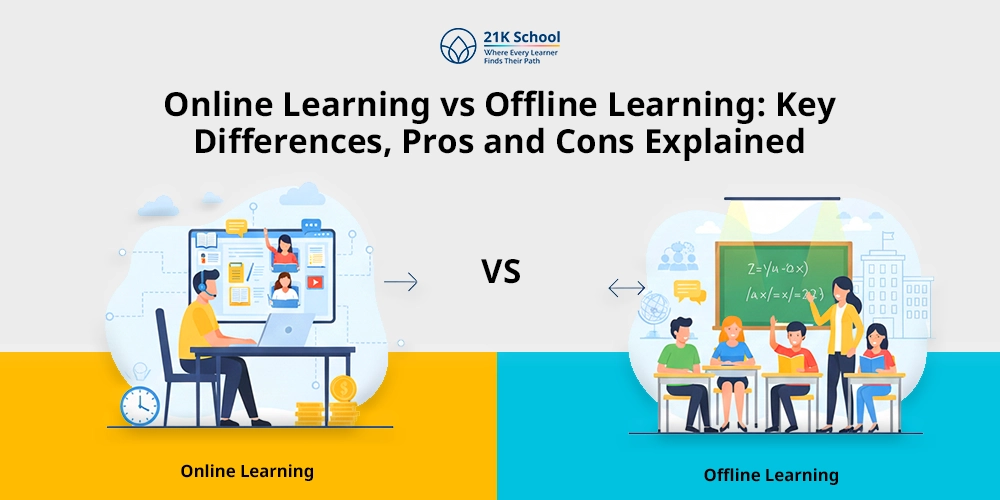
With time, education is evolving from traditional classroom learning to e-learning.
Today’s digital learning has made the learning process easily accessible, and from anywhere in the world without disturbing your time and schedule.
Meanwhile, when online learning provides flexibility and accessibility, offline learning offers a deep understanding of a structured curriculum.
Both the learnings have different challenges, benefits and competence. So, to understand them in detail, we need to classify them in terms of their flexibility, cost effectiveness and learning process.
Let’s discover how online learning is different from offline learning and what makes each feature valuable in today’s educational domain.
Table of Contents
Key Differences Between Online and Offline Learning
Given below are the key differences between online learning and offline learning.
| Sl. No. | Features | Online Learning | Offline Learning |
| Learning Mode | The learning mode of online learning includes digital platforms, lecture videos, and e-learning tools. | While the learning mode of offline learning includes face-to-face interaction in the classrooms. | |
| Interaction | Interaction is quite personal via video calls, chats, or e-mails, etc. | Interaction is direct on the spot in the classroom between the teachers and students. | |
| Flexibility | Extremely flexible; and students can access learning from anywhere and anytime. | Fixed schedules; and students can only attend by being physically present in classrooms. | |
| Learning Experience | Engaging digital learning materials, which make learning fun and interesting. | Encourages cooperative and experiential learning via different teaching methods. | |
| Technology Dependancy | Depends on internet connectivity and online services. | Depends on physical materials like notes and books. | |
| Assessments | Arranged via online assignments, quizzes and smart grading systems. | Arranged via written exams, oral tests, and practical exams. | |
| Cost Effectiveness | Some affordable options are available which save time, travelling and material costs. | Often costlier because of infrastructure, books and transportation costs. |
1. Learning Mode
Online Learning: It happens through virtual mode via digital tools like animated video lectures, e-learning courses, and online apps.
Offline Learning: It is done in a physical mode, where students need to attend the classroom and teaching is provided by physical interaction.
2. Interaction
Online Learning: In online learning personal interaction such as students one-on-one interaction, is possible through video calls, chats and virtual classroom discussions.
Offline Learning: While in offline learning direct interaction is performed between the students and teachers in the classroom. This makes learning more collaborative.
3. Flexibility
Online Learning: In an online learning approach, students are able to learn at their own pace and offer accessibility to all kinds of online learning materials.
Offline Learning: But, offline education follows a structured and disciplined schedule. It requires the physical presence of learners in the classroom for a particular time duration.
4. Learning Experience
Online Learning: With the help of digital multimedia resources and tools learners can better understand the concepts.
Offline Learning: In traditional offline education students get real-time hands-on learning experiences, improves teamwork and fast guidance from the facilitators.
5. Technology Dependency
Online Learning: Online learning needs digital devices and stable network connectivity to learn efficiently.
Offline Learning: Offline learning needs physical study guides like textbooks, notes and teachers’ guidance.
6. Assessment
Online Learning: In online learning, assessments are performed through digital tests, assignments and smart-grading systems.
Offline Learning: While in offline learning, assessments are in forms of exams, tests, practical and experimental exams and teachers’ feedback.
7. Cost Effectiveness
Online Learning: Online learning is affordable as the cost of travelling, save time, and lodging is less and minimal. However, not all the time it depends on various factors.
Offline Learning: Offline learning is expensive because of high institutional fees, learning materials, and tangible infrastructures. However, learners have options to choose from different schools based on budget.
What is Online Learning?
Online learning is a popular educational mode that helps students easily access lessons, lectures, and study materials via digital tools.
Online learning offers important benefits including flexibility in learning, access to a wider range of courses, and the opportunity to develop 21st century skills from anywhere.
Also, discover why online learning is also ideal for special needs students.
Features of Online Learning
Below are the key features of online learning:
- Learners can access from anywhere and anytime.
- Students use e-books, recorded video lectures, and quizzes.
- Students can learn at their own pace with less distractions.
- Get instant feedback.
- Use of free applications Google Classrooms, Zoom, or Moodle.
Advantages of Online Learning
There are various benefits of online learning. Some common key points are:
1. Technological Skill Development
Through online learning students can improve their digital literacy. Here, the student attends online classes, submits assessments digitally and learns how to use digital applications.
These things improve the problem-solving skills and critical thinking skills of the students.
2. Cost-Effective
Cost-effective is one of the essential yet important factors of online learning. It reduces the expenses of travel, transportation, study guides and saves time.
Most of the online learning portals offer lower tuition fees to make learning and education accessible for every individual.
3. Flexible and Convenient
Online learning offers students the opportunity to learn from anywhere and anytime without disturbing their work-life or personal life balance.
It is also effective for the senior citizens, children with special needs, and homemakers to continue their left-out education.
4. Access to Global Resources
Online learning connects students with teachers virtually and also with global resources.
Students can access the lectures from any top organisations, attend professional webinars, and easily interact with their peers worldwide.
What is Offline Learning?
Offline learning is an educational process that is performed in physical classrooms.
It is also termed as traditional learning or face-to-face learning which includes direct interaction of the students with their teachers and peers.
Features of Offline Learning
Below are the main features of offline learning:
- It provides physical interaction with the teachers.
- It is a fixed classroom with particular study hours and scheduled routines.
- It implements the use of physical study materials such as textbooks, notes.
- It helps the students to get involved in the extra-curricular activities that are being organised in the school.
Advantages of Offline Learning
Given below are some of the key advantages one must know before taking offline learning.
1. Better Discipline and Structure
Offline learning helps in improving students’ time management skills.
With the help of a fixed routine, students can concentrate and become punctual, disciplined, and responsible so that they can be successful in their future.
2. Improves Social Interaction
It promotes physical interaction with their peers and teachers, which improves teamwork, and communication skills, critical thinking skills, and problem-solving techniques.
3. Instant Feedback and Guidance
In offline classroom learning, teachers are capable of noticing the areas of difficulty faced by students and they provide immediate suggestions.
This helps the students to keep a constant improvement in their academics.
4. Focused Environment
A classroom setup decreases the disturbances and helps in improving the concentration and focus on studies.
As the students’ activities are being observed by the teachers, this helps in better memory retention and clarification of concepts.
Conclusion
In the 21st century, both online and offline learning are important in students’ lives. By understanding the difference between online learning v/s offline learning one can ensure lifetime learning opportunities.
Online learning helps in encouraging flexibility, availability, and virtual awareness. One can also explore the impact of online learning on students.
While offline learning reinforces management, relationships, and discipline among the students in the classroom.
One should choose the desired learning method to achieve short-term goals and long-term goals.

You may also want to read