


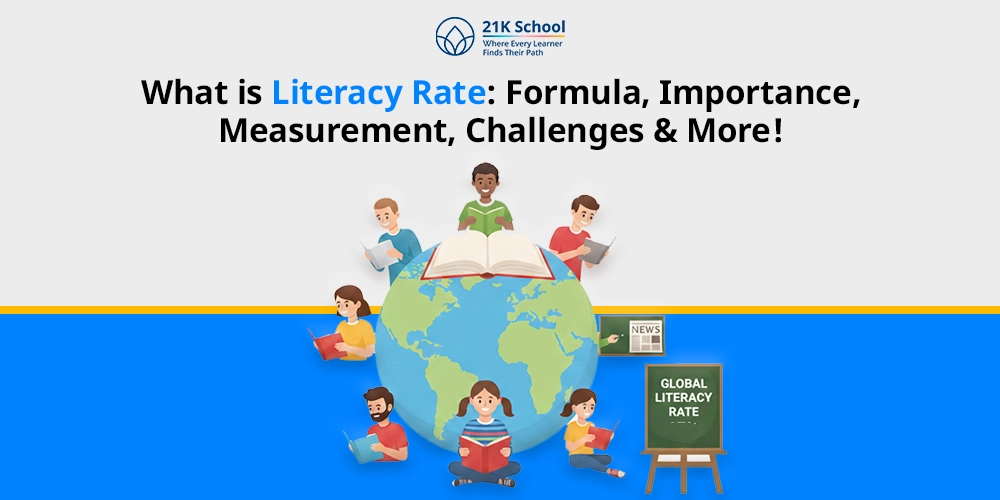
Do you also think that being literate is something tough like knowing a lot of things or being a genius?
Well, that’s not true. Being literate is simply about being able to read and write simple sentences.
Literacy rate suggests what percentage of people in an overall population can read and write after a certain age.
The trends of literacy rates have mostly been better in the last few decades, still some countries and regions face poor literacy rates, and thus poor development rate.
In this article, we will learn everything about literacy rate, including its usage, challenges, strategies, formula, and what not.
Table of Contents
- What is Literacy?
- What is Literacy Rate?
- Formula for Literacy Rate
- Literacy Rate: An Overview
- 4 Types of Literacy
- 5 Importance of Literacy Rate
- Relationship Between Literacy Rate and Human Development
- 3 Methods of Measurement of Literacy Rate
- 4 Factors Affecting Literacy Rate
- 5 Common Challenges in Improving Literacy Rate
- 4 Strategies to Improve Literacy Rate
- Relationship Between Literacy Rate and Sustainable Development
- Future of Literacy Rate
- Concluding It All
What is Literacy?
Literacy is the capacity of a person to read and write any language.
Traditionally, literacy was considered to be a simple way to know if a person knows how to read a sentence or write their name.
However, the definition of literacy has extended over the years. Its meaning has now shifted to comprehension, communication, and applying written information in the real world.
Literacy helps people to learn on their own, make calculated decisions, and cope with the social and technological transformations.
It has been the core of education and lifelong learning, which has a significant contribution to the personality, confidence, and social involvement of a person.
What is Literacy Rate?
Literacy rate is a statistical measure used to show the percentage of the population who are literate.
Literacy rate in most countries is computed among individuals aged seven years and above, although the age bracket may be slightly different depending on national definitions.
In simple words, literacy rate demonstrates the number of individuals in a society who have simple skills to read and write intelligently.
It is among the most frequently used indicators to determine educational development, human capital formation, and social progress.
Formula for Literacy Rate
Simple formula used to compute literacy rate is:
Literacy Rate (%) = (Number of literate people of 7 years age and above/Total population of 7 years age and above) x 100
This formula is different from the international standard of 15+ years.
The percentage obtained with the help of this formula helps to compare the literacy level in regions, states, or countries in a straightforward manner.
Literacy Rate: An Overview
Literacy levels in the world have increased tremendously in the last few decades because of increased access to education, mandatory laws to attend school, and global development programs.
Though, the process has not been uniform, and there are still great differences between developed and developing areas.
1. Literacy Rate in Developing Countries
The developing nations have come a long way to enhance literacy, mostly at the primary level of education.
International help, government programs, and non-governmental organizations have been significant in increasing equality for access to education.
In spite of these developments, there are still numerous challenges that affect most developing countries.
This includes poverty, inadequate educational infrastructures, shortage of teachers, high level of dropouts, and social hindrances.
It is surprising to know, but 87% of illiterate youth are from South-Asia, Eastern and Southern Africa, and Western and Central Africa.
The adult population, marginalized people, girls, and rural areas have a low level of literacy as opposed to the urban population.
2. Literacy Rate in Developed Countries
While many developed countries have rates near 99%, OECD members as a group had a 97.18% literacy rate in 2020.
These are brought by universal access to schooling, well developed education systems, and high levels of investment in education by the population.
These countries show that the emphasis has moved the population from attaining basic literacy towards getting the higher level of skills like critical thinking and digital literacy.
Innovation, research, and economic competitiveness are supported by high literacy rates.
Literacy Rate in India (Illustrative Perspective)
Since independent times, the literacy rate of India has been experiencing a gradual increase.
Recent reports show that from 2011 to 2023-24, there has been a shift of literacy rate from 74.04% to 80.9%, which is appreciable. It is crucial to note that these are Census 2011 figures versus PLFS 2023-24 figures.
This is due to the access of primary education, adult literacy schemes, and constitutional changes in favor of education.
Programs like NEP 2020 and RTE Act have targeted at providing universal enrollment and retention have led to better literacy achievement.
There is still a disparity between states, sexes, rural areas, and urban areas.
The Chief Minister of Mizoram declared that Mizoram has become the first fully literate state of India with 98.2% literacy rate, while states like Bihar and Andhra Pradesh still lag behind.
Such inequalities remain a significant concern in the planning and policy implementation in the education industry.
4 Types of Literacy
Literacy can be divided into the following types:
1. Basic Literacy
Basic literacy is the lowest level of literacy, which is defined as the simple ability to read and write simple sentences.
It allows people to carry out general daily functions like reading signboards, learning simple instructions, and writing simple information.
Basic literacy forms the base on which additional learning can be formed.
2. Functional Literacy
Functional literacy is an expansion of the simple exercises, and is concerned with actual application of reading and writing skills in everyday life.
The literate individual is capable of using literacy to function at the workplace, in finances, in understanding the official documents, and be an active member of the society.
3. Critical Literacy
Critical literacy is a skill of analyzing and questioning what is written.
It assists people to learn about different perspectives, spot bias, and make informed decisions.
This form of literacy is crucial in active citizenship and democracy.
4. Digital Literacy
Digital literacy refers to the capacity to use the digital tools and technologies, including computers, smartphones, and internet to access and distribute information.
Digital literacy in the contemporary world has become an inseparable aspect of literacy.
5 Importance of Literacy Rate
Literacy rate is vital to calculate for any nation because it shows:
1. Indicator of Educational Development
The level of literacy is a key measure of the level of education in a given nation.
High literacy rates show that the country has optimum education systems, having increased accessibility to schools and successful literacy programs.
2. Economic Growth and Employment
The employment rate and productivity are increased due to high literacy.
Educated people have higher chances of attaining skills like transforming themselves with technology and have better abilities to find future jobs in the 21st century.
Increased literacy levels lead to expansion of the economy and reduction in poverty.
3. Social Empowerment
Literacy is empowering as it provides people with the opportunity to speak, obtain information, and be a part of the social and political process.
It empowers democracy and enhances social inclusiveness.
4. Gender Equality
Gender equality requires people to improve their literacy, particularly women.
Literate women have better chances to be included in decision-making processes and to find a job.
This could guarantee better education and health results for their families.
5. Health and Well-being
Literacy enhances health awareness and outcomes.
Literate people are able to comprehend health-related information and get medical prescriptions, leading to healthier lives and have better well-being.
Relationship Between Literacy Rate and Human Development
There is a close relationship between literacy rate and human development.
Literacy is the key to human development as it provides people with the knowledge, skills, and awareness.
An increase in the literacy rate helps individuals to be able to access information that can make their lives better.
Literacy has a direct effect on aspects of human development like health, income, freedom, and quality of life.
Better information on health-related practices, lead to better understanding of nutrition intake and other health decisions. The end result is reduced mortality and extended lifespan.
Literacy also improves employability and understanding of the job market.
The educated and literate individuals are able to gain some vocational and professional skills to adapt to the changes in technology and be able to contribute to the economical growth.
The more literate the societies, the less poverty and more inclusive development they have.
Literacy also empowers social development as it enhances equality, social cohesiveness, and democratic involvement.
It helps individuals to know their rights and obligations, express their views, and participate in the decision-making activities.
Thus, literacy is not just a goal related to education but also one of the key approaches towards better human development.
3 Methods of Measurement of Literacy Rate
Literacy rate is measured using the following three ways:
1. Census Method
The most used method of measuring literacy rate is the census method.
In the national censuses, people are questioned on whether they can read and write with understanding in any language.
The data obtained is then calculated to find the literacy rate of a country or a region.
This approach covers the entire population and gives opportunities to make comparisons between regions and time.
But, it is conducted through self-reporting which can in certain instances exaggerate the real state of literacy.
2. Surveys and Assessments
Literacy is measured using surveys and literacy assessments which measure it more precisely.
Such techniques entail the assessment of reading and writing skills of people by using standardized tools.
Not only basic literacy, but functional and critical literacy rates are also evaluated with the help of surveys.
These tests, though, give more extensive information on the quality of literacy, they are more time-consuming and expensive.
Consequently, they tend to be administered on smaller samples as opposed to the whole population.
3. Limitations of Measurement
The measurement of literacy is not easy.
Self-reported information might not measure actual competence, whereas rudimentary definitions of literacy might give no attention to technological and functional literacy.
International comparisons are also not easy due to variation of definitions, language, and ways of testing in different countries.
These constraints indicate the necessity of better and standardized measuring strategies.
4 Factors Affecting Literacy Rate
The literacy rate of a country depends on the following factors:
1. Access to Education
Availability of quality institutions is one of the best factors that decide the literacy level.
Access to schools, availability of trained teachers, educational resources, and safety measures have direct impacts on enrollment and retention.
Poorly infrastructured areas tend to have low literacy.
2. Poverty and Economic Conditions
Poverty can hinder literacy to a major extent.
Low income families might put more emphasis on getting jobs rather than on education, which causes school dropouts.
The quality of education also gets affected due to the economical instability. Literacy can be greatly enhanced by reduction of poverty and providing financial support.
3. Social and Cultural Factors
Attitudes towards education are highly shaped by social norms and cultural beliefs.
Some societies limit access to education, particularly girls, and the disadvantaged members, due to early marriage, child labor, or discrimination.
4. Government Policies
Proper government policies are needed for enhancing literacy.
The techniques that assist in increasing literacy include compulsory education laws, investment in school, teacher training programs, and adult literacy programs.
But, if these policies aren’t enforced properly, it may restrict progress.
5 Common Challenges in Improving Literacy Rate
Some common challenges that limit the increment of literacy rates are as follows:
1. Dropout Rates
High rates of dropouts, especially at primary and secondary levels, is one of the biggest challenges in improving literacy.
Students tend to drop out from school early due to financial pressures and unfavorable learning conditions.
2. Quality of Education
Being enrolled does not guarantee literacy.
The teaching methods, insufficient learning materials, and overcrowded classes decrease the effectiveness of the education given.
This deprives the students of the opportunity to get good literacy skills.
3. Adult Illiteracy
There is also the lack of adult illiteracy particularly in developing areas.
In developing countries, many students drop out from schools early to work for jobs and earn money without getting a higher level of education.
This decreases their chances to advance and land on high-paying jobs, thus increasing the literacy rate.
4. Lack of Access to Education
In the rural places, schools are still very far away.
Long distance, unsafe travels, lack of infrastructure, and accessible facilities do not allow many children to attend school on a regular basis.
This discourages the children and their families from gaining literacy.
5. Gender Differences
In some areas, gender inequality has also impacted the level of literacy.
The prejudices of doing household chores, child marriage, or other cultural constraints can prove to be a barrier for girls.
To have universal literacy, it is important that these gender differences are addressed.
4 Strategies to Improve Literacy Rate
We can enhance the literacy rate by following the below mentioned strategies:
1. Universal Access to Primary Education
The best method to enhance literacy levels can be by providing quality primary education to everyone.
When a child gets education from an early age, they can learn basic reading and writing skills from then only, which would continue as a lifelong process.
This is why governments are focused on providing free and mandatory primary education, upgrading school facilities, hiring qualified teachers, and offering safe and inclusive learning conditions.
Reducing dropout rates by incentives, mid-day meals, and scholarships can also help in improving the overall literacy rates.
2. Adult Literacy Programs
Adult literacy programs play an important role in reducing illiteracy among the older population who lack formal education.
These programs aim at training in basic reading, writing, and numeracy skills to these older groups.
Providing adult literacy brings confidence and employability at the individual level.
But, when adults get literate, they get aware about the importance of school, which makes them to send their child to schools further and get education in the family.
Community-based literacy centers and workplace literacy initiatives are efficient approaches to adult literacy.
3. Use of Technology
Technology has become an effective means of enhancing literacy levels, particularly in far and inaccessible regions.
Education becomes more accessible and interactive due to digital learning platforms, mobile applications, online classes, and audio-visual content.
Technology can also assist in addressing the challenges of lack of teachers or physical schools, and enable learners to learn at their own pace.
Technology can be used to teach basics as well as digital literacy.
4. Community Participation
Community participation plays a vital role in increasing the literacy rate of a region.
When parents, leaders, and local organizations are actively involved, they understand as well as transfer the importance of schooling to their families.
The community support is seen to provide assistance in ensuring school attendance and lesser dropouts, motivating adult learners to enroll in literacy programs.
Literacy initiatives are easier to sustain and effective through a supportive social environment.
Relationship Between Literacy Rate and Sustainable Development
Sustainable development is closely related to literacy rate.
Literacy trains people to make better choices regarding health, education, work, and environmental practices.
Literate people can better align themselves towards sustainable living, learn about environmental factors and promote sustainable development goals.
Literacy also helps in reducing poverty and in encouraging gender equality and economic growth which are pillars of sustainable development.
Literacy allows people to get access to information and opportunities to make inclusive and tolerant societies.
So, it is critical to enhance literacy rate to acquire sustainable development at national and global levels.
Future of Literacy Rate
Literacy will be diversified in the future to include digital media and information literacy along with simple reading and writing.
Since technology will be a more practical part of our everyday life, citizens will need skills to use digital tools and other information critically and responsibly.
The education system needs to change to put emphasis on quality learning, lifelong learning, and advanced skills.
The aim of universal literacy is common as in India’s 2030 goal.
The future of literacy counts on increasing literacy rates along with acquiring the latest literacy skills.
Concluding It All
Literacy rate is the percentage of people who know how to read and write at the age of 7 or beyond.
The development of a nation is highly dependent on the literacy rate of that nation because it enables people to do basic things in their life and encourages education in their families too.
Though challenges like lack of teachers, poor infrastructure, cultural limitations, and lack of awareness hinders in increasing the literacy rate, it can be increased with proper strategies.
Basic literacy and primary education is made compulsory, and this has proved beneficial in improving the literacy graphs of multiple nations.

You may also want to read
CBSE Passing Marks Out of 100: Theory, Practicals & Grading

- Last updated on: 13 Mar, 2026
- 6 min read