


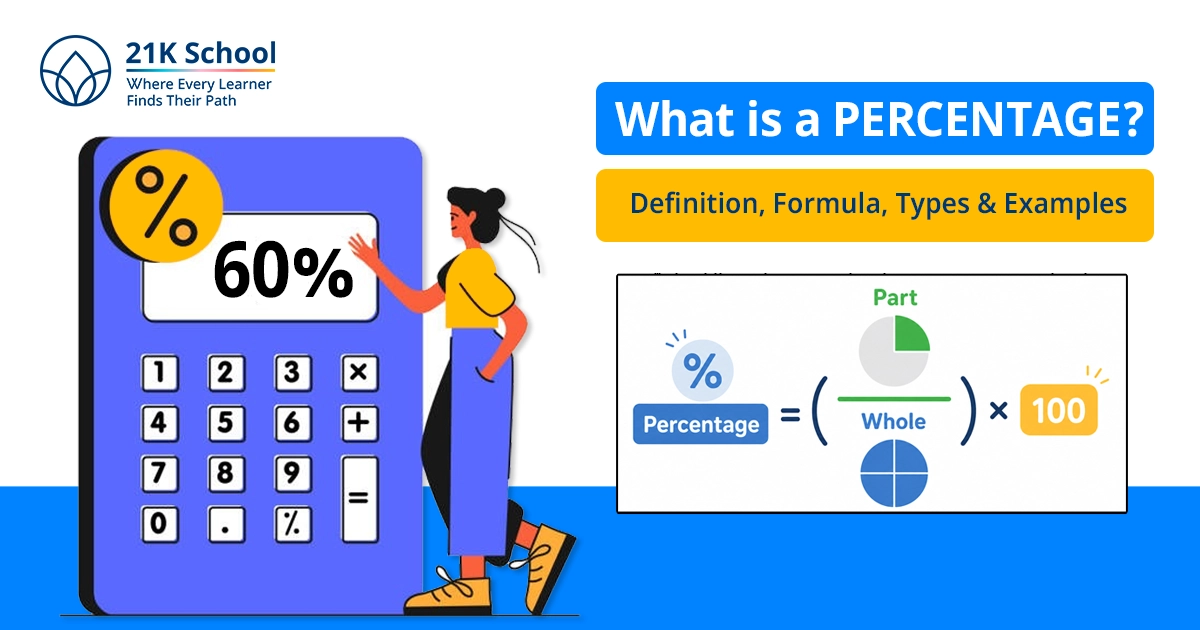
Have you ever wondered, “What is percentage” and how it can be defined in simple language?
Percentage is a unit of measure that represents a numeric value as a part of the total (100). We will learn so much more about percentages and how they are applicable in various areas of our lives in the following article.
You should read the piece till the end to know the mistakes that we make while calculating percentages.
Table of Contents
- What is Percentage?
- Percentage Formula
- Understanding Percentage with Solved Examples
- Conversion Between Percentage, Fraction, and Decimal
- 4 Types of Percentage Calculations
- Difference Between Percentage and Percentile
- Percentage Calculator
- 7 Areas of Application of Percentage
- 7 Advantages of Using Percentages
- 5 Common Mistakes While Calculating Percentages
- Final Comments
What is Percentage?
Percentage, in maths, is a pure numerical value that shows a part out of 100. The word percentage comes from Latin words “per centum”, which means “by hundred”.
It is often symbolised by the sign ‘%’, or written shortly as pct. or pc.
Percentage is represented in the form of decimals, ratios, or fractions depending on the part of the given whole.
For example, when we say the passing marks in science are 33%, it means that you need to score at least 33 marks (part) out of 100 (whole).
Percentage Formula
The simple method or formula to calculate the percentage is by taking the part unit and dividing it by the whole, and then multiplying the resultant by 100.
Percentage = (Part/Whole) * 100
Consider a general example where you have to find 20% of ₹80. For this, you will have to divide 20 by 80, which will be ¼, and then multiply the result by 100, which comes to 25%.
Understanding Percentage with Solved Examples
Let’s have a look at the following solved examples to understand the concept of percentages in a better way:
1. Finding the Part
If you got 90% in your final exams and the total marks were 600, what marks did you secure?
Answer: Secured marks = (90÷100) × 600 = 540
2. Calculating the Percentage
Now, we can reverse a similar case. If you know your secured marks are 450 out of 600, then how will you get the percentage?
Answer: The total percentage that you attained will be = (450÷600) × 100 = 75%
Conversion Between Percentage, Fraction, and Decimal
Percentages, fractions, and decimals are closely related, so you can easily convert one into another.
| Percentage | Fraction | Decimal |
| 5% | 5/100 | 0.05 |
| 5% | 1/20 | 0.05 |
| 10% | 1/10 | 0.10 |
| 20% | 1/5 | 0.20 |
| 25% | 1/4 | 0.25 |
1. How to Convert a Percentage into a Decimal?
You can convert a percentage into a decimal by dividing it by 100.
For example, you need to convert 35% into a decimal.
= 35 ÷ 100
= 0.35
2. How to Convert a Decimal to a Fraction?
To convert a decimal into a fraction, you will have to write the decimal as a fraction. For that, you need to remove the decimal point and write the numerator and denominator as given in the example below.
Example: 0.25 will be written as 25/100. Now, you will have to divide both the numbers (numerator and denominator) by the largest common factor. In this case, it will be 25.
After dividing the numerator and denominator by 25, your fraction will be ¼.
4 Types of Percentage Calculations
You will see that calculations related to percentages involve the following 4 cases or types:
1. Finding the Per cent of a Number
In this scenario, let’s take an example of 60% of 80. What will be the value that would represent this?
Formula: Numerical value = (60 × 80)÷100 = 48
2. Finding what Percentage is of Another
This method is used when you know the current value and the total value.
Formula of Percentage = (Current Value ÷ Total Value) × 100
For example, you get a score of 40 marks out of 100.
Then, the percentage will be equal to (40 ÷ 100) × 100 = 40%
3. Finding the Whole
In many cases, you might know the numerical value (part) and the percentage; you will have to find the whole.
The formula for calculating the Whole is (Part × 100) ÷ Percentage
Example: Find the whole if 6 is 30% of the whole.
= (6 × 100) ÷ 30 = 20
4. Percentage Increase or Decrease
Case 1: Percentage Increase
Consider a scenario where you missed the deadline of the sale that was on iOS, and now the rates have hiked to 76,000 INR from 70,000 INR. Here, the net increase will be ₹6,000 [76,000 (New price) -70,000 (Original price) = 6000].
Percentage Increase = (6000 ÷ 70000) × 100 = 8.58% approximately
Case 2: Let’s imagine a case where there is a drop in the prices of laptops. This will be the case of percentage decrease.
Formula of Percentage Decrease = [(Original Value − New Value) ÷ Original Value] × 100
The price of a laptop decreases from ₹60,000 to ₹50,000; then the calculated decrease will be ₹10,000
Therefore, the percentage decrease will be (10,000 ÷ 60,000) × 100 = 16.7%
Difference Between Percentage and Percentile
Many people confuse the two terms “percentage” and “percentile” with each other as both of them sound similar. Let’s look at the differences between percentile and percentage through a table.
| Criteria of Differentiation | Percentage | Percentile |
| Meaning | Represents a value out of 100 | Indicates the relative position of a value compared to others |
| Formula | (Value ÷ Total) × 100 | Based on ranking within a dataset |
| Purpose | Measures performance or proportion | Compares performance among a group |
| Comparison | Does not compare with others | Compares an individual’s score with others |
| Scale | Always out of 100 | Ranges from 1st to 99th percentile (or 100th) |
| Example | 80% means 80 out of 100 | 80th percentile means scoring better than 80% of the group |
| Used In | Marks, discounts, taxes, finance | Competitive exams like CAT, JEE, NEET, CUET, GATE |
Percentage Calculator
A percentage calculator is an online tool that calculates percentages or numbers derived from the whole and percentages.
It calculates:
- What is ____ % of ____ (total)?
- ____ is what % of ____ (total)?
- ____ is ____ % of what?
All you need to do is fill in the given blanks and get your answers related to percentages, parts, and their totals in seconds.
7 Areas of Application of Percentage
As mentioned earlier, there are many areas where percentages are applied. Let’s have a look at some of the major areas of application:
1. Education
Percentage has a pivotal role in the field of education as it helps in the evaluation of learners’ performance and institutional resources. Learners’ academic results and attendance are reported by educational institutions as a percentage out of 100%.
The success rate of varied institutions is also measured with their enrolment and dropout rates of children. And all of these are in the form of percentages.
2. Business and Commerce
Business and commerce use percentages to calculate all the discounts, profits, losses, taxes, etc. involved in business deals and transactions.
These figures, when presented as percentages, make it much more convenient to comprehend and compare monthly sales.
3. Banking and Finance
You will notice that banking and finance are the areas where percentages have a huge role. All things such as return on investments, GST, interest rates on loans, and savings rates include percentages and are expressed as such for easy interpretation.
Even bank employees and business owners utilise percentages to find depreciation of assets and tax liabilities in business meetings.
4. Healthcare
In the Healthcare sector, it is common to witness the use of numbers and percentages. They can be found on the checkup reports and CT Scans, for example.
The body composition displaying the density of blood and the presence of different cells in the blood are all reported in percentages and numbers. Since it brings convenience while comparing the required percentage with the actual, it is used widely.
5. Statistics and Research
Percentages are commonly applied to study statistics and research. You must have seen that the graphs where percentages represent proportions and probabilities are used in data analysis.
6. Sports
The players are assessed accurately with the help of percentages. Further decisions about the game and its succession are made based on the data derived from these percentages for comparison of players’ individual performance.
Even the accuracy of shooting, balling, fielding, etc. is computed precisely by utilising percentages to decide the final winners.
7. Everyday Life
Our everyday lives include calculating discounts, paying taxes, EMIs, loans, interests, and whatnot. These are all a part of applying percentages because without them, these calculations would be unfeasible.
Every purchase and even passing your classes requires an understanding of percentages and how they represent a part of the subject (whole).
7 Advantages of Using Percentages
Percentages are useful in almost all areas of human development. Note the following benefits of using percentages:
1. Make Comparison of Various Values Simpler.
It becomes simpler and faster to do calculations and decide which is greater than what with the help of percentages.
Percentages assess different quantities as relative to 100. This is why they can be used to compare varied economic information, test scores, and any other data in daily life.
2. Standardised Way of Expressing Ratios
We know that percentages are a representation of ratios. They give a standardised form to ratios since all of them are converted to fractions whose denominator is common, which is 100.
This simplifies the comparison of different ratios, so that they can be evaluated wisely.
3. Easy to Understand and Interpret
Percentages are easier to understand and interpret than fractions or ratios that do not have a common denominator. This is why percentages are preferred over all other forms of percentages.
Even complex information, when represented as percentages, is comprehensive without involving tough maths or calculations.
4. Widely Used
Percentages are used widely in almost all fields because they are needed to analyse and find differences between two dissimilar measures needed for the completion of a task.
As briefly mentioned above, percentages are applicable to mathematicians, scientists, researchers, scholars, daily taxpayers, and financial administrators. All of them require percentages to derive varied rates.
5. Assist in Making Informed Decisions
Percentages help with decisions because they compare different measurements as a part of 100, which defines the comparison more prominently.
For example, when we compare 4 out of 20 with 70 out of 100. Besides having varied parts and wholes, we can conclude that the former is 20%, while the latter is 70%. This makes the understanding of values simpler.
6. Improve Communication of Numerical Information
Percentages make communication of numerical information clear by comparing parts out of 100 alone. Groups of data reach proper conclusions when they are comprehended and grasped well.
These understandings lead to standardisation of raw scores and conclude as varied scores, risk factors, chances of growth, etc.
7. Analyse Trends and Performance
Using percentages, one can predict and analyse trends and performance in a growing business or administration. This is due to the relative scaling of the base score out of 100.
For example, during a sudden hike of 4000 more product sales, it enables us to analyse that it is 40% better sales in that particular month, thus giving comparable data.
These types of evaluation beforehand give the idea of which area needs to improve and how past decisions have impacted the present results.
5 Common Mistakes While Calculating Percentages
Though percentages are diverse in being applicable, there are some common errors that we commit while calculating them.
1. Forgetting to Multiply by 100
One of the most easily found mistakes while computing percentages is that we forget to multiply the fraction or decimal by 100. The part divided by the whole gives the decimal part, but does not represent the percentage. This can totally change the meaning and value of the resultant during the final analysis.
Taking one step further, ensure that you multiply the resultant by 100 and then recheck with the given scale. Multiplying the decimal product by 100 is simply moving the decimal point two times forward.
2. Using the Wrong Denominator
Another usual error that we commit is using the wrong numerical value as the denominator, which can totally change the percentage in the resultant.
This happens mainly in cases where we have to define the change from the previous trends, like increase or decrease. It is crucial that you remember that in these cases only the original value will be the denominator.
Avoid such mistakes by concentrating on the given data and understanding which is the part and which is the whole in a particular scenario.
3. Confusing Percentage Increase with Percentage Decrease
Apart from misrecognising denominators, you might also fail to get the desired outcome of percentages when you misunderstand whether the given data is for percentage increase or decrease.
This is inevitable if you mix the start and end values. Many people also use the wrong sign while calculating the difference in previous and later values, which can change the whole percentage output.
So, please keep in mind the original data and see if the final data has increased or decreased and then do the final calculation.
4. Misplacing Decimal Points During Calculations
Many times, while dividing the upper value by the denominator, we might need to put a decimal point. This decimal point can be wrongly placed because you were in a hurry.
This can lead to wrong outcomes. Therefore, pay attention during division and multiplication of fraction numbers.
Final Comments
In simple terms, a percentage is a value that is a part of 100. Without it, comparison between two different companies, learners’ performances, discounts, etc. would be impossible to measure.
But a few casual mistakes can totally change the picture of these comparisons and overall analysis of the results. So, try to pay attention while doing these calculations and reading the given data.
