


Since we have known our schools and education systems, we have also been aware of exams. These exams mostly are taken in two ways-formative and summative.
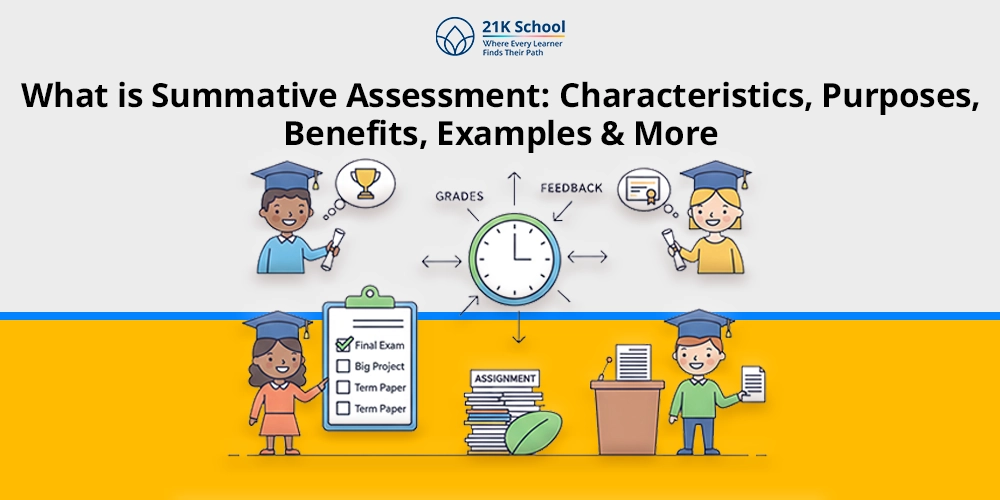
Here, summative assessments are the final exams taken after multiple formative tests, at the end of the term.
It gives learners their final performance at an academic level.
This article will entail everything you need to know about summative assessment, their characteristics, benefits, types, limitations, and much more.
Table of Contents
What is Summative Assessment?
Summative assessment is a type of assessment that is done at the end of a learning period, say a unit, course, program or a school year.
It is utilized to evaluate the extent to which students have attained the learning objectives.
In contrast to formative assessment, which is continuous and is applied to give feedback in the learning process, the summative assessment is concerned with the final outcome.
Summative tests are high-stakes tests and they are often applied to give grades and certify competence, assessing the progression of students.
They are standardized to achieve fairness and uniformity.
6 Key Characteristics of Summative Assessment
Summative assessments are distinct to their key traits including:
1. Conducted at the End of Learning
Summative assessments are done after a term or course is completed.
They are meant to check the level of alignment with learning goals or achievement in the end.
Examples can include end of year tests or final exams.
2. Results Are Used for Grading
A characteristic attribute of summative assessment is that the outcomes are used to directly add grades for terminal assessment of students.
These results assist in establishment of academic ranks and credit-worthiness for proceeding to the next class or course.
3. Based on Defined Learning Objectives
The summative tests are well-established in line with the course objectives or curriculum standards.
They are used to gauge the level of outcomes obtained by students to grasp some important concepts or apply knowledge to solve problems.
4. Standardized or Uniform
Summative assessments tend to be given in a standard format.
Their grading procedures and scoring scheme is predetermined to eliminate any favoritism.
Standardized tests, therefore, employ the same criteria in comparing performance of multiple students.
5. High Stakes
In many cases, summative assessment has major implications.
Final exams can be conducted to identify if a student passed a course or even national standardized tests which can influence college placements or scholarships.
6. Evaluates Mastery, Not Progress
In contrast to formative, summative ones can assess what students have learnt after completion of a particular stage.
It is focused on mastery and competence at the end.
6 Top Purpose of Summative Assessment
Summative assessments were brought into the educational curriculum to serve the following purposes:
1. Evaluate Learning Outcomes
The main aim of the summative assessment is to determine how well the students learned the content.
It is an objective report of academic accomplishment.
2. Provide Accountability
Summative results are mostly accountable to students, teachers, and all other stakeholders.
They show whether the instructional objectives have been achieved and whether the learning methods are effective.
3. Support Student Advancement
All the course placements, graduation, or certifications are mostly based on the results of the summative assessment.
These assessments allow determining the readiness of students to proceed further in their career.
4. Guide Curriculum and Instruction
Summative assessments can be beneficial as they take place at the end of learning and provide useful data to be used in further planning.
Schools and teachers can utilize these student outcomes to implement changes to the methods of instruction or curriculum development.
5. Motivate Students
Due to the importance of the consequences, summative assessments tend to encourage students to learn and achieve good results.
High expectations foster a feeling of motivation to reach your ambitions.
6. Identify Achievement Gaps
Final outcomes reveal differences between the various sets of students and the learning gaps between them.
And, as the educators know that there are differences they can develop specific interventions or support programs.
8 Common Examples of Summative Assessments
The most common examples of summative assessments that you might have witnessed in your daily learning can be as follows:
1. Final Exams
Final exams are the type of summative assessments taken at the last to conclude a term or a course.
All the final-year exams or annual exams that we give in our schools and end of semesters include this.
2. Standardized Tests
Standardized tests are a major example of summative assessments as they are conducted at the end of a time-period for either college admission or placements.
These may be in the form of SATs, GCSEs, state-level examinations, or international exams like PISA.
3. Unit or Chapter Tests
Being smaller in size, compared to final exams, these tests mark the end of certain units or chapters.
They are devised to determine the knowledge of specific material taught in the class in that unit.
4. Final Projects
As students engage in a learning process, they put the cumulative knowledge of the course to generate a final product.
This could be in the form of a presentation, a research paper, or a portfolio.
5. Performance Assessments
Performance based assessments might involve students who can show their skills in science laboratory tests, in dance, in music, or in sports.
6. End-of-Year Grades
Summative assessment includes grades which provide an overview of the performance in final exams and projects.
7. Oral Exams
Oral exams are commonly taken before final written-exams during practicals in our schools and universities.
Invigilators assess your speaking abilities and quick response to grade you for final marks.
8. Capstone Projects
Generally, capstone projects are usually completed at the end of degrees, applying collaborative learning skills.
They compel students to extract the end knowledge of the course utilizing this knowledge in conducting research to solve real-world issues.
7 Best Benefits of Summative Assessment
Some most efficient functions of summative assessments might be the following:
1. Measures Overall Achievement
Summative assessments offer administrators the finest method to find what the students know.
This gives an educator certain data to assess mastery.
2. Motivates Students
Since the results are significant for going to the next level or accessing scholarships, students are motivated to work hard and do their best.
3. Helps Teachers Improve Instruction
Teachers can use the results of the evaluation to determine the areas that require reinforcement, thus, changing the teaching strategies to meet the requirements.
4. Ensures Accountability
Summative tests give evidence to the fact that teachers and schools are properly achieving set academic standards and learning objectives.
5. Provides Benchmarks
Results provide points of reference in comparing performance over time.
Due to this learners can make informed decisions to take exams further of either the local and national-level.
6. Supports Academic Advancement
Summative tests are used to check the level of preparation for further studies, after being a graduate or aiming for some other certification.
7. Helps Identify Strengths and Weaknesses
The results can be used to show where the students are doing well and where they need improvement or further assistance.
6 Limitations of Summative Assessment
Summative assessments are really good at practice, but still have some limitations that are mentioned below.
1. High Pressure for Students
Summative assessments can result in exam-stress and anxiety due to performance pressure.
This might be because students are well-aware that these assessments are high stakes that may impact their overall future.
2. Limited Feedback
Being at the end of term, summative assessment usually takes place when the student can no longer use the information to enhance the ongoing learning.
3. One-Time Measurement
One test might not always represent the real abilities of a student, and it becomes critical in case a student feels anxiety before tests.
4. May Encourage Rote Learning
Instead of acquiring deeper knowledge of a subject or bringing critical thinking ability, students can depend on rote learning (memorizing information) to just pass the exam
5. Not Inclusive for All Learners
Regular or standardized formats could be unfavorable to students with various learning requirements and abilities.
6. May Not Assess All Skills
Summative tests tend to assess academic knowledge without taking into account essential competencies like creativity, teamwork, problem-solving, and others.
Concluding Comments
Summative assessments are a crucial part of the evaluation system that give the end result of a studied course.
It can enable a student to move to their next academic level where they can learn more and finally be competent for future jobs in the 21st century.
It ensures that educators and administrators change their teaching methods when necessary, arising from the poor results of children in a school or college.
Besides many advantages, there are some limitations to summative assessments due to which students might feel anxious about their career.
But all of these come together and prove how summative assessment can foster quality education at every level.

You may also want to read