

Education is a powerful, purposeful, and systematic process through which students gain knowledge throughout their lives.
And the two major terms are aims of education and curriculum. Aims of education represents what society expects from its learners and to achieve these aims education requires a practical framework known as curriculum.
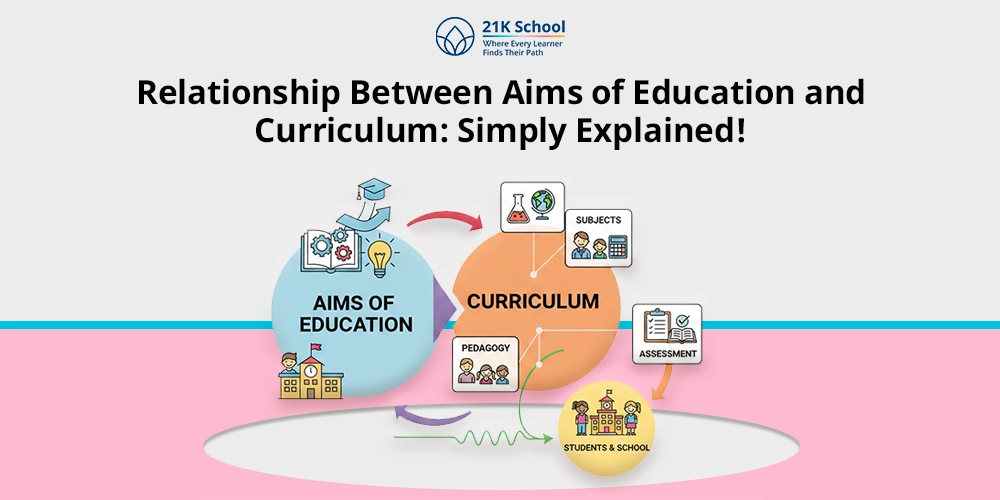
This showcases an effective relationship between aims of education and curriculum which help students to enhance their learning experiences.
To explore the relationship between aims of education and curriculum, benefits and challenges, let’s go through a detailed blog.
Table of Contents
What are the Aims of Education?
The aim of education simply means the specific goals or objectives which helps the education system to continue the process of teaching and learning without obstacles.
Some of the key aims of education are:
- intellectual development
- personal growth
- moral development
- social responsibility
What Are the Aims of Curriculum?
Curriculum is a structured set of learning experiences or activities which guides the education process in an academic year in institutions like schools and colleges.
The aim of the curriculum is focusing on overall learning objectives, educational philosophy, and skills development.
Key aims of curriculum:
- intellectual development
- personal growth
- social and cultural transmission
- citizenship
- skill acquisition
- holistic development
- adaptability
Relationship Between Aims of Education and Curriculum
For better understanding of the relationship between aims of education and curriculum, go through the following points:
1. Aims Determine the Curriculum
For curriculum development, the aim of education works as an initial point. That’s why before creating a curriculum it’s important to define what they want learners to achieve.
For example, including value education and ethical discussions in curriculum to fulfill the aim of moral development.
2. Curriculum Translates Aims into Practice
Curriculum translates aims into practice by implementing in the right ways.
For example, if one of the aims of education is to develop social responsibility then curriculum helps in implementation through group projects, community service etc.
3. Curriculum Selection Depends on Educational Aims
The curriculum selection depends on the aims of education to make education relevant and purposeful.
For example, selection of subjects, topics, and activities etc should be based on future goals.
4. Aims Provide Direction to Curriculum Development
Educational aims are crucial to guide curriculum objectives, teaching-learning strategies and assessment methods.
This ensures consistency and effective structure of learning.
5. Dynamic Relationship Between Aims and Curriculum
The relationship between aims of education and curriculum is dynamic in nature. Both evolve and adapt according to societal needs.
For example, technology integration in education to meet the needs of the digital world.
4 Benefits of Maintaining the Relationship Between Aims of Education and Curriculum
To understand the relationship between aims of education and curriculum go through the benefits:
1. Meaningful and Goal-Oriented Education
Curriculum aligned with aims of education is more effective and meaningful which offers goal-oriented education to learners.
This helps students to understand their learning objectives and contribution to development.
2. Improved Teaching Effectiveness
The relationship between aims of education and curriculum improves teaching effectiveness where teachers align lessons effectively.
By selecting the right techniques, resources, and assessments, teachers can contribute to learning goals.
3. Adaptability to Change
Including aims of education and curriculum help in meeting the requirements of 21st century learning.
This ensures education is not static, it is rapidly changing with the world.
4. Effective Curriculum Planning
Effective planning is helpful for better learning outcomes, and balanced development of learners for the long run.
4 Common Issues in Maintaining the Relationship Between Aims of Education and Curriculum
Given below are the common challenges or issues faced in maintaining the relationship between aims of education and curriculum:
1. Over-Rigidity in Curriculum
Over-Rigidity in Curriculum is one of the challenges faced by schools while implementing the aims of education and curriculum.
2. Changing Educational Priorities
With time educational objectives and societal needs change and evolve.
Frequent change in policies and curriculum can impact on students’ learning.
3. Lack of Clarity in Aims
One of the common issues that arise if aims are poorly defined can lead to confusion.
Clear aims are important to make curriculum effective and well-structured.
4. Implementation Gaps
A well-structured curriculum can also fail if it is implemented wrongly.
That’s why one should avoid lack of training, resources, or institutional support.
Conclusion
A clear understanding of the relationship between aims of education and curriculum ensures the success of any educational system.
Both work together to enhance students’ experience for lifelong learning. The aims of education and curriculum ensures that education fulfills its true purpose.

You may also want to read