

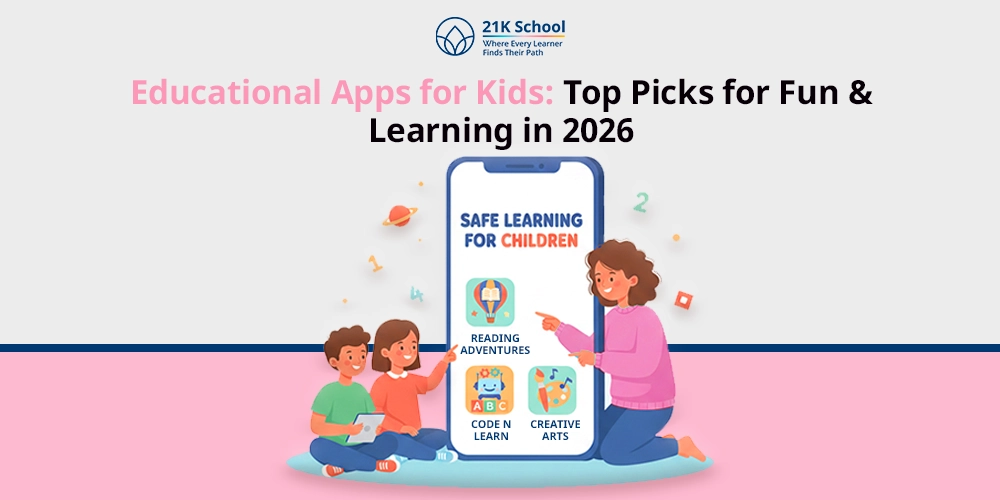
If you are a parent, you might feel concerned when your kid can’t learn some concepts like other kids do.
Well, you can find some educational apps that include fun learning and teach basic concepts, languages, coding, or arts simply.
In this article, we will look at some of the best educational apps that need to be downloaded for your child’s learning.
We will also understand why educational apps are this important, their types, and things to remember while letting your child use these apps.
Table of Contents
Why Educational Apps Matter for Kids?
Educational apps affect child’s overall cognitive development by offering the following:
1. Personalized Learning
Each child learns at a distinct rate. Some children comprehend things faster and some require more time and practice.
With educational apps, one can get a personalized education where the content is modified to fit the needs of the child.
A child practices and revises more with these apps, if the child is struggling with a topic.
If a learner is more intelligent, they can use these apps to excel to higher levels of learning.
Such an individual approach allows children to feel confident without stressing out much about others’ pace of learning.
2. Engagement Through Interactivity
Educational apps are also very interactive, which speaks for the amount of engagement they offer to kids.
Traditional approaches in learning can be boring and repetitious to young learners.
Educational apps have bright colors, sound effects, and interactive challenges to draw the attention of children.
Games, puzzles, quizzes, and rewards give children the interest to engage themselves in the learning process.
Children tend to be more attentive and learn for long periods as they enjoy the learning process.
3. Learning Wherever and Whenever
Through educational apps, children are able to learn even outside the classroom.
They can learn at home in their free time and improve their knowledge more interestingly
This flexibility can be particularly useful in strengthening the lessons that have been acquired at school.
Children are able to read or revisit concepts, practice or even get to know about something new.
Education is now more accessible since learning is not confined to a strict study time-table.
4. Multisensory Learning
Kids are in a better position to learn when they involve more than one sense.
Educational apps on mobile phones usually include graphics, audio, text, and physical touch.
This is a multisensory method that allows children to learn and memorize ideas better.
An example could be of a child who is learning letters. He can see the alphabet, hear how it is pronounced, and draw it on the screen.
This improves memory and appeals to various learning styles such as visual, auditory, and kinesthetic.
5. Building Digital Skills
Digital literacy is an essential skill required in this modern world.
Educational applications are useful in making children familiar with technology at a tender age.
They can get trained to use digital platforms and technological instructions on their own.
These skills won’t just be useful in gaining academic success, but also in career success.
Children are transformed into responsible and self-confident users of technology through educational apps.
Types of Educational Apps for Kids
Educational apps are of various types including:
1. Literacy and Language Apps
Literacy and language applications make children learn to read, write, hear, and speak.
Such applications usually pay attention to recognition of the alphabets, phonics, word-building, grammar, and sentence structure.
For small children, letters and sounds are presented in these apps in the form of a song or animation.
While for older children, they provide them with reading comprehension, spelling games, and storytelling tasks.
There are also some language apps that teaches foreign languages, allowing children to learn new words and phrases in an entertaining manner.
When you try for corporate jobs, you would be surprised to know the number of benefits of learning foreign language.
2. Math Learning Apps
The purpose of math learning apps is to make numbers simpler and more fun.
They educate the fundamentals which are counting, addition, subtraction, multiplication, and division using games and puzzles.
Blocks, shapes, and number lines are among some of the visual tools that assist children to learn abstract concepts.
Advanced math applications are also aimed towards problem-solving and logical thinking.
These apps allow children to enhance their accuracy and speed by practicing on a regular basis.
3. Science and Discovery Apps
Curiosity and exploration are inspired by science and discovery apps.
Children can learn about a variety of plants, animals, space, weather, the human body, and easy science experiments for young scientists.
Children are able to learn about science in a safe and easy way, through the use of animation videos and interactive simulations.
These apps can present the ability to observe and be critical while learning about the world around them.
4. Coding and Logic Apps
Coding and logic apps provide children with basic knowledge of programming and logic. These applications are frequently based on block-based code and puzzles, and have challenges in steps.
Children are taught how to provide instructions, identify patterns, and how to solve problems in a systematic manner.
Coding applications can be used to create problem-solving, creativity, and rational reasoning, which can be useful in different fields of study.
5. Creativity and Art Apps
Creativity and art applications provide the freedom of expression among children.
These applications consist of drawing, painting, music creation, animation, and story building applications.
With the help of creativity applications, children can discover their imagination, learn art and gain confidence in sharing ideas.
These applications also bring about better fine-motor skills and initiate creative thinking.
6. Life Skills and Emotional Learning Apps
Emotional learning and life skills applications are concerned with social and emotional development of a child.
They instill the values of being empathetic, kind, self-controlled, time-management, and a healthy lifestyle.
There are apps that contain mindfulness exercises, emotion recognition games, real-life scenarios, and so on to make children aware of feelings and relationships.
These applications aid in developing emotional intelligence and make children grow into stable personalities.
Key Features of Good Educational Apps
Educational apps would be considered good only when they have the following properties:
1. Age-Appropriate Content
The apps used in education should be based on the age and level of development of a child. Simple content can lead the child to be bored while difficult content can lead to frustration.
Age-specific apps apply applicable language, graphics, and activities that correspond to the level of understanding of a child. This guarantees positive and productive learning.
2. Clear Learning Goals
An effective learning application should have clear learning goals.
The child should know what he or she is supposed to learn, be it reading, learning maths, or problem-solving skills.
Defined objectives will assist every parent and educator to recognize the aim of the app and monitor the child’s progress.
3. Engaging Design
The design of an educational application is made to attract and engage students.
Learning becomes fun with the use of bright colors, user-friendly characters, easy navigation, and significant rewards.
But, the design should not distract the child with irrelevant games or useless animations, thus facilitating the learning process.
4. Progress Tracking
Monitoring learning of a child is also a significant attribute of progress tracking, which can be performed by parents and teachers.
Good quality apps would provide reports, scores or levels, which will improve over time.
This feature assists in finding the strengths and areas which require additional practice, so that they can be directed better.
5. Safe and Child-Friendly
The issue of safety is of primary concern with regard to children apps.
Preferable educational applications are those which lack offensive content and dangerous advertisements or links.
They also have parental controls, privacy protection, and security settings to offer a safe learning environment to children.
6. Offline Access (When Possible)
Educational apps should have good offline access, particularly in regions where there is low internet connection.
This would allow children to learn at any time without interruptions, with the help of apps that make it possible to download content.
Once the offline access is available, it would not cause any disruption on the screen and ensures a smooth learning process.
10 Popular Educational Apps for Kids
Though there are many apps for learning purposes, here are some of the most talked ones:
1. SplashLearn
SplashLearn is a popular education application that primarily deals with mathematics and reading among primary school students.
It utilizes interactive quizzes and lessons in the form of games to represent concepts like numbers, fractions, geometry, and basic reading skills.
The app can adjust to the level of learning of the child to provide individual practice and instant feedback, which assists children learn without any fear or pressure.
Official Link: SplashLearn
2. ABCMouse
ABCMouse is specifically created to suit the preschoolers and kindergarteners.
It provides a full early-learning course, which incorporates reading, math, science, art, and music.
The app consists of lessons, songs, stories, and interactive activities, following the sequence of learning steps.
Its systematic method contributes to the establishment of basic skills of small children.
Official Link: ABCMouse
3. Khan Academy Kids
Khan Academy Kids is a free and highly regarded educational app for kids.
It includes content on reading, math, social learning, emotional growth, and creative activities.
The app seems engaging because of its captivating characters, stories, and physical activities with which children are involved.
The app is easy to use since it has no advertisements and the teaching material is excellent.
It is therefore valued by the parents and teachers as well.
Google Playstore Link: Khan Academy Kids
4. Duolingo
Duolingo is a successful app used for learning languages. It helps children become acquainted with new languages in an easy and entertaining manner.
Through short lessons and games, it teaches vocabulary, sentence structure, pronunciation, and listening skills.
This app consists of rewards and levels, which motivate children to practice on a regular basis.
Google Playstore Link: Duolingo
5. Gus on the Go
Gus on the Go is a language application that is designed to assist younger children.
It trains children to get familiar with fundamental vocabulary of different languages using interactive stories, animations, and games.
It is simple to use for children who don’t prefer lesson plans, thus making learning languages easy and less stressful among new users.
Apple Appstore Link: Gus on the Go
6. ScratchJr
ScratchJr teaches little children the fundamental concept of coding and programming.
Children do not use complicated coding languages, instead they make animations, stories, and games using colorful blocks.
This app allows children to think rationally, be creative, as well as arrange blocks sequentially- skills valuable for solving their future problems.
Google Playstore Link: ScratchJr
7. Spell Stage
Spell Stage is aimed at advancing spelling and vocabulary.
Before moving ahead, read about how to improve students’ vocabulary.
Children would progress through different levels of game by spelling words correctly, making learning a game.
The app assists the children to know words’ patterns, develop language accuracy, and build a strong vocabulary through practice and difficulty levels.
Official Link: Spell Stage
8. Prodigy Math
Prodigy Math is about learning through adventure. To advance through the fantasy game world, children are challenged to solve math problems.
The app provides maths content depending on grade level and increases difficulty based on the performance of the child. This game-based strategy makes math enjoyable and free of fear or anxiety.
Google Playstore Link: Prodigy Math
9. Epic! (Ebook)
Epic! is an online reading solution that provides access to thousands of e-books, audiobooks, and instructional videos for young people.
It promotes reading by letting children select books that they like.
This app assists children to read independently, enhances vocabulary, and builds a reading habit that stays throughout their lives.
Here are some tips on how to develop reading habits in students.
Official Link: Epic!
10. BrainPOP Jr. Movie of the Week
BrainPOP Jr. Movie of the Week app assists children to understand new subjects with the help of short animated videos.
These subjects include science, math, health, and social studies. All of these videos are followed by quizzes and fun learning activities that reinforce the learning.
Complex concepts can be taught in a simple and easy way thanks to clear explanations and attractive pictures.
Official Link: BrainPOP Jr. Movie of the Week
5 Benefits of Educational Apps for Kids
Educational apps are a new approach towards kids’ learning that keeps them entertained and updated with the recent trends of education.
1. Boost Academic Skill
Students learn important academic skills like following a routine and time-management with the help of educational apps.
Due to the interactive learning options, these learners also become confident while expressing themselves in the classroom.
Education apps also build imagination and deeper comprehension of concepts that learners learn.
2. Encourages Independent Learning
Educational apps are really easy to operate once children learn the basics.
This allows independent learning in students as they can play games and perform different exercises on their own on mobile phones.
Traits like confidence and autonomy start appearing in the learners as they complete their tasks and evaluate their progress on their own.
3. Improves Focus and Memory
Focus and memory can only be enhanced in learners when they totally engage themselves in learning activities.
This is made easier with educational apps that have multiple strategies and exercises that keep children motivated to participate.
Along with these, these educational apps have captivating animations and visuals that let boost their attention.
4. Supports Different Learning Styles
Educational apps support different learning styles as they don’t pressurize learners to fit in with others.
They can learn and track their progress depending on the levels of games available.
This flexibility makes learning inclusive and effective for all learners.
5. Bridges Learning Gaps
Even if a child lags behind his other classmates, with educational apps he can reduce the learning gaps and learn at his own pace.
This is because educational apps are interesting and available all the time at their homes.
It also reduces dependency on teachers or parents to guide these learners as they can learn on their own.
4 Things to Watch Out For Educational Apps for Kids
Children practice so many exercises and educational games on the educational apps on their own.
But, these educational apps cannot be trusted entirely as they might be dangerous for kids.
These are the following things to watch out for while your child has access to these apps:
1. Too Much Screen Time
Too much screen time for kids can be harmful for the overall health of children.
Their sleep schedule might get disrupted with excessive use of educational apps resulting in insomnia and poor sleep patterns.
Guardians should remember that physical interactions and social activities are also crucial for all-round development of learners.
2. Distractions from Games and Ads
It is really common that educational apps show inappropriate ads and content in between learning exercises.
This might result in distraction from actual learning and expose kids to irrelevant content that might distort their thinking process in the long run.
Parents and teachers should pay attention to such mishappenings and ensure parental controls in these apps.
3. Quality Variation
Some educational apps might lack clear learning goals that provide inaccurate or superficial information.
It is necessary to ensure that the educational apps that you choose for your kids have quality content and learning exercises.
These high-quality apps are created only after expert consultations from teachers and other relevant authorities.
4. Dependence on Technology
With the current digitization of education and learning, students are already reliant on technology.
But, this should not exceed the limits while utilizing the educational apps.
Real learning comes from classrooms, healthy interactions, social awareness, and creative activities.
So, instead of replacing traditional learning completely, technology can assist in improving the approach of learning.
Conclusion
Educational apps are significant for the overall academic boost of children.
Parents and teachers need to be extra careful while they give their children access to these educational apps as they might contain inappropriate advertisements.
Though, these apps are good to enhance the concept clarity and teach basic numeracy, alphabet, or even coding through blocks to kids.
Since these apps are extremely interesting and interactive, students learn from them while remaining engaged throughout the learning process.

You may also want to read