


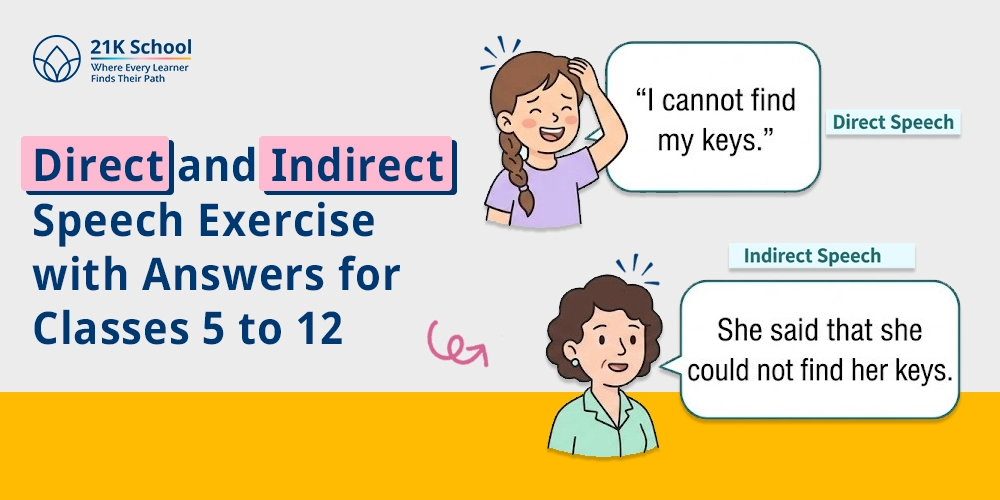
One of the best ways to correct your English grammar and improve your English speaking skills is by using direct/indirect speech. The practice will ensure you know how to correctly translate sentences by following the principles of tense, pronouns, and reporting verbs.
Whether it is a school-going kid or someone preparing for a competitive exam, practice will contribute to your grammar, writing and speaking.
Table of Contents
- What is Direct Speech?
- What is Indirect Speech?
- Difference Between Direct and Indirect Speech
- Direct and Indirect Speech Exercises (Questions and Answers)
- 1.Exercise 1: Change Direct Speech into Indirect Speech
- Exercise 2: Change Commands and Requests into Indirect Speech
- Exercise 3: Change Questions into Indirect Speech
- Exercise 4: Change Indirect Speech into Direct Speech
- Exercise 5: Indirect Speech and Direct Speech Conversions
- Common Mistakes to Avoid In Reported Speech
- 1. Changing Tenses Incorrectly
- 2. Using the Wrong Pronouns
- 3. Forgetting to Change Time and Place Words
- 4. Choosing the Wrong Reporting Verb
- 5. Keeping Quotation Marks
- 6. Using Incorrect Word Order in Questions
- 7. Ignoring the Rules for Commands and Requests
- Conclusion
What is Direct Speech?
Direct speech is the exact sentence that the person is saying, and it is written as it is without any changes and is enclosed in quotation marks (” “).
It maintains the original meaning, tone and words that the speaker employs. Direct speech is widely used in dialogues and narratives, conversations and reporting, and it captures what an individual needs to say.
Examples of Direct Speech
- Rahul said, “I am going to the library.”
- “Finish your homework before tomorrow,” the teacher told the students.
- She asked, “Where are you going?”
- “Please clean your room,” my mother said.
- The coach said, “You should practise every day to improve your skills.
What is Indirect Speech?
Indirect speech is also referred to as reported speech; this is a speech that has been reported by a person without necessarily having to repeat the exact words used by him/her.
Indirect speech is automatically removed, and the speech provided can be modified with regard to tense, pronouns and references to the time; however, the sense of the speech must not be distorted.
Examples of Indirect Speech
- Direct: Rohan said, “I am going to the library.”
Indirect: Rohan said that he was going to the library. - Direct: The teacher said, “Complete your homework before tomorrow.”
Indirect: The teacher instructed the students to complete their homework before the next day. - Direct: She said, “I have finished my project.”
Indirect: She said that she had finished her project.
These two instances indicate that the actual words that are spoken by the speaker are repeated in altered form and the meaning is retained.
Difference Between Direct and Indirect Speech
Awareness of the distinction between direct and indirect speech would make the students report conversations correctly. Their rules and examples are easier and convenient to compare and comprehend, and apply them both correctly.
| Aspect | Direct Speech | Indirect Speech |
| Definition | Reports the words of the interlocutor. | Reports the speech of the speaker without quotes. |
| Quotation Marks | Uses quotation marks (” “). | Does not use quotation marks. |
| Wording | Makes use of the original words used. | Alters words in order to keep the meaning. |
| Verb Tenses | Are generally the same as the spoken. | May vary with the principles of reported speech. |
| Pronouns | Remain the same as they are spoken | Change frequently to the speaker or listener. |
| Linking Words | No linking word is required. | Usually uses connecting words such as that, if or whether. |
| Example | Manoj said, “I am studying English.” | Manoj said that he was studying English. |
Direct and Indirect Speech Exercises (Questions and Answers)
These activities will involve using statements, commands, requests, questions and talking about the sentences. Answer all the exercises and compare as a way of enhancing your grammar skills in English.
1.Exercise 1: Change Direct Speech into Indirect Speech
Questions
- Riya said, “I am reading a novel.”
- Rahul said, “I visited my grandparents yesterday.”
- The teacher said, “The test will begin at 10 a.m.”
- My brother said, “I have completed my homework.”
- Neha said, “We are planning a picnic.”
- Ankit said, “I can solve this puzzle.”
- My father said, “We will leave tomorrow morning.”
- The doctor said, “You should exercise daily.”
- Kavya said, “I was watching a movie.”
- Aman said, “I have been waiting for an hour.”
Answers
- Riya said that she was reading a novel.
- Rahul said that he had visited his grandparents the previous day.
- The teacher said that the test would begin at 10 a.m.
- My brother said that he had completed his homework.
- Neha said that they were planning a picnic.
- Ankit said that he could solve that puzzle.
- My father said that they would leave the next morning.
- The doctor said that I should exercise daily.
- Kavya said that she had been watching a movie.
- Aman said that he had been waiting for an hour.
Exercise 2: Change Commands and Requests into Indirect Speech
Questions
- The teacher said, “Finish your assignment by the end of the day.”
- Mother said, “Please tidy your room before you go out.”
- The doctor said, “Take these medicines regularly.”
- The coach said, “Don’t miss your practice sessions.”
- The librarian said, “Please maintain silence in the library.”
- Father said, “Turn off the lights before you leave.”
- The principal said, “Wear your school uniform.”
- The police officer said, “Show me your driving licence.”
- The manager said, “Please submit the report today.”
- My friend said, “Please help me with this project.”
Answers
- The teacher instructed the students to complete their assignment that day.
- Mother requested me to clean my room.
- The doctor advised me to take my medicine regularly.
- The coach instructed the players not to miss practice.
- The librarian instructed everyone to keep silent in the library.
- Father told me to switch off the lights.
- The principal instructed the students to wear their school uniform.
- The police officer asked me to show my driving licence.
- The manager requested the employees to submit the report that day.
- My friend requested me to help him with the project.
Exercise 3: Change Questions into Indirect Speech
Questions
- She said, “Where do you live?”
- The teacher asked, “Have you finished your homework?”
- Father said, “Why are you late?”
- The officer asked, “What is your name?”
- My friend said, “Can you help me?”
- Mother asked, “When will you return?”
- The teacher asked, “Who solved this question?”
- Rahul asked, “Did you watch the match?”
- The doctor asked, “How are you feeling today?”
- She asked, “Will you attend the meeting?”
Answers
- She asked where I lived.
- The teacher asked if I had finished my homework.
- Father asked why I was late.
- The officer asked what my name was.
- My friend asked if I could help him.
- Mother asked when I would return.
- The teacher asked who had solved that question.
- Rahul asked if I had watched the match.
- The doctor asked how I was feeling that day.
- She asked if I would attend the meeting.
Exercise 4: Change Indirect Speech into Direct Speech
Questions
- Rohan said that he was feeling better.
- The teacher instructed the students to complete their work.
- My mother asked if I had eaten lunch.
- The doctor advised me to drink plenty of water.
- She said that she would visit me the next day.
- The principal instructed the students to maintain discipline.
- Rahul said that he had completed the assignment.
- My father asked where I was going.
- The coach advised the players to practice regularly.
- The manager requested the staff to attend the meeting.
Answers
- Rohan said, “I am feeling better.”
- The teacher said, “Complete your work.”
- My mother asked, “Have you eaten lunch?”
- The doctor said, “Drink plenty of water.”
- She said, “I will visit you tomorrow.”
- The principal said, “Maintain discipline.”
- Rahul said, “I have completed the assignment.”
- My father asked, “Where are you going?”
- The coach said, “Practice regularly.”
- The manager said, “Please attend the meeting.”
Exercise 5: Indirect Speech and Direct Speech Conversions
Questions
Convert each sentence into the opposite form (Direct ↔ Indirect).
- Aman said, “I can solve this problem.”
- The principal instructed the students to maintain discipline.
- My sister said that she had finished her project.
- The doctor said, “Do not eat too much sugar.”
- The teacher asked if the students understood the lesson.
- Rahul said, “I will help you tomorrow.”
- My mother advised me to eat healthy food.
- Neha said, “I have completed the painting.”
- The manager requested the staff to arrive on time.
- The teacher said, “The Earth revolves around the Sun.”
Answers
- Aman said that he could solve that problem.
- The principal said, “Maintain discipline.”
- My sister said, “I have finished my project.”
- The doctor advised me not to eat too much sugar.
- The teacher asked, “Do you understand the lesson?”
- Rahul said that he would help me the next day.
- My mother said, “Eat healthy food.”
- Neha said that she had completed the painting.
- The manager said, “Please arrive on time.”
- The teacher said that the Earth revolves around the Sun.
Common Mistakes to Avoid In Reported Speech
The most common grammatical mistake of the students is when the direct speech is transformed into indirect speech. These mistakes will be avoided, and you will be able to write appropriate and grammatically correct reported speech.
1. Changing Tenses Incorrectly
If the statement reported is mere truth or science, then do not change it. Otherwise, follow the rules of conversion of tenses.
2. Using the Wrong Pronouns
The pronouns must vary according to who is talking, the listener, and the situation in which the sentence is being discussed.
3. Forgetting to Change Time and Place Words
The use of the terms today, tomorrow, yesterday, here and now often requires conversion when the speech is an indirect one.
4. Choosing the Wrong Reporting Verb
Depending on the type of sentence, proper reporting verbs might be said, told, asked, requested or advised.
5. Keeping Quotation Marks
Direct speech only makes use of quotation marks. When converting a sentence to indirect speech, they should be eliminated.
6. Using Incorrect Word Order in Questions
When reporting the questions, the order of the normal statement should be taken instead of using the format of the question.
7. Ignoring the Rules for Commands and Requests
Imperative sentences will be reported according to the use of proper verbs such as told, asked, requested or advised and to + base verb.
Conclusion
Direct and indirect speech exercises can be undertaken on a regular basis so that students can grow to be more competent grammatically, writers and communicators.
Knowing how the tense, reporting verb, pronoun, and time expressions change, the learners will be able to translate the sentences of one of the forms into another.
Exercises involving solutions also instil confidence and prepare students for school exams and competitive English language tests.
