


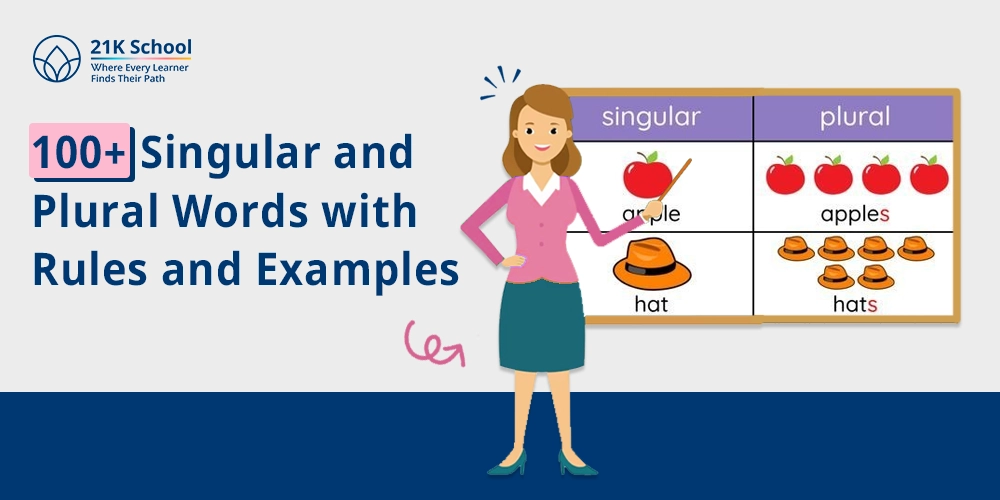
Do you feel sure that you make the right changes in singular words to the right plurals?
English grammar consists of singular and plural words, which assist us in saying whether we are speaking of a single thing, place, animal or object, or of a great many objects.
Grammar, sentence structure and communication are enhanced with the knowledge of these kinds of words. To refresh his or her knowledge, you will find yourself in this guide knowing what singular and plural words are, rules, examples, a list of words and practice activities.
Table of Contents
- What Are Singular Words?
- What Are Plural Words?
- Difference Between Singular and Plural Words
- Rules for Changing Singular to Plural Words
- Singular and Plural Words for Class 1
- Singular and Plural Words for Class 2
- Singular and Plural Words for Class 3
- 100+ Singular and Plural Words List
- Difficult Singular and Plural Words
- Common Mistakes For Singular and Plural Words
- Conclusion
What Are Singular Words?
Singular words are nouns which describe one individual, one place, an animal, a thing or a concept. They are used when we talk of a single object or individual. Singular nouns more frequently have only a single verb; they are typically preceded by an, the and a.
Singular words are an essential part of English grammar, as they can help learners to construct sentences correctly and speak and write fluently. E.g.: Boy, Girl, Book, Apple, Dog, Car, etc.
What Are Plural Words?
Plural words refer to nouns that refer to a group of people, places, animals, objects or concepts. They are used in talking about two or more things or people.
Most of the plural nouns are formed using -s or -es to the singular form, although in a few cases they are irregular. Plural words tend to take on plural verbs and assist in grammatical correctness and sense-making in sentences. e. g., Boys, Girls, Apples, Dogs, Cars, etc.
Difference Between Singular and Plural Words
Knowledge of singular and plural words assists students in using nouns correctly as well as the structure of a grammatically correct sentence. The table below shows the significant differences between the two.
| Aspect | Singular Words | Plural Words |
| Definition | Refers to one individual, place, creature, object or idea. | Relates to a single or multiple people, locations, animals, objects or ideas. |
| Number of Nouns | Symbolises a single noun. | Expresses two or more nouns. |
| Verb Usage | Accepts a single verb. | Accepts a plural form. |
| Articles Used | Usually used in conjunction with a, an or the. | Typically, it is applied to the, some, many, few or numbers. |
| Examples | Book, Child, Apple, Dog, Teacher | Books, Children, Apples, Dogs, Teachers |
Rules for Changing Singular to Plural Words
There are some rules which students should keep in mind while changing words from singular to plural. The following are the rules that students should keep in mind.
1. Add -s
Most of the singular nouns which are subjects take the plural -s. It is the most general rule and is used for nouns not ending in special letters and irregular spelling.
- Book = Books
- Pen = Pens
- Apple = Apples
- Teacher = Teachers
- Chair = Chairs
2. Add -es
Add -es to nouns ending in -s, -ss, -sh, -ch, -x, or -z. The rule makes the plural more pronounced and grammatical.
- Bus = Buses
- Box = Boxes
- Class = Classes
- Brush = Brushes
- Watch = Watches
3. Change -y to -ies
Nouns ending in a consonant before the end of the word, and the extra y that follows after the consonant, change -y to -ies to form the plural. In the case that y comes before a vowel, just put -s.
- Baby = Babies
- City = Cities
- Story = Stories
- Lady = Ladies
- Family = Families
4. Change -f or -fe to -ves
There are nouns which terminate in -f or -fe, which substitute these endings with -ves, rather than with -s. However, not every noun is subject to this and, thus, there are exceptions to be learned.
- Leaf = Leaves
- Knife = Knives
- Wolf = Wolves
- Wife = Wives
- Life = Lives
5. Change -o to -oes
Nouns that have a final -o sound create their plural by suffix -es, e.g. potato and tomato. But there are certain words such as photo and piano which just end in -s.
- Potato = Potatoes
- Tomato = Tomatoes
- Hero = Heroes
- Mango = Mangoes
- Echo = Echoes
6. Irregular Plural Forms
The irregularity in the plural forms of nouns is in the sense that they do not follow regular spelling. These are words that are either different altogether or are identical, and hence they should be learnt through constant practice.
- Man = Men
- Woman = Women
- Child = Children
- Tooth = Teeth
- Mouse = Mice
Singular and Plural Words for Class 1
The study of singular and plural words will assist Class 1 students to know the difference between one and many. These word pairs with minimal words help to improve vocabulary, reading and sentence construction skills and make the learning of English grammar simpler.
| Singular Word | Plural Word |
| Cat | Cats |
| Dog | Dogs |
| Boy | Boys |
| Girl | Girls |
| Ball | Balls |
| Book | Books |
| Pen | Pens |
| Apple | Apples |
| Mango | Mangoes |
| Egg | Eggs |
| Cup | Cups |
| Toy | Toys |
| Bag | Bags |
| Chair | Chairs |
| Tree | Trees |
Singular and Plural Words for Class 2
Class 2 pupils get better acquainted with singular and plural words, and this non-conformity to the general rules of the plural form of nouns. These words can be practised to enhance grammar, spelling and confidence in everyday English.
| Singular Word | Plural Word |
| Teacher | Teachers |
| Student | Students |
| Rabbit | Rabbits |
| Duck | Ducks |
| Leaf | Leaves |
| Knife | Knives |
| Wolf | Wolves |
| Tomato | Tomatoes |
| Potato | Potatoes |
| Hero | Heroes |
| Lady | Ladies |
| City | Cities |
| Family | Families |
| Story | Stories |
| Brush | Brushes |
Singular and Plural Words for Class 3
Learning singular and plural words will help Class 3 learn a more appropriate vocabulary, grammar and sentence structure. At this stage, the learners are also introduced to irregular and regular plural forms so that they would be flawless in English.
| Singular Word | Plural Word |
| Book | Books |
| Pencil | Pencils |
| Apple | Apples |
| Chair | Chairs |
| Boy | Boys |
| Girl | Girls |
| Bus | Buses |
| Box | Boxes |
| Baby | Babies |
| Story | Stories |
| Leaf | Leaves |
| Knife | Knives |
| Child | Children |
| Tooth | Teeth |
| Mouse | Mice |
100+ Singular and Plural Words List
You will be able to learn singular and plural words when you learn by category. Below, a list of 100 or more singular and plural words that are used in everyday English is provided in categories.
1. Common Singular and Plural Words
| Singular | Plural |
| Book | Books |
| Pen | Pens |
| Chair | Chairs |
| Table | Tables |
| Bag | Bags |
| Car | Cars |
| Bottle | Bottles |
| Phone | Phones |
| Key | Keys |
| Door | Doors |
| Window | Windows |
| Lamp | Lamps |
2. Bird Names
| Singular | Plural |
| Bird | Birds |
| Sparrow | Sparrows |
| Parrot | Parrots |
| Peacock | Peacocks |
| Pigeon | Pigeons |
| Crow | Crows |
| Owl | Owls |
| Eagle | Eagles |
| Duck | Ducks |
| Swan | Swans |
| Hen | Hens |
| Goose | Geese |
3. Animal Names
| Singular | Plural |
| Dog | Dogs |
| Cat | Cats |
| Lion | Lions |
| Tiger | Tigers |
| Elephant | Elephants |
| Horse | Horses |
| Cow | Cows |
| Goat | Goats |
| Sheep | Sheep |
| Deer | Deer |
| Mouse | Mice |
| Wolf | Wolves |
4. Fruits and Vegetables
| Singular | Plural |
| Apple | Apples |
| Mango | Mangoes |
| Orange | Oranges |
| Banana | Bananas |
| Grapes | Grapes |
| Tomato | Tomatoes |
| Potato | Potatoes |
| Carrot | Carrots |
| Onion | Onions |
| Cabbage | Cabbages |
| Pea | Peas |
| Cucumber | Cucumbers |
5. Household Objects
| Singular | Plural |
| Chair | Chairs |
| Table | Tables |
| Bed | Beds |
| Sofa | Sofas |
| Cup | Cups |
| Plate | Plates |
| Spoon | Spoons |
| Glass | Glasses |
| Clock | Clocks |
| Mirror | Mirrors |
| Pillow | Pillows |
| Bucket | Buckets |
6. School-Related Words
| Singular | Plural |
| Student | Students |
| Teacher | Teachers |
| Book | Books |
| Notebook | Notebooks |
| Pencil | Pencils |
| Eraser | Erasers |
| Ruler | Rulers |
| Blackboard | Blackboards |
| Classroom | Classrooms |
| School | Schools |
| Desk | Desks |
| Bench | Benches |
7. Food
| Singular | Plural |
| Sandwich | Sandwiches |
| Burger | Burgers |
| Pizza | Pizzas |
| Biscuit | Biscuits |
| Cake | Cakes |
| Cookie | Cookies |
| Bread Roll | Bread Rolls |
| Chocolate | Chocolates |
| Candy | Candies |
| Egg | Eggs |
| Noodle | Noodles |
| Pancake | Pancakes |
8. Profession
| Singular | Plural |
| Teacher | Teachers |
| Doctor | Doctors |
| Engineer | Engineers |
| Nurse | Nurses |
| Pilot | Pilots |
| Farmer | Farmers |
| Police Officer | Police Officers |
| Chef | Chefs |
| Driver | Drivers |
| Artist | Artists |
| Scientist | Scientists |
| Dentist | Dentists |
9. Nature and Environment Words
| Singular | Plural |
| Tree | Trees |
| Flower | Flowers |
| Leaf | Leaves |
| River | Rivers |
| Mountain | Mountains |
| Hill | Hills |
| Rock | Rocks |
| Forest | Forests |
| Plant | Plants |
| Cloud | Clouds |
| Star | Stars |
| Island | Islands |
10. Body Parts
| Singular | Plural |
| Eye | Eyes |
| Ear | Ears |
| Hand | Hands |
| Foot | Feet |
| Tooth | Teeth |
| Finger | Fingers |
| Leg | Legs |
| Arm | Arms |
| Shoulder | Shoulders |
| Knee | Knees |
| Nose | Noses |
| Elbow | Elbows |
Difficult Singular and Plural Words
Some singular and plural forms are difficult as they do not follow the usual grammatical principles. These words will be more likely to be spelt irregularly (or completely different in plural form), so the students will practice them until they remember how to spell them.
| Singular Word | Plural Word |
| Child | Children |
| Person | People |
| Man | Men |
| Woman | Women |
| Mouse | Mice |
| Goose | Geese |
| Tooth | Teeth |
| Foot | Feet |
| Ox | Oxen |
| Louse | Lice |
| Cactus | Cacti |
| Fungus | Fungi |
| Nucleus | Nuclei |
| Syllabus | Syllabi |
| Analysis | Analyses |
| Thesis | Theses |
Common Mistakes For Singular and Plural Words
Proper grammar depends on the proper way words are used in singular and plural forms. However, students typically make basic mistakes in the usage of plural nouns or the matching of these nouns with verbs.
Here are some of the errors that can be corrected to improve writing, speaking and overall English language skills.
1. Incorrect Plural Endings
Students often use incorrect endings of plurals, overlooking grammar guidelines and subsequently end up adding -s and- es. Knowing when you should add -s, -es or when there are spelling errors is useful in creating the proper plural form of nouns and enhances sentence structure.
2. Confusing Irregular Plurals
Irregular nouns of the plural form are not easy to remember as they take the irregular formation of the plural. To avoid such grammatical errors, the students are supposed to practice using such words as child, children, man and men, tooth and teeth.
3. Subject-Verb Agreement Errors
The common mistakes are that of the singular verb used with a plural subject or the plural verb with a singular subject. Always make sure that the verb agrees with the noun and constitutes grammatically correct and meaningful sentences.
4. Uncountable Nouns
When it comes to information, advice, milk, and furniture, students are guilty of adding the plural ending to the uncountable nouns. These nouns are normally singular and must be used with the proper quantifiers rather than in the plural.
5. Same-form Singular and Plural Words
There are others which are the same in singular and plural, and this may create an illusion for the students. Other words like deer, sheep, fish and aircraft are not modified; i.e. students need to know their meaning based on the context of the sentence and not spelling.
Conclusion
Learning English grammar is one of the areas that involves learning singular and plural words.
With the help of the basic principles of plural formation, training with irregular forms and regular exercises, students will be able to learn how to develop their vocabulary and make sentences.
Regardless of your Class 1, Class 2 or above grade, the practice of singular and plural word usage will give you more confidence to write and speak with greater accuracy in English.
