

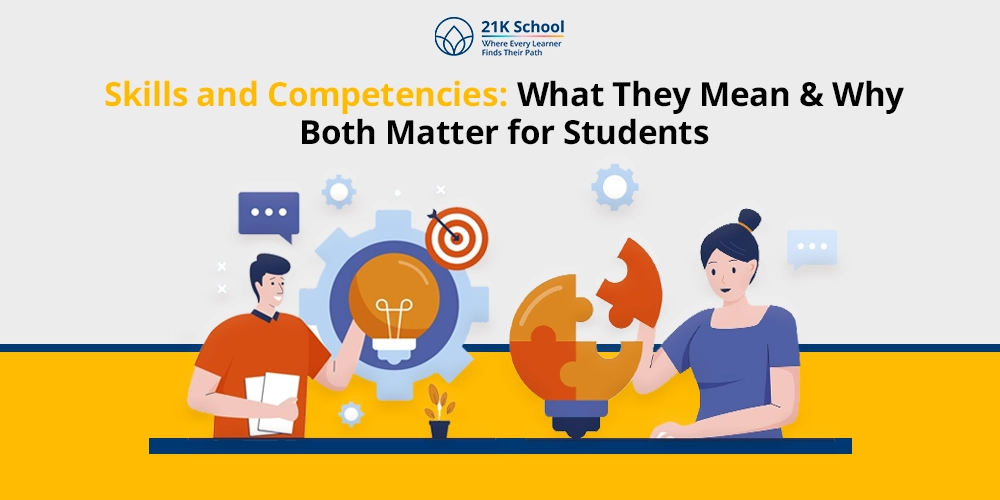
Competencies and skills play a very critical role in personal, academic and professional achievement. These are the talents, expertise and practises that assist people in carrying out work effectively and adapt to the changing situations.
The development of the appropriate set of skills and competencies is the essential factor in problem-solving, communication, decision-making, and lifelong learning in the modern world, which is highly dynamic.
Table of Contents
What is Skill?
A skill refers to the ability to accomplish some task efficiently through knowledge, practise and experience to deliver a desirable end product. Skills are acquired and perfected over time and may be either physical, mental, technical or interpersonal skills.
They assist individuals to apply knowledge in practise, solve problems and achieve goals. Expert competencies are used to improve individual performance, confidence in both personal life and work careers.
What are Competencies?
Competencies are knowledge, skills, attitudes and behaviours that are integrated and make the individual perform tasks effectively in set-ups in the real world. They do not simply reflect what somebody has been taught, but as well how they apply that knowledge.
The skills include problem solving, communication skills, adaptability and decision-making skills.
They help individuals to overcome their academic, career, and social problems effectively and demonstrate the desire to become responsible leaders and constantly enhance themselves.
Types of Skills
Types of skills refer to the different skills that individuals learn in order to help them to accomplish things effectively. These are hard skills, technical and quantitative in nature; soft skills, those that concern interpersonal and communication skills; and transferable skills, those that may be applied in a very diverse variety of roles and situations.
1. Hard Skills
The hard skills are specific skills which are generally technical and domain specific. These may be imparted in an educational institution, through practise or training, and they are not hard to measure.
Some of them include coding, accounting, data analysis, and the running and writing of machinery. Hard skills are often required in specific jobs and accomplishments in the fields of education and work.
2. Soft Skills
The soft skills are individual and social skills, which define how people relate to others and how they approach situations. They are communication, teamwork, leadership, time management and emotional intelligence.
Soft skills enable adaptability, cooperation, and forming good relations. They play a very important part in career development, in workplace harmony and in the problem solving in ordinary life.
3. Transferable Skills
Transferable skills are those skills that can be transferred or applied in different jobs, roles and under different circumstances. The examples include communication, problem-solving, critical thinking, adaptability, and organisation.
All these skills are valuable since they can be utilised even during a career transition or even in other fields. Transferable skills add up to flexibility, employability, and learning and succeeding skills within varying environments.
Types of Competency
The competencies that are needed to work are categorised into types of skills and behaviours. These are essential skills of every job, leadership skills for guiding groups, and also skills that are vocational and job-specific.
1. Core Competencies
Core competencies refer to those essential skills and activities that are required by all people within an organisation or in society. These are communication, teamwork, ethics, adaptability and problem-solving skills.
These competencies reflect shared values and expectations, which enable people to act in various roles effectively and affect the organisational culture and overall performance positively.
2. Leadership Competencies
Leadership competencies refer to skills and behaviours necessary to manage, motivate, and guide other people. They are decision-making, strategic thinking, emotional intelligence, conflict management, and teamwork.
These competencies help leaders influence people, achieve goals, change management, as well as create a positive and productive team or organisational climate.
3. Functional Competencies
Job-specific knowledge and skills required to perform some roles or functions are known as functional competencies.Some of them are technical skills, professional skills and special skills in a field.
Such competencies ensure efficiency, accuracy and effectiveness in performing tasks and are necessary in ensuring that they introduce high performance in some professions or industries.
Importance of Skills and Competencies
There are professional, academic and personal development that require skills and competencies. In other circumstances, they promote performance, versatility, assurance, decision-making, critical thinking, social development, and personal development
1. Improved Performance and Productivity
Proficiencies and abilities can help people to accomplish tasks properly and efficiently. With effective use of knowledge and abilities, individuals minimise errors, waste of time, and improve the overall quality of work.
Effective abilities enhance academic, personal and professional performance, which helps an individual to accomplish the objectives more quickly and play a positive role in the success of the team and organisation.
2. Adaptability and Lifelong Learning
The skills and competencies assist individuals in adapting to the challenges and dynamic learning environment. These encourage flexibility, adaptability and readiness to acquire new things or skills.
Lifelong learning helps to make individual and professional transformation a lifelong process, and a person feels relevant, learns to live with uncertainty, and gets opportunities when situations change constantly.
3. Boost Confidence
Self-confidence and certainty are improved by the issue of developing skills and competencies. People are motivated and stronger when they are aware of how to do things or when they have mastered skills.
Confidence enhances communication skills, performance and decision making, which helps individuals to face challenges, take initiative and pursue their personal and professional goals with more power.
4. Better Decision-Making
Skills and competencies enhance the ability to analyse situations and evaluate options, and to make good decisions.
These are used to provide critical thinking, problem-solving, and good judgment. Sound decision-making skills can help one make the best course of action in academia, industry and personal life with enhanced outcomes and success.
5. Social Development
Teamwork, empathy, and communication are some of the competencies that are useful in developing healthy social relationships. They help individuals to develop close relations, cooperate and resolve conflicts.
Social development improves collaboration skills, networking and emotional intelligence, which may enable one to succeed in a group, create a favourable environment in school or workplace and within society.
6. Personal Development
The competencies and skills assist in the overall development, including self-awareness, discipline and responsibility. They help individuals in setting goals, time management and personal competencies.
Entirely, these competencies result in personal holistic development and provide one with challenges in life, both personal and professional.
7. Boost Critical Thinking
Acquiring appropriate skills and competencies enhances critical thinking. It helps individuals to think critically, debate assumptions, question evidence, and rationally resolve issues.
Better decisions, creativity and the ability to handle complex situations through better and more effective critical thinking all enhance intellectual skills and how one generally perceives the world.
Difference Between Skill and Competencies
The difference between skills and competencies lies in scope; skills are particular skills to do something, and competencies are a combination of skills, knowledge, attitudes, and behaviours to be able to work in different real-life situations.
| Aspect | Skill | Competencies |
| Meaning | A skill is having the competence to carry out a given task or activity effectively, e.g. writing, coding, or utilising a machine. | Competency is more inclusive and involves not only skills but also knowledge, behaviours and attitudes that are needed to perform effectively in a role or a situation. |
| Process | The development of skills is attained through practice, training and repetition of certain tasks. | Competencies entail a more holistic approach where several skills, knowledge, experience and adapting behaviour are merged. |
| Assessment | Skills are appraised through tests of task performance, operational tests or demonstrations. | The competencies need to be comprehensively evaluated, and they include behaviour, decision making, problem solving and outcomes obtained in actual life situations. |
| Focus | Skills are centred on how to do it, in an efficient way and the technical capability or skills. | Competencies are concerned with how to be successful in a job, integrating knowledge, skills, attitudes, and behaviours in various situations and to become flexible. |
| Nature | Skills are task-oriented, technical and specific, which focus on a specific ability required in performance. | Competencies are holistic, and thus a combination of skills and knowledge, a sense of personal qualities, and behaviours has a reflection of overall ability, flexibility, and efficacy. |
| Transferability | Skills can be transferred to similar jobs or assignments, but may usually need to be adjusted or further learned. | The competencies are highly transferable across roles, functions and industries as they comprise knowledge, skills and behaviours that enable individuals to improvise differently. |
| Measurement | The proficiency tests, the accomplishment of tasks or even demonstrations can be used to test the skills. | Performance reviews, behavioural observation, assessment centres and actual results must be considered as a broader scope in order to evaluate a skill. |
| Goal | Skills development is meant to achieve efficiency, accuracy, and competency in some activities. | Competencies are more about guaranteeing efficient performance in a job regularly and dynamically through the integration of several skills and knowledge. |
| Examples | One of the skills would be the proficiency with Excel, programming, or public speaking. | An example of competency is leadership, teamwork, problem-solving, or communication, which will be a combination of several skills. |
Challenges in Skills and Competency Development
The lack of opportunities, ignorance, and unequal opportunities are also amongst the challenges that lead to the failure to obtain, practise and apply the relevant and valuable skills in personal and professional development.
1. Lack of Awareness
In an attempt to achieve personal or professional development, many people do not know their capabilities or their strengths, yet are unaware of them.
Ignorance regarding what to work on and how to work can deny individuals a chance to build their skills and abilities, hence decreasing career prospects, performance and overall growth in terms of academic, social and work life, respectively.
2. Limited Access to Training
The quality training programmes are not readily available due to the place, price or supply.
Without relevant instructions, training, or coaching, people cannot achieve the required skills and competencies and, therefore, experience lax personality development diminished employability, and the lack of a chance to meet the demands of a profession or a school in an efficient manner.
3. Mismatch Between Education and Industry Needs
The education systems are not even geared towards the needs of the industry, and end up graduating inadequately prepared for industry needs whose skills are mere theoretical knowledge.
The disconnect of the insufficient preparation of the individuals, the failure to obtain employment and the failure of the employers to hire qualified employees; therefore, the part of education and training in preparing the specific skills is highly significant.
4. Time-Consuming
These abilities and competencies require time, practice, learning and contribution. A majority of the population face challenges in terms of time allocation due to schooling, work or personal issues.
This time-consuming aspect of skill building may hamper the process; therefore, patience, discipline and long-term commitment are needed to realise major growth.
5. Inadequate Assessment Methods
The conventional assessment mechanisms will most likely concentrate on theoretical as opposed to practical skills or competencies.
The inadequate assessment methods do not provide the right measurements of the real-world capabilities, and a person struggles to figure out the gaps and make progress in the right direction, or offer evidence of their mastery of the most important skills that education, employment or self-perpetuating conditions require.
6. Unequal Opportunities
Not all people have equal resources, mentoring, and learning opportunities. There might be a limitation to the opportunities to develop skills and competencies due to socioeconomic disparities, gender, and regional disparities.
Lack of equality robs the majority of the potential, leading to an eventual loss of talents, career growth and self-development.
Skills and Competencies Examples
The examples of skills and competencies demonstrate what people can accomplish in order to perform their work and what skills, knowledge and behaviours are implemented.
They reflect practical, interpersonal, and professional attributes of personal, academic, and career achievement.
Example of Skills
1. Active Listening Skills
Active listening is the ability to give the speaker as much attention as possible, to understand his/her message and to respond appropriately.
It builds trust, prevents misunderstanding, develops relationships, and improves personal, academic, and professional level cooperations.
2. Communication Skills
The communication skill also involves the skill of conveying ideas intimately, either by speaking, writing, or presenting.
They ease the correct cooperation of teams, conflict resolution, and exchange of information, all of which are essential for success in education, work and social living.
3. Leadership Skills
Leadership skills involve being a leader, inspiring and influencing people to accomplish goals. Such are decision making, delegation, problem solving and conflict management that help individuals lead teams and inspire others.
4. Computer Skills
Computer skills refer to the skills of utilising computer apparatus and computer apps like Word processors, spreadsheets, and rudimentary programming languages. They also need them in the contemporary workplace, education, and daily work.
5. Problem-Solving Skills
Problem-solving skills are employed in searching for problems, analysing data, brainstorming, and taking effective action.
They sharpen the mind, increase flexibility and empower people to conquer obstacles in their personal, academic and career life.
Examples of Competencies
1. Behavioural Competencies
Behavioural competencies refer to personal qualities and dispositions that shape the behaviour of a person in different situations. These include teamwork, communication, adaptability, empathy and leadership.
Through such competencies, people are able to do well in terms of interaction, management of conflicts and positive relationships, among others, which contribute to personal and professional success.
2. Functional Competencies
Job-specific skills/ knowledge are functional skills which are required to perform specific jobs. This can be in the field of finance (accounting), IT (coding) or the processes of teaching in the case of an educator.
These competencies help individuals to do their jobs efficiently and to deal with the organisational or professional demands.
3. Professional Competencies
Professional competencies refer to a collection of knowledge, skills and ethical standards that are required in a particular profession. These are project management, research skills, critical thinking and ethical decision making.
They enable people to maintain a high standard, making them steady and skilled in the field of their profession.
4. Networking Competencies
Networking skills involve the ability to build, maintain and exploit professional as well as social networks.
Relationship-building, effective communication, collaboration and influence are some of the examples. The competencies help individuals to gain access to opportunities, knowledge and develop positive working relationships with each other.
Conclusion
Personal, academic and professional growth require the use of skills and competencies. While skills put attention on how to carry out certain tasks, competencies have a wider combination of knowledge, behaviours and attitudes as a prerequisite to effective performance.
When developed, they both enable flexibility, problem-solving, critical thinking, and social and personal development.
Through development of relevant skills and competencies, they can improve performance, confidence and career achievement as well as equip themselves in lifelong learning and make a significant contribution to society.

You may also want to read